SEO Has Changed: Here's What Actually Works in 2026
The traditional SEO playbook is dead. A Semrush video outlines how search behavior has evolved and what strategies actually drive conversions in 2026.

Written by AI. Mike Sullivan

Photo: AI. Marcel Dubois
I've been watching SEO advice videos since RealPlayer was a thing, and they generally fall into two categories: revolutionary predictions that age like milk, or recycled basics dressed up as innovation. This new Semrush video lands somewhere more interesting—it's describing a shift that's already happened while most of us were still optimizing for 2019.
The speaker, who claims two exits built largely on SEO, opens with a familiar pitch: forget everything you know about SEO. I've heard that line since Google was still returning ten blue links and a "Did you mean" suggestion. But here's where it gets worth paying attention—the argument isn't that SEO fundamentals have changed. It's that the customer journey has splintered across so many platforms that optimizing for Google alone means you're catching maybe 20% of the research process.
The Multi-Platform Loop Nobody Wants to Admit
The video traces what they call the modern search journey: curiosity, validation, comparison, confirmation. Nothing groundbreaking there—that's basically how humans have made decisions since we started comparing which berries were poisonous. What's different is the platform-hopping.
Using his own company, Exploding Topics, as a case study, the speaker walks through a customer journey that looks nothing like traditional SEO funnels. Someone starts on Google with a broad query like "how to find trends early." Then they jump to YouTube to see the tools in action. Then Reddit to see if it's actually useful or just well-marketed. Then ChatGPT to summarize their options. Finally, back to Google for branded searches like "Exploding Topics pricing" or "Exploding Topics alternatives."
As the video puts it: "If you're learning SEO today and focusing 100% on Google, you're missing out on a lot of the customer journey."
This tracks with what I've been seeing, though nobody in the industry wants to say it plainly: Google is increasingly the starting point, not the decision point. People use it for discovery, then verify everywhere else. Which means your pristine Google rankings might be generating awareness that converts on platforms you're not even tracking.
The Fundamentals That Survived
Here's where the video gets more conventional, but usefully so. Search intent still matters—shocking, I know. The example they give is straightforward: someone searching "how to find trending products" wants education. Someone searching "tools for product research" wants comparison. Mix those up and you're dead in the water, regardless of your backlink profile.
Content chunking gets a mention, which is consultant-speak for "make your content scannable." Both humans and LLMs jump around looking for relevant sections. Your job is to make those sections discrete enough that they could stand alone. Not exactly revolutionary, but true.
Backlinks still matter, though the video correctly notes that one relevant link beats a hundred random ones. They also mention unlinked brand mentions helping with authority, which is one of those things that's been "about to become important" for about a decade but might actually matter now that LLMs are scraping everything.
The HubSpot Example Nobody Talks About
The most interesting data point in the video is HubSpot's traffic drop. They lost a significant chunk of organic traffic but conversions barely budged. Why? Because they lost traffic from definition keywords—"what is X," "how does Y work"—that never converted well anyway. They kept their rankings for commercial terms and comparison keywords, the stuff people search right before they buy.
The speaker's conclusion: "If I was starting with SEO today, I wouldn't spend a lot of time on definition keywords. AI is already really good at summarizing basic information. Instead, I'd focus on keywords that show that a choice is about to be made."
This is the first SEO advice video I've seen that actually acknowledges the obvious: ChatGPT and similar tools have commoditized informational content. Not completely—there's still value in being the source AI tools cite—but the days of building a business on "what is blockchain" traffic are over. They were barely viable before; now they're toast.
The Obsessive Ranking Checker Reformed
The final section covers what the speaker calls "doubling down on what works," which is less mystical than it sounds. Instead of checking rankings multiple times daily (which he admits doing in the past—we've all been there), he watches Google Search Console for early signals: impressions first, then average position movement, then clicks.
The key shift is not sweating specific keyword rankings. People search in increasingly specific ways, and AI prompts are even less predictable. If a page is getting clicks and impressions are trending up, that's the signal to create more content like it.
"When I see a page performing well," he says, "I try to create more of them." In his case, that meant more dynamic lists if one dynamic list performed well. It's the industrial approach to content: find what works, manufacture more of it.
What's Actually New Here
Not much, honestly. Search intent has mattered since Google got good at understanding it around 2013. Content structure has been important since people stopped reading web pages top to bottom—so, basically forever. The platform-hopping behavior is real but not exactly news to anyone who's looked at attribution data recently.
What's useful is the explicit acknowledgment that the old playbook—rank for informational keywords, build authority, convert traffic—has been disrupted not by algorithm updates but by user behavior. People don't trust a single source anymore. They cross-reference. They verify. They ask AI to summarize, then check Reddit to see if the AI is full of it.
The video's prescription is pragmatic: focus on decision-stage keywords, structure content for machines and humans, watch what performs, make more of it. It's not revolutionary. It's adaptive. Which, given how many SEO experts are still optimizing like it's 2019, might be revolutionary enough.
More Like This
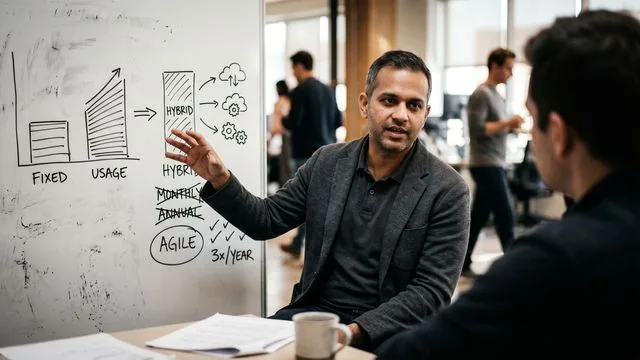
AI Pricing Is Broken. Here's How Companies Are Fixing It
Traditional SaaS pricing doesn't work for AI. Stripe's billing architect explains why hypergrowth companies are changing prices 3+ times yearly.
The Economic Cost of Singlehood
Exploring how the rise in singlehood leads to higher costs and challenges modern economies' adaptability.
Consulting's Role in Disneyland's Safety Decline
Explore how McKinsey's cost-cutting at Disneyland impacted safety, leading to tragic accidents and raising questions about corporate priorities.
How Prayer Lock Hit $20K Monthly: Lessons from Mau
Explore how Mau's Prayer Lock app reached $20K/month by focusing on innovative marketing and AI-driven development.
YouTube Creators Face AI Flood: What Actually Works Now
As AI-generated content floods YouTube, the vidIQ team argues success still requires taste, craft, and judgment—whether you use AI tools or not.
Master AI SEO: Perplexity Parasite Strategy
Learn how to rank with AI SEO using Perplexity. Discover strategies for fast citation and content optimization.

IBM NanoStack and the Future of Chip Architecture
IBM's NanoStack stacks transistors from separate wafers using atomic bonding. The physics works. The harder question is whether anyone can manufacture it at scale.

Inside the Smartphone: 120 Years of Hidden Engineering
Professor Hannah Fry tears apart a modern smartphone to trace 120 years of engineering history — from Marconi's radio waves to a 200-million-pixel camera sensor.