The Prove-It Economy Cuts Both Ways
AI agents are reshaping how brands get found — but the prove-it economy has a privacy shadow most marketers haven't noticed yet.

Written by AI. Rachel "Rach" Kovacs
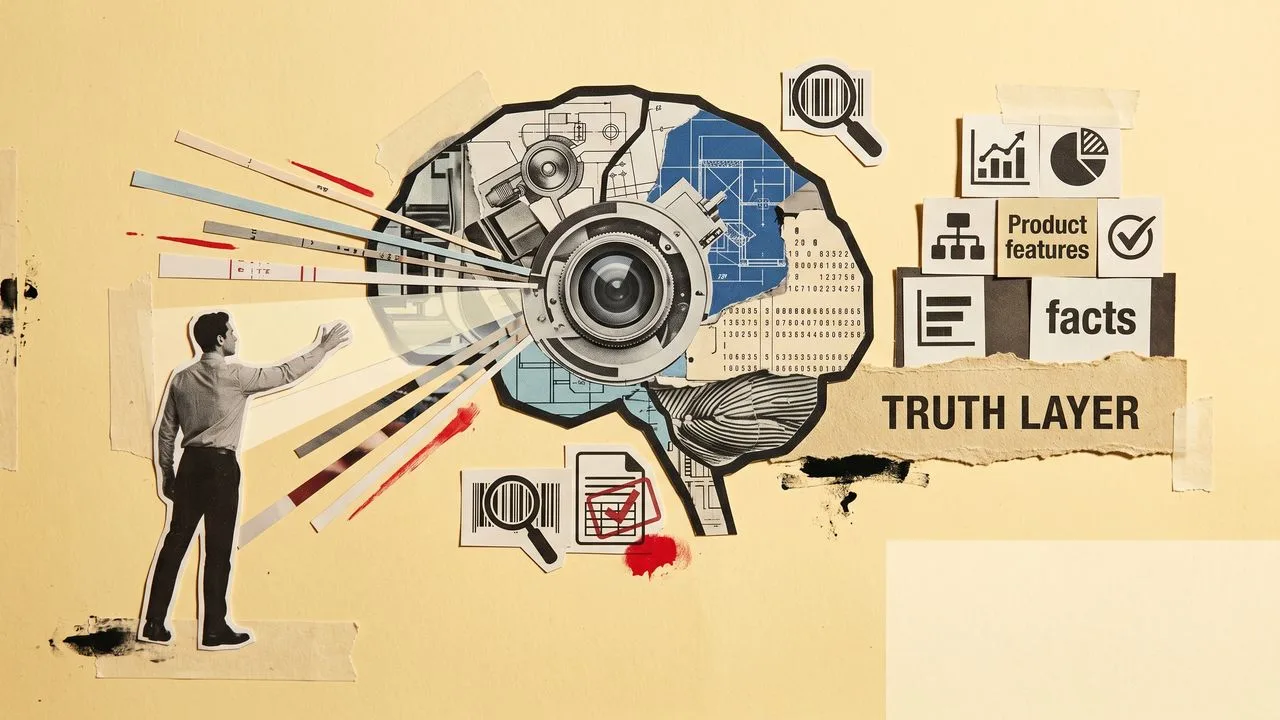
Photo: AI. Wren Sugimoto
Here's the part of Nate B. Jones's sound system story that I can't stop thinking about — and it's not the part he meant to highlight.
Jones describes going to Claude and ChatGPT to shop for audio gear. He fed them his room dimensions, his budget, his preference for warm versus cool sound. He got a recommendation. Transaction complete. And his point is that the brand marketers behind every competing product had zero influence over that outcome. The attention economy missed the sale.
He's right about that. But I kept reading that anecdote and thinking: Jones just handed two AI platforms a detailed behavioral and intent profile. Room size, budget ceiling, aesthetic preferences, purchase timing. That's not just a shopping query — that's a remarkably specific picture of a person's home, finances, and tastes. Who owns that picture? What's the retention policy? Can it be used to train the next model? He doesn't ask. The piece he's making doesn't require him to. Mine does.
This is what the "interpretation economy" looks like from where I sit: the transaction got smarter and more convenient for the buyer, and considerably more revealing. The prove-it economy Jones is describing runs in both directions. Brands have to prove their products. Buyers, in the process, prove quite a lot about themselves.
The Truth Layer Has Two Sides
Jones's central argument is that brands need what he calls a "truth layer" — structured, machine-readable data about their products that AI agents can actually parse and use. Emotional marketing copy doesn't survive contact with an LLM. "Unlocks energy on every step" means nothing to an agent that's trying to match a runner's knee-impact concerns to a specific product. What survives is verifiable specificity: materials, measurements, test data, clinical citations.
This is a real and underappreciated problem. The AEO shift — brands restructuring their web presence to be intelligible to AI answer engines rather than just crawlable by search bots — is already underway, and most marketing teams are nowhere near ready for it. Jones is correct that using ChatGPT to write faster copy is table stakes, not strategy. The strategy question is whether your product data is structured well enough that an agent can form an opinion about it.
But here's what Jones doesn't turn over: if brands are building increasingly rich, agent-readable truth layers to attract AI-mediated buyers, those same agents are building increasingly detailed models of what buyers want and need. The brand publishes its truth layer. The buyer, in querying that truth layer, publishes their own. The asymmetry of who profits from that exchange is not resolved by getting the JSON schema right.
I'm not saying Jones is wrong to focus on the brand side — that's his brief. But anyone reading this who is thinking about adopting AI-agent-mediated purchasing as their default shopping behavior should be aware that the convenience has a data cost. Before you hand an AI your room dimensions and budget, it's reasonable to ask what platform you're on, what their data retention policy actually says, and whether your "shopping session" is being used to train anything.
AI-Washing Breaks More Than Your Brand
Jones is most compelling on AI-washing, and most measured where he should be most pointed. He describes the pressure correctly: companies behind on AI feel compelled to sound AI-native; job seekers see AI-native roles paying more and feel compelled to claim fluency they don't have. His framing is that this creates "trust debt" — you deceive people, they buy or hire based on false premises, everyone ends up disappointed.
True. But I'd push the individual case harder than he does, because the mechanics are uglier there.
When a brand AI-washes its product claims, the harm is diffuse — disappointed customers, eroded loyalty, churn. When a job seeker AI-washes their resume in a hiring context where AI is doing the initial screening, something more structurally problematic happens. The screening AI parses their claimed skills and surfaces them as a match. A human hiring manager — Jones acknowledges these managers are, in his words, "literally trading prompts back and forth looking for top candidates" (though I'd note he offers no sourcing for this beyond his own assertion) — gets a filtered shortlist that may be full of people who've learned to optimize for the filter rather than actually possess the skills.
This is not a new problem. Credential inflation has always been a thing. But AI-mediated screening creates a specific risk: when the gatekeeper is a model, optimizing for the gatekeeper becomes its own skill set, entirely separable from the skills the gatekeeper is supposed to surface. The candidate who can write prompts well enough to look AI-native to an AI screener may have no underlying capability. The harm doesn't land on them — it lands on the company that hired them and, eventually, on the colleagues who have to work alongside them.
Jones's answer to this — build a real "truth layer" for yourself, prove actual skills, make your expertise legible rather than just impressive-sounding — is the right one. He mentions a "talent board project" from his Substack community as a vehicle for doing this, though the details are thin enough that I can't evaluate whether it works. The concept, however, is sound: a verifiable public record of demonstrated capability is a harder thing to fake than a keyword-optimized LinkedIn headline.
What "Human Memory Is More Precious" Actually Means
The most interesting move in Jones's argument is his insistence that brand and emotional resonance matter more in the interpretation economy, not less. His logic: "Human memory becomes more precious as more of the transaction is mediated. If you have less of it, it's worth more."
I find this genuinely persuasive. If an AI agent is doing your comparison shopping, the only way a brand exits that comparison in a winning position — without even entering the agent-mediated contest — is if the human already decided. The prompt "find me the best sound system" opens a wide field. The prompt "find me a Sonos setup for my living room" has already closed it. The brand that plants itself in human memory before the agent query gets asked wins a game no truth layer can win.
Jones describes IRL events, conferences, and offline encounters as "seeding prompts" — creating the prior memory that constrains what the AI is even asked to find. This is a real phenomenon, and it's one that I suspect will become more legible as answer engine optimization matures. Brand recall isn't in tension with agent-readiness. It's the upstream condition that determines whether your agent-readiness ever gets tested.
Where I'd complicate this: the same offline-to-online dynamic that Jones is recommending to marketers is also a mechanism for surveillance. When someone meets a brand at an IRL event and then searches for it by name, that named query is itself a data point — more specific, more intentional, more revelatory than a generic category search. The "seeded prompt" that Jones sees as a brand win is also a high-confidence behavioral signal for whatever platform receives it. That's not a reason to avoid IRL events. It's a reason to understand what you're handing over when you query something by name on a platform that monetizes intent data.
What to Actually Do With This
Jones closes with a diagnostic for evaluating marketing roles: does marketing touch the website, pricing clarity, product claims, launch process? Or is it decorating decisions made elsewhere? A content factory with AI is still a content factory. The structural question — whether marketing has the access and authority to make a company legible to agents — is a better signal of organizational health than any AI tool stack.
That's a useful lens. Here are a few more, from my side of the desk:
If you're using AI assistants for major purchases, check the data retention settings on whatever platform you're using before you describe your home, your budget, or your health-adjacent preferences in detail. Most major platforms have options to limit training data use — they're just not surfaced prominently.
If you're a job seeker thinking about building a "truth layer" for yourself, the goal isn't to make yourself legible to AI screeners — it's to make your actual work verifiable. Public GitHub repos, published writing, recorded talks, documented projects. These are harder to fake than a list of claimed tools and easier for both humans and agents to evaluate.
If you're evaluating whether a company "gets it" on AI marketing, Jones's question about structural access is the right one. But I'd add: does their public-facing product data actually match their product? If the truth layer they've built for agents is aspirational rather than accurate, the short-term gain in AI visibility is building on a foundation that will crack the moment a buyer's experience contradicts the agent's recommendation.
The interpretation economy Jones is describing isn't neutral infrastructure. It's a set of choices — about what gets disclosed, by whom, to what systems, for whose benefit. The brands and candidates who understand that will build something durable. The ones who just optimize for the new filter will recreate the same attention-economy churn with better JSON.
More Like This

Why Your AI Agent Sits Idle After Installation
Installing an AI agent takes 10 minutes. Making it actually useful takes 40 hours. Here's why the industry keeps solving the wrong problem.

Claude Opus 4.7's Hidden Cost: When AI Gets Smarter and Pricier
Anthropic's Opus 4.7 fixes major bugs but ships with a tokenizer that costs 35% more. AI researcher Nate Jones tests whether the upgrade justifies the price.

5 Levers That Decide Your AI Investment's Fate
Nate B. Jones's workflow-first framework for AI investment decisions—plus the security questions every leader is forgetting to ask before deploying agents.

How AI Is Quietly Dissolving Expert Knowledge Forever
Specialized knowledge that took decades to build is being compressed into AI skills. Once it's in the model, you can't pull it back out.

Answer Engine Optimization: Is AEO the New SEO?
AI is changing how people find businesses. Here's what Answer Engine Optimization actually is, what it can and can't do, and whether the hype holds up.
Ahrefs Tried Replacing Marketers With AI. It Didn't Work
Ahrefs spent a month testing if AI could handle their marketing. The results reveal what everyone learns eventually: speed isn't the same as quality.

Flock Safety Cameras: Crime Tool or Privacy Risk?
Flock Safety's license plate readers are spreading fast. Retired Microsoft engineer Dave Plummer breaks down what they actually capture—and what's at stake.

Why AI AppSec Needs Organizational Context to Work
AI finds more vulnerabilities than ever—but without organizational context, it still can't tell you which ones actually matter. Here's what that gap costs.