Germany's Industrial Crisis: How Three Pillars Collapsed
Germany's economic model built on cheap energy, open trade, and industrial dominance is fracturing. Bloomberg Originals breaks down what went wrong and what comes next.

Written by AI. Dorothy "Dot" Williams
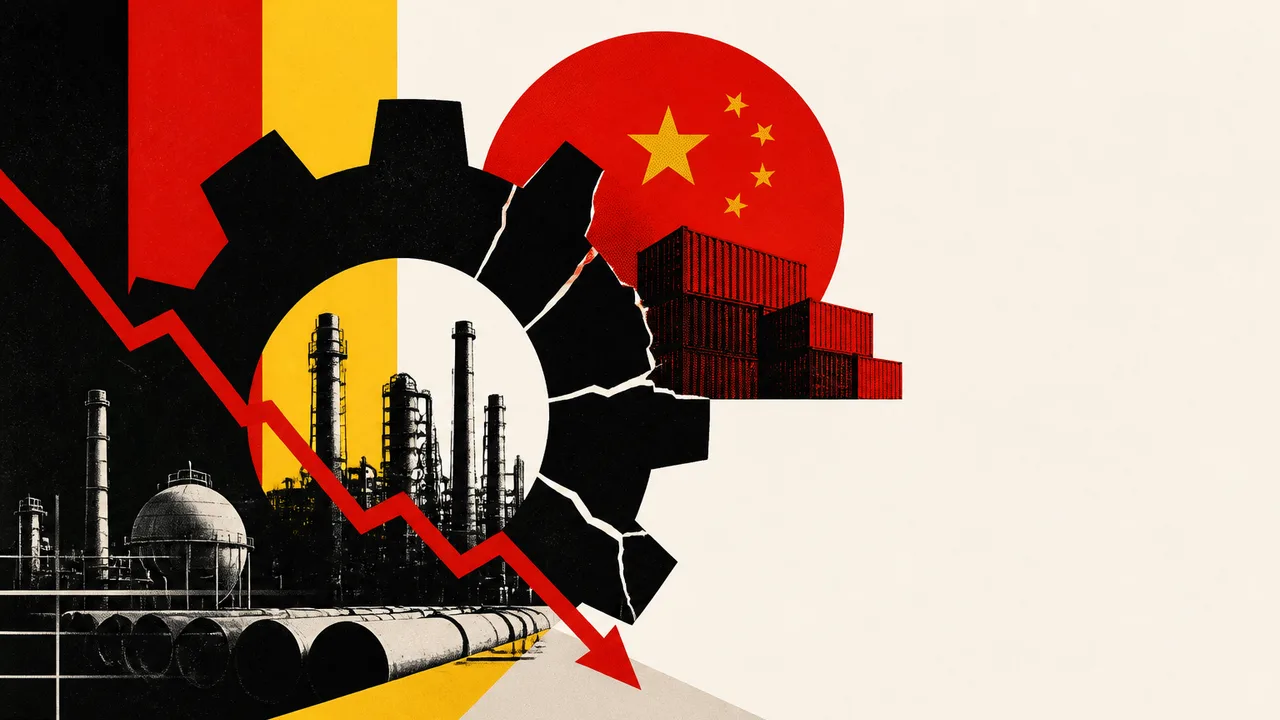
Photo: AI. Ondine Ferretti
There is a particular kind of crisis that looks, from the outside, like it arrived suddenly — and looks, from the inside, like it took decades to build. Germany is deep in that second kind.
A recent Bloomberg Originals video poses the question directly: what happened to Europe's biggest economy, and can it adapt fast enough to matter? It's a good question. The answer is not simple, and anyone offering you a simple version is probably selling something.
The clearest framing in the video comes from one of the analysts interviewed: "The three pillars of Germany's economic success were cheap Russian gas, an open global rules-based trade, and industrial leadership, especially in areas like machinery, automotive, and engineering." All three, the video argues, developed structural problems in quick succession. That's the architecture of the crisis — not one bad decision, but three simultaneous load-bearing failures.
The Energy Reckoning
Start with energy, because it's the most concrete.
Germany had built its industrial cost structure around relatively inexpensive Russian natural gas. When Russia's full-scale invasion of Ukraine severed that supply, the damage wasn't just logistical — it was a repricing of the entire German manufacturing proposition. Energy costs in Germany climbed well above those in competitor economies, including the United States and China, according to the Bloomberg analysis.
The chemical industry took the sharpest hit. Unlike most manufacturers, chemical producers can't simply swap inputs. As one expert explains in the video: "They cannot switch from gas and oil that quickly. They need gas and oil not only for energy, but they need the carbon molecules." This is an important distinction that usually gets lost in general energy-cost coverage. The feedstock is the gas. You can't electrify your way out of that in the short term.
The BASF facility in Ludwigshafen — described in the video as the birthplace of Germany's chemical industry and one of the world's largest chemical complexes — serves as a concrete illustration of what this looks like in practice. Bloomberg reports that BASF's workforce there has dropped to under 30,000 for the first time since the 1950s. Meanwhile, the company has been building new capacity in China. That sequence — shrinking at home, expanding in the country with cheaper inputs — is the energy crisis made tangible.
China Shock 2.0
The second pillar is more complex, because it involves a partner that was, until recently, also Germany's biggest customer.
The Bloomberg video distinguishes carefully between the first "China shock" — the early 2000s wave of low-cost export competition after China joined the WTO — and what analysts are calling China Shock 2.0. Germany largely dodged the first wave. Its premium, high-complexity manufacturing occupied a different price point than the labor-intensive goods China was flooding into global markets. For a long time, Germany and China were complementary: Germany supplied the machinery, the cars, the engineering infrastructure; China supplied the market and, increasingly, the manufacturing capacity for lower-tier goods.
That relationship has inverted. Chinese manufacturers have moved up the value chain, and they're now competing with Germany in its core export categories — industrial machinery, electrical engineering, energy infrastructure, vehicles. According to Bloomberg, German vehicle exports to China fell more than 30% last year. The trade relationship itself has swung from surplus to deficit as exports to China declined while imports from China increased.
The EV transition is the sharpest edge of this. "Germany was complacent about China's EV for a very long time," one analyst says in the video. "They switched gears now, but it might be difficult to catch up." The "might" is doing a lot of work in that sentence. German automakers are not absent from the EV space, but China's manufacturers moved faster, scaled harder, and now hold significant market position — including inside Germany itself, where consumers are buying Chinese-made EVs.
There's also a supply chain dimension. China controls significant supplies of critical minerals that German manufacturers depend on. Bloomberg's analysts note that China hasn't necessarily cut off these supplies — but it has delayed them. For manufacturers, that distinction matters less than it sounds. Uncertainty about supply is its own form of competitive disadvantage. You can't plan capital investment around inputs you can't count on.
The Policy Box
Here's where things get genuinely complicated, in ways the Bloomberg video handles honestly.
Germany can't simply subsidize its way to competitiveness. Not because German politicians lack the will, but because EU membership constrains unilateral state aid in ways that don't apply to China, the United States, or other major competitors. As the video notes: "Germany is part of the European Union, so it cannot just come up with subsidies on its own." This is a real structural constraint, not an excuse, and it means Germany's policy toolkit is narrower than the scale of its problem might suggest.
Chancellor Friedrich Merz did loosen the so-called debt brake last year — Germany's constitutional constraint on deficit spending — unlocking a substantial package for defense and infrastructure investment. The Bloomberg analysis notes that the full economic impact of this will take time to filter through. It's worth noting that infrastructure spending and defense spending have different multiplier effects on industrial competitiveness. The former can reduce input costs and improve logistics; the latter is less directly connected to the civilian manufacturing challenges at the core of this crisis.
Merz also has a China problem that is fundamentally bilateral. Germany needs China as a market and a supplier, even as China increasingly competes with Germany's core industries. "He's got to have that tricky balancing act," Bloomberg's analysis observes. "Protect German interests, but also engage with China." That's not a solvable tension — it's a permanent condition that requires constant navigation.
What Fracture Looks Like From the Inside
Step back from the trade statistics for a moment and ask what all of this means for the communities built around German industry — because that's the part that tends to disappear in macro-level economic coverage.
The Bloomberg video makes the point that German industry accounts for roughly 20% of the country's total value added, a higher share than comparable large EU economies like France, Spain, and Italy. That's not just a GDP figure. It means that industrial contraction cascades into business services, logistics, local retail, municipal tax bases — all the economic tissue that surrounds a factory town.
When stagnation persists long enough, the political consequences become structural too. The video is direct about this: for some German voters, economic anxiety is fueling support for political extremes. And as one analyst explains, that dynamic compounds itself — "if you can't reform then growth is hindered and at the same time you lose tax revenues and the trust of the people. So it's a kind of a vicious cycle." Political fragmentation makes reform harder. Harder reform means slower adaptation. Slower adaptation means more economic pain. More economic pain means more political fragmentation. Anyone who has watched smaller versions of this loop play out in deindustrializing communities in other countries will recognize the pattern.
Germany's social contract — its expansive pension system, healthcare infrastructure, and labor protections — was built on the assumption of sustained industrial growth generating sustained tax revenue. The Bloomberg analysis notes the government is already cutting social benefits as revenue tightens. That's not an abstract fiscal adjustment. It's a renegotiation of what the state owes its citizens, made under duress.
The Stakes Beyond Germany
Germany's industrial problems don't stay inside Germany's borders. European manufacturing supply chains are deeply integrated across national lines. Countries throughout Central and Eastern Europe in particular have built substantial parts of their economic development around supplying German industrial production. A contracting German manufacturing sector is a contraction that propagates outward.
There's modest evidence of stabilization — Bloomberg's analysts note Germany saw slight GDP growth in 2025, and German stock markets have reached record highs. But the video is careful, and correct, to separate financial market performance from the deeper structural question: whether Germany can actually reinvent its industrial model.
German companies are exploring whether industrial AI could provide an edge in a world where they've lost ground on cost and, in some sectors, on product quality. It's a reasonable bet. It's also worth noting that the United States and China are both investing heavily in the same territory.
"It's not the first time that Germany faces a changing time," one analyst says near the end of the Bloomberg video. "Germany has shown that it's capable of getting up and rebuilding, innovating and getting back on track." That historical record is real. So is the scale of what's required this time. Whether the two are commensurate is a question that the next decade will answer, not the next earnings call.
More Like This
The Electrical Grid Is Being Rebuilt for AI—Now What?
AI and EVs are forcing a complete grid overhaul. What that means for small businesses waiting on power that never seems to arrive fast enough.
Nuclear's New Fuel Has 11,000 Empty Holes
Inside the nuclear fuel supply chain scramble — from Piketon, Ohio to Saskatchewan — and why the six-to-seven-year timeline deserves your skepticism.
Mountain Pass Mine and the U.S. Rare Earth Supply Gap
The Mountain Pass mine once supplied 70–80% of global rare earths. Here's how the U.S. surrendered that dominance—and what it actually takes to rebuild it.

UK Economy Grew 0.4% in Q2, But Who Did the Work?
The UK's 0.4% Q2 2026 GDP growth looks good on paper. But behind the World Cup and sunshine numbers are workers whose hours have already started to shrink.
China's Economy Grew 4.3% in Q2, Its Slowest Since 2022
China's Q2 2026 GDP grew just 4.3%, its weakest since the COVID lockdowns of late 2022. Here's what the numbers reveal about the structural cracks underneath.

China Embraces AI While America Frets
China's public is broadly optimistic about AI while Americans grow wary. The Economist's editors ask how long that gap can hold—and what breaks first.

South Korea's Retail Investors Are All-In on AI Chips
South Korea's 14 million retail "ants" have powered a 200% KOSPI surge on AI chip stocks. A Bloomberg report maps the rally—and the risks hiding inside it.

How FIFA Engineered the 2026 World Cup Grass
FIFA spent $5M+ with a UT turf scientist to grow, test, and install 16 World Cup pitches. The farms, the students, and the contract pressure behind the grass.