China's Economy Grew 4.3% in Q2, Its Slowest Since 2022
China's Q2 2026 GDP grew just 4.3%, its weakest since the COVID lockdowns of late 2022. Here's what the numbers reveal about the structural cracks underneath.

Written by AI. Jonathan Park
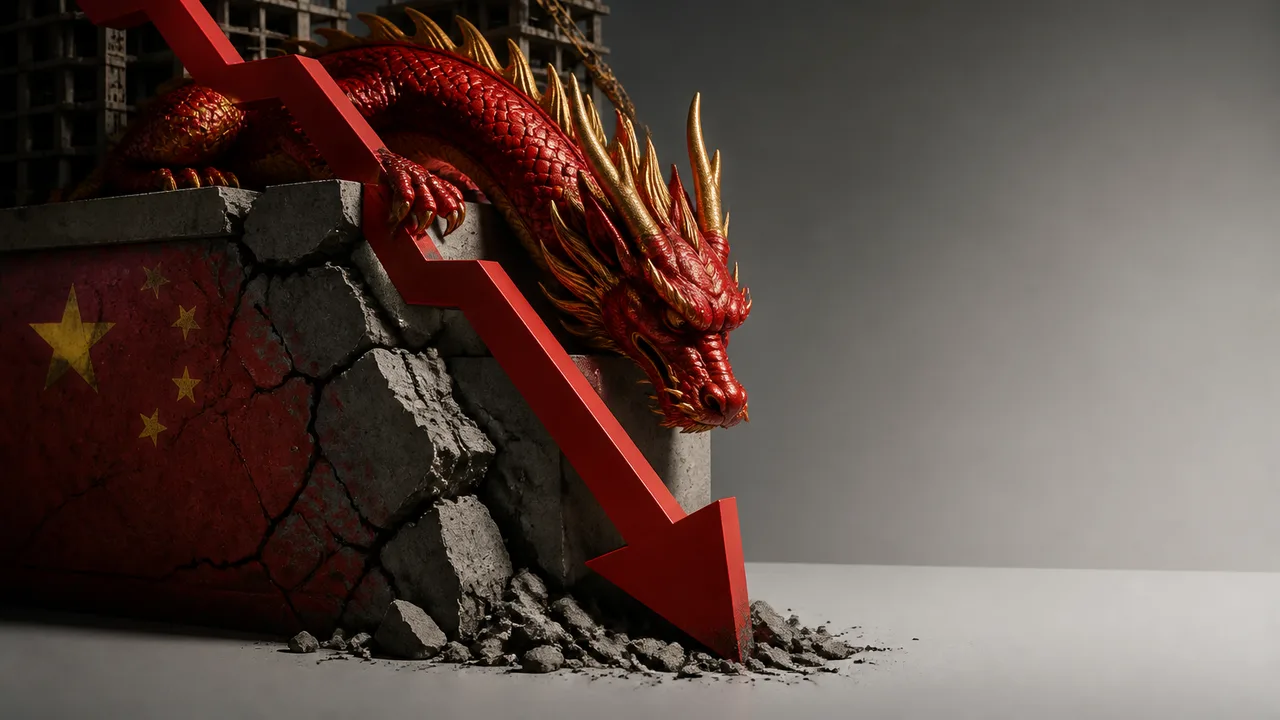
For three years, Beijing has run the same playbook: cite export strength, manage the GDP headline, and reassure markets that the post-COVID rebound is intact. The Q2 2026 numbers make that story significantly harder to tell.
China's economy expanded at just 4.3% year-on-year in the second quarter of 2026, according to multiple reports including CNBC and congress.net. That's below the government's own target band of 4.5% to 5%, and — as NPR and ABC News both note, citing Lynn Song, chief economist for Greater China — "the slowest growth in any quarter since the lockdown-impacted fourth quarter of 2022."
That framing matters. Q4 2022 was an asterisk quarter — factories shut, consumer activity frozen, cities locked down under China's zero-COVID policy. Comparing favorably to that baseline was never meant to be difficult. The fact that China has now matched that floor without a lockdown in sight tells you something about the underlying momentum, or the lack of it.
The Number That Explains the Number
4.3% still sounds respectable by the standards of most economies. In China's context, it's a distress signal — and the composition of the figure is what makes it one.
The New York Times puts the dynamic plainly: Q2 growth "reflected a broad slump outside of the country's export-oriented manufacturing might." Translation — one engine is still running, and it's running hard. Everything else has stalled.
Exports have been the part of the story Beijing can credibly claim. Chinese manufacturers — in electric vehicles, solar panels, consumer electronics — have captured global market share in ways that are structurally difficult to reverse quickly. The export machine is real.
But exports alone can't carry a $18 trillion economy indefinitely, particularly when the domestic side of the ledger looks the way it does right now. CNBC reports that "an accelerating slide in investments deepened the strain on growth, while consumption stayed subdued." Yahoo Finance is more direct: "weak domestic demand and a prolonged property downturn outweighed strong exports."
That word "prolonged" is doing a lot of work. The property downturn isn't a recent development — it's been grinding since Evergrande's 2021 collapse threw a spotlight on how systematically overleveraged China's real estate sector had become. Four-plus years later, the sector still hasn't found a floor that the rest of the economy can confidently build on.
Why Property Is Different From Other Slumps
In most large economies, a struggling sector eventually clears — prices fall, inventory sells, new buyers emerge. The China property story has been resistant to that logic, and it's worth understanding why.
Chinese household wealth has historically been parked in real estate to an unusual degree — estimates have varied, but the structural reality is that housing has functioned as both an investment vehicle and a savings mechanism in ways that Western housing markets don't quite parallel. When property values stagnate or decline, the wealth-effect drag on consumption is amplified. People feel poorer, spend less, and defer large purchases — including, often, more property.
That feedback loop is part of what makes the consumption story so stubborn. The government's stated goal for years has been to rebalance the Chinese economy away from investment and export dependence toward domestic consumption. The Q2 data is evidence of how far short that project has fallen. Consumption didn't pick up the slack — it barely moved.
Beijing's Stimulus Dilemma
The policy question now is what Beijing actually does about it, and the honest answer is: nobody outside the Politburo knows for certain, and even the people inside are probably still arguing.
The conventional tools — interest rate cuts, reserve requirement reductions, looser credit conditions — are available, and the People's Bank of China has used versions of them periodically throughout the downturn. The problem is that monetary easing works best when the barrier to borrowing is the cost of credit. When the barrier is a lack of confidence in asset values, cutting rates is like pushing on a string.
The more potent option is direct fiscal stimulus — government spending that puts money into the real economy rather than hoping it filters through the financial system. But that path carries its own complications. Local government finances in China are under considerable stress, partly because land sales — a major revenue source — have collapsed alongside the property market. Beijing has more fiscal capacity than its local governments, but deploying it at scale requires both political will and a clear theory of where the spending lands.
The reporting across these sources converges on one thing: pressure is mounting. Whether that pressure translates into action, and what kind, remains the open question.
The Global Dimension
The international stakes are worth being precise about, because they tend toward either overstatement or understatement in coverage like this.
The overclaim: that a Chinese slowdown automatically triggers global recession. The reality is more textured. China's growth slowdown is already priced into certain commodity markets — iron ore, copper, and industrial metals have been tracking Chinese property and infrastructure investment for years, and the signals have been pointing in this direction for a while. Countries and sectors most exposed to Chinese import demand — Australian mining, Southeast Asian manufacturing inputs, German industrial machinery — have had time to adjust, though adjustment doesn't mean painless.
The underclaim: that because China's exports are strong, the global ripple effects are limited. That ignores the other direction of the relationship. A China that is exporting aggressively into a world of softening demand is also a China that is competing more intensely for market share in categories that matter to manufacturers in Europe, North America, and emerging markets. That competitive pressure has real costs for workers and industries in those places, even if the GDP headline in China looks manageable.
The version worth watching is what happens if Beijing's stimulus response, whenever it comes, is targeted heavily at bolstering export-sector capacity further — manufacturing subsidies, industrial policy doubled down — rather than at rebalancing toward domestic consumption. That would solve Beijing's growth problem in the near term while exporting it to trading partners. It's a pattern with recent precedent.
What the Export Engine Hides
There's a temptation to read China's export strength as a clean counterweight to its domestic weakness — as if the two sides of the ledger are merely offsetting rather than structurally disconnected. They're not.
An economy where one sector is globally competitive and the rest is underperforming is an economy with an imbalance problem, not a growth story. The workers and businesses on the domestic consumption side of China's economy — services, retail, construction, real estate services — are experiencing an economy that looks nothing like the export headline. Youth unemployment, while the specific figures require care given data reporting concerns, has been cited as a persistent problem in Chinese economic discourse. The gap between the economy of a Shenzhen electronics factory and the economy of a third-tier city real estate developer is not a rounding error.
China's 4.3% GDP print is a national aggregate that flattens a lot of divergence. The aggregate matters. So does what it's averaging over.
Whether Beijing's next policy move addresses the structural divergence or papers over it with another round of credit expansion is the question that will define the next several quarters — and the answer will be visible not just in the GDP number, but in where that growth is actually coming from.
More Like This
USMCA Won't Be Renewed: What Annual Reviews Mean
The Trump administration has blocked USMCA's 16-year renewal, opting for annual reviews. Here's what that means for trade, business, and North America.

US and China Train Almost All the World's AI Models
US and Chinese companies train nearly every major AI model the world uses. Here's what that concentration means for global power, values, and sovereignty.
Bill Ackman's Art of Finding Invisible Money
Explore Bill Ackman's strategy of finding hidden value in companies, beyond standard metrics.
Big Tech's AI Spending Has a Free Cash Flow Problem
Big Tech's AI investment boom is straining free cash flow, raising questions about circular financing, inflated valuations, and whether the returns ever materialize.

How APL Turned an NBA Ban Into a Brand Identity
APL's NJ Falk breaks down the six storytelling threads behind one of e-commerce's most unlikely brand-building moves—starting with an NBA ban.
China's Housing Bust Is Still Happening, Just Quietly
China's property crisis never ended — it got papered over by a manufacturing boom. Now that buffer is fading, and Main Street may feel it next.

Home Swapping Saves Families Thousands on Holidays
Home swapping is helping families save thousands on holidays by cutting accommodation costs. Here's how the model works, what it costs, and what the risks are.

Divorce Rings Are Booming — and Jewelers Are Paying Attention
Women are turning post-divorce jewelry into declarations of independence. What's driving the divorce ring trend—and who's really selling it?