Fake Scrolls Could Help Read Herculaneum's Library
Researchers burned replica papyrus to test lead-sensitive X-rays, offering a safer way to triage and decode Herculaneum's fragile scrolls, with limits.

Written by AI. Nadia Marchetti
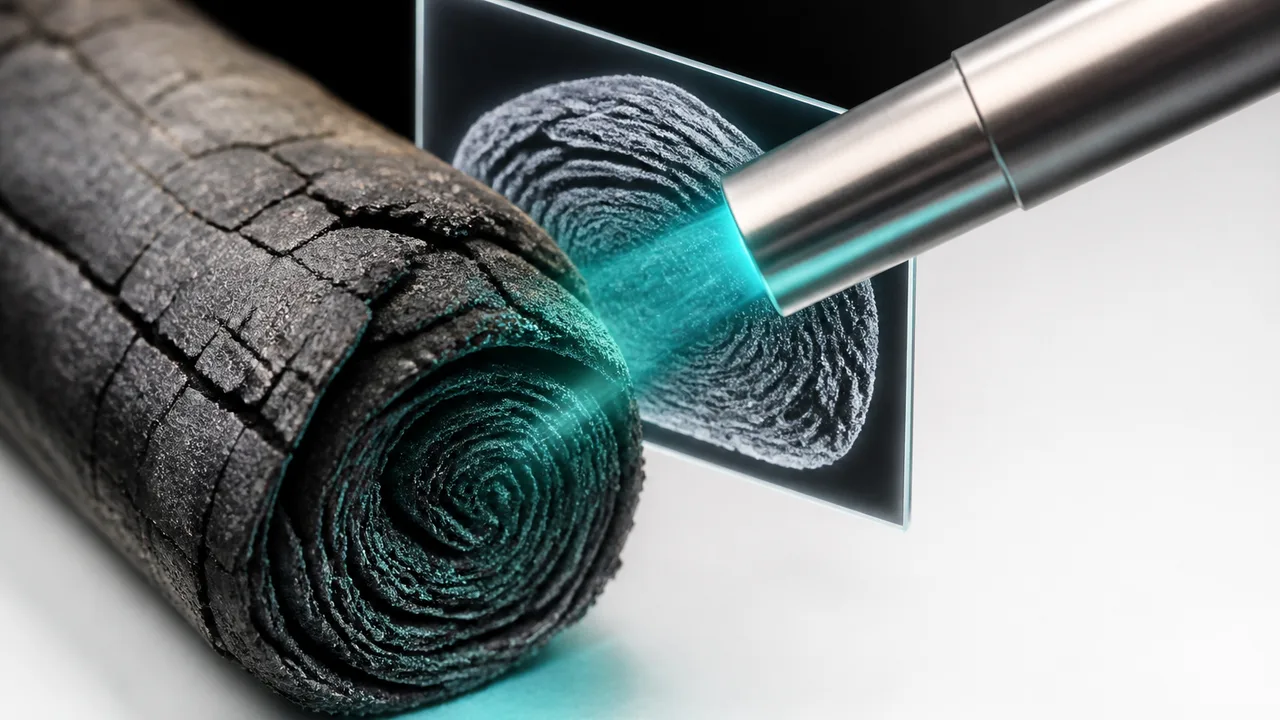
Douglas Seiler and his collaborators burned modern papyrus scrolls in a furnace to improve the odds of reading a Roman library buried by Mount Vesuvius in 79 CE.
The experiment sounds like archaeology conducted by a mildly alarming book club. High school students copied passages from Star Wars, the Bible and The Outer Limits onto papyrus using inks with different concentrations of lead. The scrolls went into metal containers and a high-temperature furnace, producing charred replicas of the carbonized Herculaneum papyri.
That theatrical recipe served a careful purpose. The researchers knew every word inside their replicas before scanning them. They could therefore compare what their imaging software recovered with the correct answer, something an unopened ancient scroll cannot provide.
The resulting study, published in PLOS ONE on September 16, tested a possible route through one of virtual archaeology's nastier obstacles. The researchers detected lead at every concentration they tested using X-ray fluorescence. X-ray tomography and custom software then recovered some of the writing from inside the burned scrolls.
Those results support two connected ideas. Researchers could screen the ancient collection for lead before committing resources to detailed scans. They could also use replica scrolls as calibration material for the algorithms that digitally separate, flatten and read tightly packed papyrus layers.
The second idea may have the longer reach. A bright letter in a scan is useful. A controlled object that reveals when the software is getting letters wrong is how a promising demonstration becomes a repeatable method.
Why Carbon Ink Makes the Problem so Stubborn
Mount Vesuvius covered Herculaneum with roughly 20 to 21 meters of rock and ash. Heat carbonized the library's papyrus, preserving many scrolls as brittle, blackened rolls. The collection includes more than 1,800 scrolls, according to Nautilus' account of the research and its history.
Virtual unrolling begins with X-ray tomography, which reconstructs an object's internal structure. Software identifies the warped sheets, separates them digitally and attempts to flatten them into readable surfaces. The ink then has to stand out from the page.
That final step is a nuisance worthy of Vesuvius. Traditional lampblack ink and carbonized papyrus are both rich in carbon, producing weak contrast in conventional X-ray images. Lead changes that equation because it absorbs X-rays more strongly than the surrounding papyrus. In the model scrolls, lead-bearing letters appeared bright enough for the team to recover portions of the known text.
The proposed workflow resembles medical triage, minus the waiting-room magazines. A handheld X-ray fluorescence instrument could first look for elemental lead. Scrolls producing a signal could then become candidates for more elaborate tomography and virtual unrolling optimized to detect it.
That sorting function is important because scanning and computational reconstruction require time and equipment. A preliminary screen could direct those resources toward scrolls with a favorable physical property, rather than treating every sealed roll as an equally promising candidate.
Archaeology Already Learned the Cost of Touching Them
The scrolls were discovered in 1751. Early readers tried to open them physically, sometimes reducing the carbonized papyrus to piles of ash. Another method pulled a scroll apart by a few millimeters per day and required four years for one specimen; Italian officials eventually halted destructive operations.
That history explains the caution built into the replica experiment. For much of the collection's modern existence, reading and damaging a scroll were uncomfortably close neighbors. A model can be scanned repeatedly, heated differently, damaged, rebuilt and used to expose software errors without sacrificing an irreplaceable object.
The field has since made a remarkable turn toward non-contact reading. X-ray CT and artificial intelligence have allowed researchers to recover portions of hidden texts. Previously opened or digitally decoded material has included works associated with Epicurean and Stoic philosophy, while the villa itself was likely owned by Julius Caesar's father-in-law, Live Science reported in its account of the new study.
In summer 2026, another team completed a virtual reading of an entire Herculaneum scroll without exploiting lead in the ink, according to Gizmodo's report. That precedent helps define the new proposal. Both routes rely on internal imaging, layer segmentation and digital flattening. The lead-assisted route adds a high-contrast target and a way to identify promising scrolls before the heavier computational work begins.
The comparison also exposes the boundary. Lead screening helps only when lead is present in the writing. Carbon-sensitive virtual unrolling remains necessary for scrolls whose ink offers no convenient elemental beacon.
The Counterfeit Scroll is Calibration Data
The replicas supply what machine-learning researchers call ground truth: an answer known independently of the model trying to recover it. If an algorithm reads a familiar passage correctly, its output can be checked letter by letter. If it invents a stroke where none exists, that error can be traced through the scan and segmentation process.
This produces a defensible inference from the experiment. The model scroll may prove more valuable as a testing platform than as proof that the ancient library can now be read. Researchers can alter lead concentration, handwriting, layer spacing and carbonization conditions, then measure how each variable affects recovery. Ancient scrolls arrive without that experimental control.
The study itself leaves several doors firmly closed. It recovered only some writing from modern replicas. It did not establish how much text could be extracted from an original Herculaneum scroll, whose age, chemistry, deformation and volcanic history cannot be reproduced fully in a furnace.
The prevalence of leaded ink is another large unknown. Lead has reportedly been identified in only two fragments from the Herculaneum collection, and no thorough survey of the scrolls has been completed. Two fragments cannot reveal whether lead appears across a substantial portion of the library, within one scribal period or only in rare cases.
That uncertainty changes how the proposal should be understood. Lead screening offers a selection tool, not a universal decoder. A collection-wide survey might uncover many strong candidates, a handful or almost none. Each outcome would still provide useful information about the materials used by ancient scribes.
What Would Establish that the Method Works?
A persuasive next phase would separate three questions that headlines can easily mash together.
First, can handheld X-ray fluorescence find lead reliably in unopened ancient scrolls without harming them? The replicas suggest it can detect low concentrations, but original artifacts present different geometries and chemical backgrounds.
Second, does a lead signal correspond to letters arranged deeply enough inside a scroll for tomography to map them? Detecting an element somewhere in a roll is easier than reconstructing coherent handwriting across crushed and folded layers.
Third, can independent specialists reproduce and validate the recovered text? Known replica passages test technical accuracy. Ancient text adds another layer of uncertainty because damaged characters invite interpretive judgment from papyrologists.
The cleanest demonstration would begin with a lead-positive ancient scroll or fragment, document the scan and reconstruction process, and produce text that multiple readers can evaluate. Publishing unsuccessful scans would help too. Failure patterns reveal whether the obstacle lies in ink concentration, layer geometry, carbonization or software.
Herculaneum has spent nearly three centuries teaching readers an expensive lesson: curiosity needs controls when the evidence can crumble between your fingers. A furnace-blackened counterfeit, filled with familiar lines and expendable papyrus, may be the safest place to learn how to ask the originals what they contain.
More Like This
Why All Mammals Share Seven Neck Bones
Giraffes and humans both have seven cervical vertebrae. The evolutionary reason involves Hox genes, cancer risk, and the surprising anatomy of the diaphragm.

Einstein vs Quantum Mechanics: The EPR Paradox Explained
Physicist Jim Al-Khalili unpacks the EPR paradox—Einstein's 1935 challenge to quantum mechanics that inadvertently gave us the concept of entanglement.