Inside America's Next Particle Physics Megaproject
Brookhaven's Relativistic Heavy Ion Collider has shut down after 25 years. Its replacement, the Electron Ion Collider, may answer physics' deepest open question.

Written by AI. Nadia Marchetti
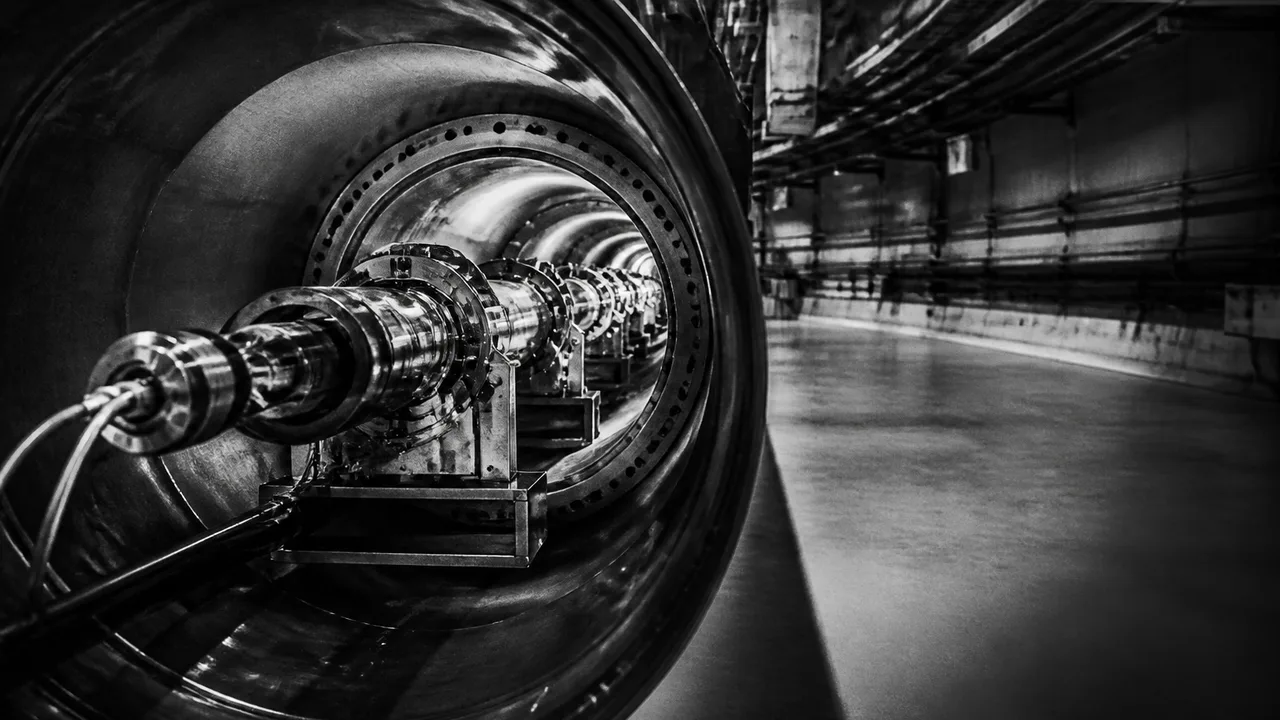
Photo: AI. Atticus Ferenczi
There's a particle accelerator on Long Island. Has been for more than 25 years, sitting in plain sight on the northeastern edge of New York's most densely storied metro area, its 3.8-kilometer ring clearly visible from the air — and almost completely invisible to the 20 million people living nearby. Most of them never knew it existed. In early 2026, it was permanently switched off.
That machine was the Relativistic Heavy Ion Collider, or RHIC, operated by Brookhaven National Laboratory. And what replaces it — the Electron Ion Collider, or EIC — is the kind of project that makes you reckon with how much of the universe we still don't understand, even at the most fundamental level.
What RHIC Actually Did
To understand why the EIC matters, you have to start with what RHIC accomplished — and what it couldn't.
RHIC's method was elegant in a brutal sort of way: fire two beams of ions in opposite directions around the ring at nearly the speed of light, then smash them together. The collisions reached temperatures roughly 250,000 times hotter than the core of the sun — somewhere around 4 trillion degrees Celsius. At those temperatures, protons and neutrons effectively melt, releasing the particles inside them: quarks and gluons.
That soup of free-roaming quarks and gluons — called quark-gluon plasma — is what the universe looked like somewhere between one-millionth and one-trillionth of a second after the Big Bang. RHIC was built to create it and study it. The machine used gold ions specifically because gold is one of the heaviest common elements, densely packed with protons and neutrons, which maximized collision probability.
What researchers found surprised them. As one of the scientists interviewed in The B1M's documentary put it: "That form of matter where quarks and gluons are free to move around was something that we had never seen before RHIC came along. So the questions for RHIC were about what is that form of matter? How does it behave? What are its properties?"
The answer turned out to be counterintuitive. Before RHIC, most physicists expected quark-gluon plasma to behave like a gas — particles bouncing around with minimal interaction. Instead, RHIC demonstrated it behaves more like a liquid, flowing with almost no viscosity. That finding reshaped theoretical models of the early universe and gave the much larger Large Hadron Collider at CERN a foundation to build on when it came online years later. The LHC got the headlines; Brookhaven did much of the foundational work.
RHIC's lineage at Brookhaven runs even deeper. Just south of the RHIC ring sits a smaller predecessor, the Alternating Gradient Synchrotron, launched in 1960. That machine was so productive it generated three Nobel Prizes and still operates today — feeding ions into RHIC, and eventually into the EIC. The tunnel RHIC occupied wasn't even originally built for it; it was excavated in the 1970s for a project called ISABELLE, which was cancelled after its superconducting magnets proved unworkable. The tunnel sat waiting. Someone eventually looked at it and asked the right question.
The Question RHIC Couldn't Answer
RHIC fulfilled its mission. It created plasma, researchers spent years characterizing it, and the physics community moved on to the next layer of the problem.
That next layer is deceptively simple to state and ferociously hard to answer: where does the mass of a proton actually come from?
The Higgs boson — the LHC's landmark 2012 discovery — is the particle that grants mass to fundamental particles like quarks. But here's the thing: when you add up the mass of the quarks inside a proton, you get only a tiny fraction of the proton's total mass. Maybe 2 to 5 percent. The rest comes from somewhere else — from the gluons, and specifically from the energy tied up in the interactions between them.
One of the researchers featured in the documentary put the stakes plainly: "That gluon interaction is critical, and unless we understand that, we won't understand the remaining 95% of the mass."
Ninety-five percent. Of the mass of essentially everything we can see and touch in the universe. That's not a rounding error. That's the main event.
This is what the EIC is designed to probe. Instead of colliding ions with ions like RHIC did, it will collide electrons with ions — making it, according to Brookhaven, the only accelerator in the world capable of this particular type of experiment. Electrons are point-like particles with no internal structure, which makes them ideal probes: scatter them off a nucleus, catch the debris with a detector, and work backward to map the internal architecture of the proton.
Building on What's Already There
The EIC isn't starting from nothing, which is both a practical advantage and a kind of institutional elegance. Brookhaven's plan is to repurpose the existing RHIC infrastructure wherever possible: the tunnel, one of the two ion rings, over a thousand superconducting magnets, the ion source, support buildings, roads, electrical systems. The second ring — the one that fired ions in the opposite direction — is being replaced with a ring that fires electrons instead.
Disassembly was already underway weeks after RHIC's shutdown, as one Brookhaven researcher described: "One of the rings of the RHIC has already been disconnected. There is no power on it and we are systematically taking each magnet out and placing it in the storage area. So some magnets are moving from one part of the RHIC to another part of the RHIC to be useful in the future operations of the Electron Ion Collider."
The central instrument of the new machine will be the EPIC detector — and yes, that's actually what it's called, not editorial enthusiasm. This single component will be larger than a school bus, housing a 10-meter barrel detector with additional instruments extending 45 meters in each direction along the beam line. Repurposed magnets from Argonne National Laboratory's Advanced Photon Source in Illinois are among the components being folded into the build.
The total price tag sits at nearly $3 billion — roughly the cost of a major urban transit line, for context, except instead of moving commuters it's probing the structure of matter itself. The existing RHIC infrastructure that feeds into the project represented around $2 billion in prior investment, so the EIC is, in one sense, a $3 billion extension of decades of accumulated capital.
The machine won't be operational until the mid-2030s. Nothing about it is being rushed. These are components that don't exist anywhere else on Earth, built to tolerances that have no commercial equivalent.
What's striking about the collaboration structure is its genuinely international character. Roughly 1,600 to 1,800 scientists from institutions around the world were already engaged with the project when the documentary was filmed — split approximately evenly between American and international partners. The expectation is that this grows to somewhere between two and three thousand researchers by the time the collider runs its first experiments. Brookhaven is the host and the anchor, but the science being pursued belongs to no single country's physics program.
The Tunnel and the Question
RHIC operated for more than 25 years. Millions of particles smashed, terabytes of data collected, a Nobel Prize-adjacent finding about the nature of primordial matter — and most New Yorkers drove past the exit on the Long Island Expressway without a second thought.
The EIC will run from that same tunnel, asking a harder question. It wants to know what holds the universe together at the most basic level — not metaphorically, but literally, mechanically, quantitatively. Gluons bind quarks into protons, and protons bind into everything. If 95% of the mass of ordinary matter comes from interactions we don't yet fully understand, then our picture of physical reality has a very significant gap in it.
The tunnel on Long Island has been sitting at the edge of that gap for decades. What happens next, somewhere under the ground between the suburbs and the Atlantic, is the attempt to close it.
More Like This
CERN's Particle Asymmetry: Cracking the Universe's Mysteries
Exploring CERN's recent findings on matter-antimatter asymmetry and their implications for understanding the universe.
Physicists Just Caught Virtual Particles Becoming Real
New experiment at Brookhaven Lab allegedly proves virtual particles exist—challenging how we understand empty space and quantum reality itself.
CERN's LHC and the Search for Hidden Dimensions
Inside CERN's Large Hadron Collider: how 600 million proton collisions per second could reveal dark matter, extra dimensions, and the Higgs boson.
The Most Sensitive Dark Matter Detector Might Find Nothing
LUX-ZEPLIN sits a kilometer underground, waiting for dark matter. But success might look like silence—and that would tell us something huge.
The Top Quark and the Fate of the Universe
Physicist Kate Shaw explains how measuring the top quark's mass with precision could reveal whether the universe is stable—or sitting on a quantum knife-edge.
Solar Flares, Earth's Magnetosphere, and StormWall
Recent X-class solar flares and CMEs have prompted serious discussion about Earth's space weather vulnerability—and a theoretical plasma shield called StormWall.
Neil Turok's Case for Quantum Gravity Without Strings
Neil Turok argues quadratic gravity—a 1970s idea—may solve quantum gravity without strings or extra dimensions. Here's what that claim actually rests on.
Electric and Magnetic Fields Explained From First Principles
From ancient amber to Gauss's law: how physicists replaced "action at a distance" with the field concept that underpins all of modern physics.