Delhi's Air Reaches Very Poor Levels Before Diwali
Delhi's AQI reached 377 before Diwali as firework limits and regional pollution curbs took effect. What the readings show, and what they cannot tell us yet.

Written by AI. Nadia Marchetti
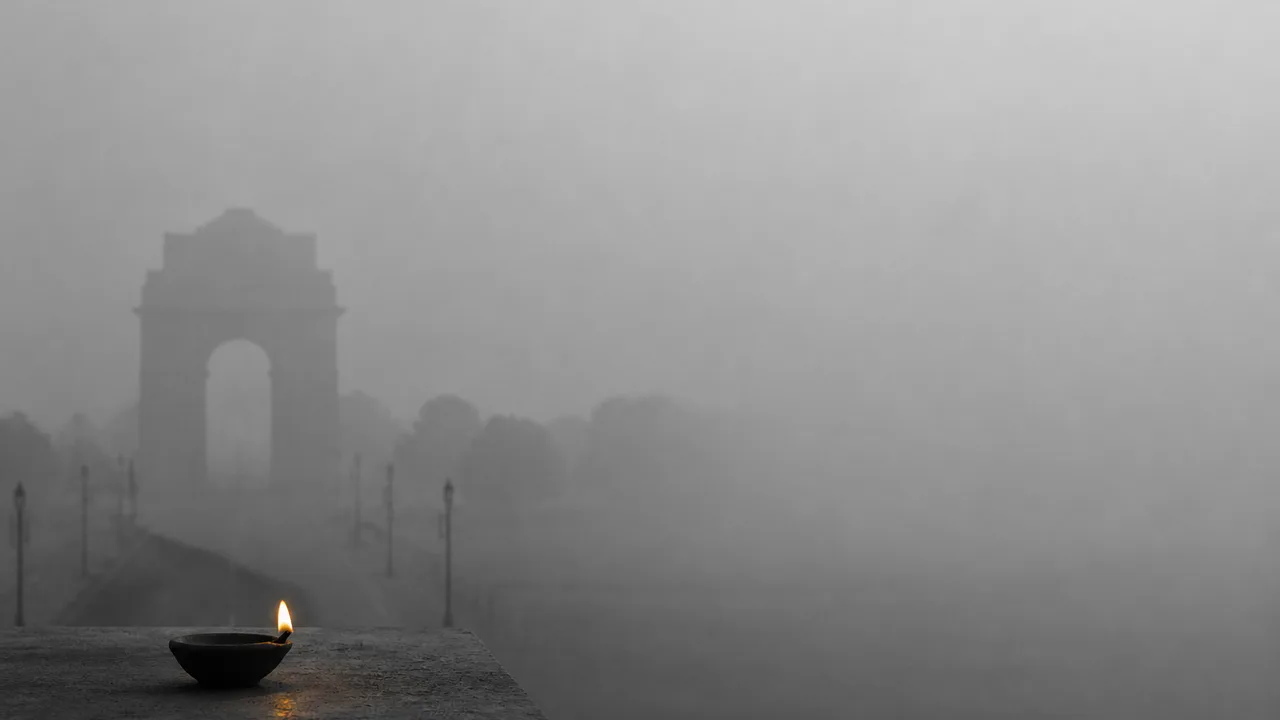
Delhi’s air quality index reached 377 on Wednesday morning, November 4, placing the capital in the “very poor” category before Diwali’s firework emissions have fully played out. Restrictions on fireworks were coming into force, but the city was already breathing heavily polluted air.
That sequence makes the policy question unusually sharp. If pollution rises during the festival, how much should officials attribute to fireworks? If it falls, how much credit should restrictions receive? The Wednesday reading establishes the condition Delhi faced at one point in time; it cannot assign a share of pollution to any source or measure the effect of a rule on its own. Answering those questions requires readings across the holiday, alongside weather and information about how many fireworks people actually set off.
A Citywide Number, Many Local Conditions
The citywide figure compresses a patchwork of conditions into one number. On Tuesday, eight monitoring stations recorded “severe” air quality, while 33 registered “very poor” and 17 registered “poor.” Its citywide AQI figure was 331. Another Tuesday account put the average at 324 and identified three areas above 400.
Those reports offer different Tuesday snapshots. Their station counts and averages should not be treated as measurements taken under identical conditions. Together, though, they show why a single Delhi-wide label can feel inadequate on the ground: a resident near a station above 400 faces a different immediate reading from someone near a station in the “poor” category. Neither gets a clean bill of health from the citywide average.
The rise from Tuesday’s reported averages to Wednesday morning’s 377 also needs its clock attached. Pollution changes through the day. Weather can disperse pollutants or allow them to accumulate near the ground, and emissions continue while those conditions change. A higher reading the next morning is a serious development for exposure; it is not, by itself, a verdict on whether a newly introduced measure worked.
What the Restrictions Are Trying to Change
Firecrackers release particulate matter and gases into air that is already polluted. Their contribution can arrive over a short period, making Diwali nights and the hours that follow a particular concern. Limiting when people can set them off targets that added burst. A Supreme Court order limiting firework hours has also been reported as restrictions begin.
Delhi-NCR faces another, broader set of controls: GRAP-2 pollution curbs were being rolled out across the region as air quality worsened. The two approaches address different parts of the problem. Firework limits focus on a festival-related addition; regional measures respond to pollution that has already built up. Their coexistence reflects the timing of the crisis, with unhealthy air arriving before the holiday’s main emissions.
A rule also has a practical middle step between announcement and cleaner air: people must follow it, and authorities must enforce it. If many fireworks are set off despite limits, a poor post-holiday reading would say little about what a widely observed limit might have achieved. If use falls substantially, the effect could still be difficult to see in a citywide AQI when other emissions and weather are changing at the same time.
That is the strongest case for firework restrictions, and its boundary. Cutting an avoidable addition to polluted air could reduce exposure during the festival. It cannot remove the pollution already present on Wednesday morning. People who question whether a firework rule can solve Delhi’s winter air crisis are asking about its scope; people worried about the extra smoke are asking about the next few nights. Both questions have concrete answers to pursue.
How to Judge the Holiday Readings
Delhi’s winter air reflects emissions from multiple activities interacting with conditions that govern where pollution travels and how long it lingers. To assess the holiday period, the useful comparison goes beyond one day before and one day after Diwali. It would track the same monitoring locations over time, look at the hours when fireworks are permitted, and account for changes in wind and other weather conditions. Comparable periods from earlier years could help, provided differences in weather and emissions are kept in view.
The local pattern may be as informative as the average. A short-lived spike across many stations after widespread firework use would pose a different question from a rise confined to a few locations. Persistent high readings before, during and after the festival would point attention toward the longer-running pollution burden as well. Measurements of pollutants, especially fine particles, would help explain what sits behind changes in the AQI number; observations of compliance would help interpret whether the firework limits reached the streets.
These are practical tests, rather than a demand for a perfect experiment. Officials have to act while residents are exposed, and residents need useful information before anyone can calculate an exact contribution from each source. The very poor reading of 377 is already a reason to pay attention to local advisories and reduce exposure, especially for people with respiratory or cardiovascular conditions. The precise policy accounting can follow the measurements.
Diwali will add a new chapter to Delhi’s air-quality record. Wednesday’s number sets the starting point: restrictions have begun, and the air is already unhealthy. What happens next will test both the limits on fireworks and the city’s ability to see their effects through the pollution that was there first.
More Like This

Neil Turok's Case for Quantum Gravity Without Strings
Neil Turok argues quadratic gravity—a 1970s idea—may solve quantum gravity without strings or extra dimensions. Here's what that claim actually rests on.

Statins May Cut Dementia Risk in Type 2 Diabetes
A major study finds early statin use after a type 2 diabetes diagnosis is linked to up to 15% lower dementia risk. Here's what the evidence actually shows.

America Wants Nuclear Cargo Ships by 2028: The Real Obstacles
A MARAD-Core Power agreement targets nuclear merchant ships laid down from 2028. The reactor is the easy part; lawyers, insurers and ports are not.

SpaceX Hits 600 Falcon 9 Booster Reuses
SpaceX reached 600 flight-proven Falcon 9 booster launches on July 13-14, 2026. Here's what that number actually means for spaceflight economics.

Artemis III Orion Modules Joined at Kennedy Space Center
NASA technicians joined the Artemis III Orion crew and service modules on July 30, 2026 — real flight hardware, in the building where Apollo spacecraft were checked out.

Michael Shermer on Truth, Bias, and the Post-Truth Era
Neil deGrasse Tyson and Michael Shermer unpack objective truth, motivated reasoning, and why your brain argues like a lawyer, not a scientist.