College Sports Bill Passes Senate, Faces House Test
The Senate passed the Protect College Sports Act 77-22. The House now weighs payment caps and NCAA antitrust protections, with stakes for athletes and schools.

Written by AI. Elena Vasquez-Moreno
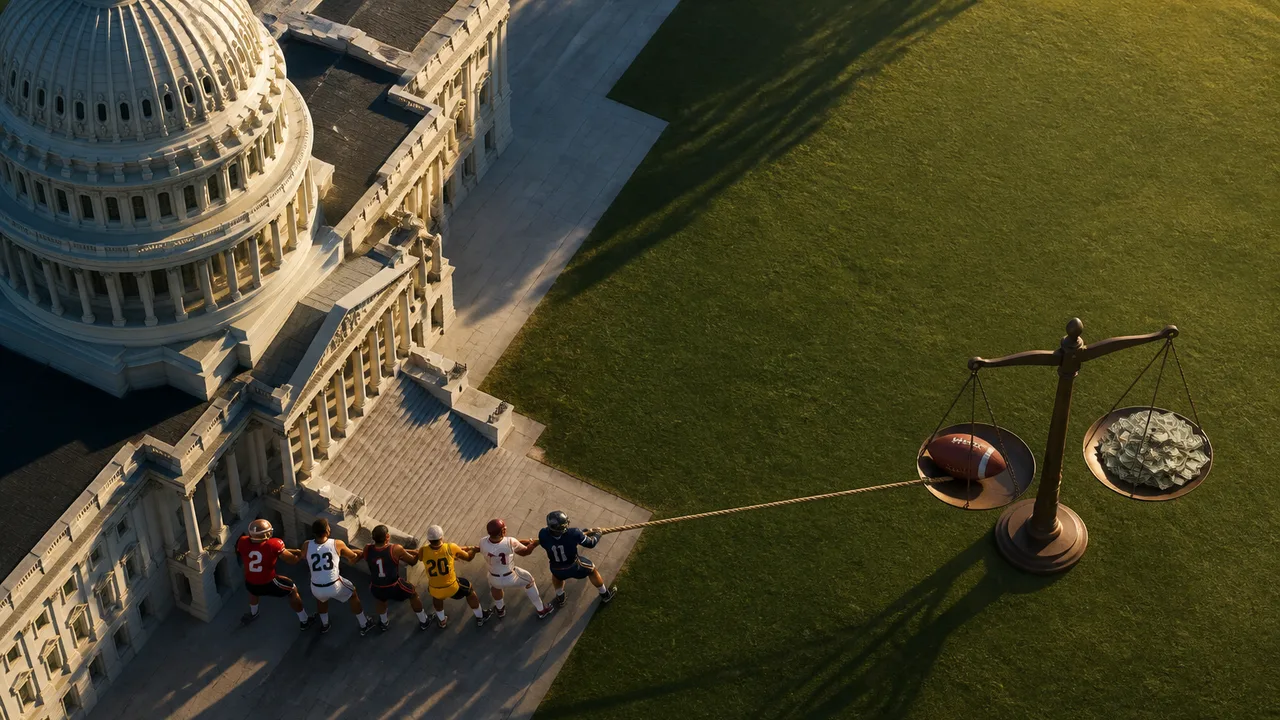
The Senate voted 77-22 Monday night to pass the Protect College Sports Act. That is a large coalition for a bill that could change who gets to write the rules of college athletics. It is also a coalition in one chamber. The House has yet to decide what version of federal intervention, if any, it will accept.
The clearest reported stakes concern money and authority. The bill includes new payment caps and antitrust protections, according to The Hill. It would also grant the NCAA a limited antitrust exemption intended to restore its five-year eligibility rule and transfer limits, NPR reports. Whether those eligibility and transfer restrictions ultimately take effect depends on the language Congress enacts. For now, the Senate vote identifies the direction of travel; it does not establish the rules athletes and schools will live under.
Who Gets to Defend the Rules
An antitrust exemption changes the legal position from which the NCAA can defend collective restrictions. When schools coordinate through an athletic association, rules that limit an athlete’s options can face antitrust challenges. A limited exemption would give the association protection for whatever conduct Congress places inside its boundaries. The scope matters: protection for an eligibility rule, for example, would not automatically protect every NCAA rule or every decision made by a conference.
That power has a practical economic value even before anyone calculates a dollar figure. Schools want common rules they can plan around. An association able to defend those rules has more room to enforce them consistently. Athletes, meanwhile, may have fewer opportunities to contest a restriction if Congress shields it from a line of legal attack. The precise shift depends on what the exemption covers and what remedies remain available. The reporting provided here does not establish those boundaries.
The NCAA’s case for federal help is understandable. A national competition needs shared eligibility standards, and a school building a roster has reason to want rules that survive more than one season of litigation. Uniformity can also spare individual schools from negotiating the same disputes separately. But uniformity always has an author. Congress must decide how much control to assign to the NCAA and how much room athletes retain to challenge its decisions.
NPR’s account makes that choice concrete. If final statutory language permits the NCAA to reinstate a five-year eligibility rule, an athlete’s remaining time to compete would depend in part on a collectively enforced clock. If it permits transfer limits, moving schools could carry constraints set beyond the athlete’s prospective campus. Those are conditional effects of the provisions NPR describes, not rules already restored by Monday’s vote.
The Cap Without a Number
A payment ceiling works through a different mechanism. It would set a limit on covered payments, while an antitrust exemption would affect the legal vulnerability of covered collective rules. Schools would need to know which transactions count toward a cap, who must comply and what happens if a school exceeds it. Athletes would need to know which potential earnings, if any, the ceiling reaches.
The available accounts identify payment caps but do not provide a figure or enough operative detail to calculate their effect. A cap’s financial consequences depend on its base as much as its height: a limit on one category of school payments would have a different reach from a limit that included other forms of compensation. There is no sound per-athlete savings estimate, compliance-cost estimate or distributional claim to make from the reported details alone.
For athletic departments, the appeal of a defined ceiling is budget predictability. Administrators making multi-year commitments have an interest in knowing what expenses they can incur under a common set of rules. For athletes, a ceiling raises the corresponding question of foregone opportunity: whose potential payments would the rule constrain, and who would otherwise have paid them? A cap could ease one school’s budgeting problem while limiting another party’s bargaining room. The answer depends on its coverage, not on the reassuring arithmetic of a single maximum.
The NCAA’s prospective antitrust protection may carry the larger change in leverage because it concerns the association’s capacity to maintain collective rules over time. A payment cap states a constraint; legal protection can make a covered constraint harder to dislodge. That assessment remains bounded by the word limited in NPR’s account. Congress could protect a narrow set of rules while leaving others open to challenge. Readers should be wary of either treating the exemption as a blanket license or assuming it is too narrow to affect athletes.
The Allocation Question for HBCUs
Historically Black colleges and universities also have to assess a bill about college-sports stability through their own budgets. The available reporting does not establish an HBCU-specific funding commitment, allocation formula or exemption from compliance duties. That leaves concrete questions for an HBCU athletic department: Would a payment ceiling change what the school owes athletes, or mostly constrain better-funded competitors? Would new compliance work require staff or spending the school must cover itself? Would any benefit from more predictable NCAA rules come with costs that fall differently across campuses?
Those questions cannot be answered by calling the legislation good or bad for smaller programs as a group. A rule that limits spending might narrow one competitive gap while doing little to pay a school’s administrative costs. If lawmakers intend a benefit for institutions with fewer resources, the mechanism should be visible in the bill’s obligations and allocations. None can be quantified from the reported provisions here.
The House is divided over how Congress should intervene in college athletics. That division gives the 77-22 Senate margin its proper scale. A bipartisan vote can move a proposal across the Capitol; it cannot settle which rules receive federal protection, which payments face limits or who pays to administer the result.
As House lawmakers take up the bill, the sharpest questions sit in its operative language: which NCAA restrictions Congress would protect, how far any payment cap would reach and what recourse an athlete would have when a protected rule blocks a season or a transfer. The NCAA wants rules it can enforce. Schools want costs they can forecast. Athletes will bear the restrictions Congress chooses to make durable.
More Like This

Stephen A. Smith Tests Sports Media's Political Reach
Stephen A. Smith's 2028 speculation shows how sports media can convert recurring attention into political capital, while creating new risks for ESPN and its audience.

Rays Stadium, US Open Records and Prediction Markets
The Rays finally got their votes. The US Open set a prize record. And prediction markets got a legal gut-punch. Here's what it all means financially.

How an MLB Lockout Could Expand the Bananas' Market
A possible MLB lockout could give the Savannah Bananas more attention, venue leverage and ticket demand, while testing whether fans stay after MLB returns.

Dodger Stadium's 4th of July Fan Experience Reviewed
A Dodgers fan vlog captures rock climbing, a $22 burger, commemorative coins, and a Yamamoto gem against the Padres on Independence Day.

ESPN's College Sports Bill Problem, and Other Stories That Matter
ESPN's SportsCenter counterprogramming on the Protect College Sports Act, Florida State's AD shakeup, and NHL dress code changes.

Ballmer Suspended, SEC Sues LSU, Padel Leads Growth
NBA sanctions hit Steve Ballmer hard, the SEC sues its own member LSU, and padel tops the SFIA participation survey. The week's sports business landscape, mapped.

MLB Proposes Five-Year Contract Cap in New CBA Talks
MLB's latest CBA proposal caps free agent contracts at five years and raises minimum salaries—but the fine print reveals a much bigger ask from the league.

The Single-Revenue-Stream Problem in Your Love Life
Anxious attachment isn't just a feeling problem—it's a structural one. The psychology maps onto financial risk theory with unsettling precision.