Ballmer Suspended, SEC Sues LSU, Padel Leads Growth
NBA sanctions hit Steve Ballmer hard, the SEC sues its own member LSU, and padel tops the SFIA participation survey. The week's sports business landscape, mapped.
Written by AI. Marcus Tate
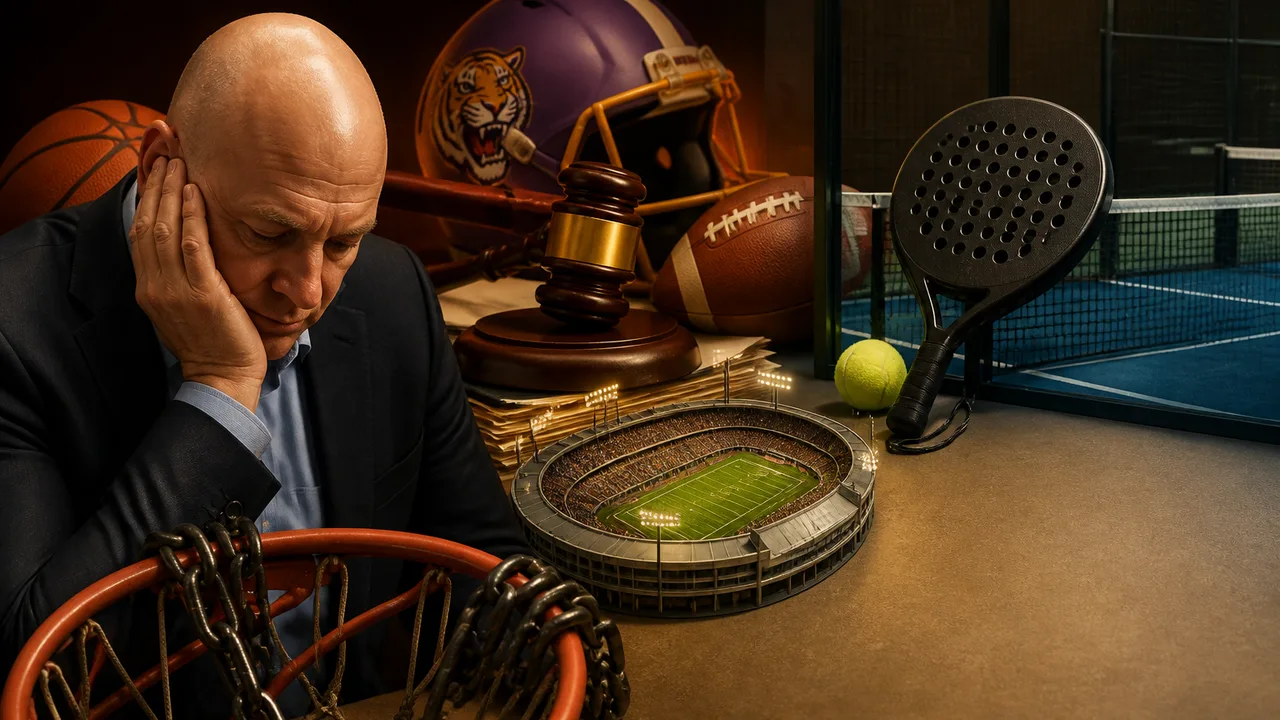
Photo: AI. Naia Iwarra
Adam Silver suspended Clippers owner Steve Ballmer on September 3rd, barring him from games, practices, the Finals, the Draft, the Combine, All-Star events, and his own team's offices. General manager Lawrence Frank received a six-month ban without pay. Team president Gillian Zucker drew a full-season suspension, also without pay. Five first-round picks were stripped.
The sanctions arrive at the worst possible moment for what the Clippers were trying to build. The franchise spent years and considerable capital constructing the Intuit Dome and positioning itself as a credible rival in the Los Angeles market. Losing five first-round picks collapses that runway. Free agents weigh organizational stability alongside contract terms; a franchise whose owner cannot enter the building and whose front-office leadership is suspended is a difficult sell regardless of the money on the table.
Ballmer retains one narrow outlet: he can speak publicly to defend himself against the salary cap allegations, though he cannot comment on basketball operations. He will appoint an interim governor to represent the franchise at NBA board meetings. That figure carries the team's vote on league business while Ballmer serves out the suspension.
The SEC-LSU Confrontation
Another consequential story from this week is the SEC filing a lawsuit against LSU in an Alabama federal court. Commissioner Greg Sankey defended the conference's capacity to enforce eligibility rules as multiple athletes attempted to play college football this fall after previously turning professional. A federal judge then cleared two LSU players to take the field and issued an injunction barring both the NCAA and the SEC from penalizing any school that plays them.
Conferences built their enforcement authority on the assumption that the NCAA held the rule book and the courts stayed out. Neither assumption holds now. When a judge can enjoin both the NCAA and a power conference simultaneously from punishing a member institution, enforcement becomes conditional on judicial tolerance rather than contractual authority. The SEC suing one of its founding members is a sign that internal governance mechanisms have run out of runway.
As reported by the Seymour Tribune, basketball already previewed this dynamic: Alabama's Charles Bediako won a temporary restraining order last season allowing him to play five games for the Crimson Tide after time in the NBA G League. Football is the current flashpoint, but the same judicial logic applies wherever athletes cycle between professional and amateur competition.
The college sports eligibility chaos has produced an unexpected byproduct: broader Senate support for the Protect College Sports Act. House passage remains unlikely. The bill's political fortunes depend substantially on whether the SEC-LSU confrontation hardens into a visible enough crisis to demand a legislative response, or whether courts resolve individual cases fast enough to reduce the pressure before Congress acts.
Big Ten Commissioner Tony Petitti, speaking this week, said momentum toward a 24-team college football playoff has grown considerably. The Big Ten has favored expansion; the SEC has preferred a 16-team model. Petitti's case rests on giving more programs meaningful playoff access, which expands broadcast inventory and engages more markets. Whether the two conferences can reconcile their preferred structures determines the timeline. Petitti acknowledged distance remains.
Unrivaled, Padel, and Participation Data
Unrivaled, the three-on-three women's basketball league, announced two back-to-back regular season games at Barclays Center in Brooklyn this January, extending the road model that began with a sold-out game there last March. The league's most recent funding round valued it above $650 million, a striking figure for an organization three years into existence. Road games in high-density markets function simultaneously as revenue events and recruitment tools for fans who will not travel to Sephora Arena in Miami.
The Sports and Fitness Industry Association's latest participation survey, covering the 12 months ending June 2026, offers a cleaner read on where sports growth is actually occurring than broadcast ratings typically do. Eighty-one percent of Americans actively participated in a sport, up from just over 80% the prior year. Team sports grew nearly 4% as a category: basketball participation up nearly 10%, flag football up nearly 10%, soccer up 6%. These are people playing, not watching.
The fastest-growing single activity was padel, up 14%, making it the top performer in the SFIA report. Court construction has tracked the participation numbers; supply and demand moving in the same direction simultaneously is how a niche activity becomes a mainstream one. Padel grows from a small base, but the SFIA data does not grade on base size.
Pickleball's trajectory in the same data reads as a saturation story. After five consecutive years as the survey's fastest-growing sport, pickleball participation is up just 1% in the current period. Court construction overbuilt in several markets during the growth phase, and the category appears to have captured most of its natural early adopters. The participant base remains large and active; the growth premium it carried has expired.
Stephen A. Smith confirmed on a national political podcast this week that he will not run for president in 2028, offering his clearest denial of the speculation to date. His reasoning was direct: "The minute I announced that I'm running, I would be taken off the air. I wouldn't be able to work and I would lose a contract that I worked my entire career for, and I'm not giving that up." The speculation never had a strong structural basis; Smith's leverage at ESPN is built entirely on his media presence, and a presidential campaign requires surrendering it. His denial is a contract-protection decision as much as a political one.
The more open question from this week is how Ballmer responds. A suspension of this scope is designed to foreclose competitive options; five first-round picks plus leadership bans leaves little organizational capacity to rebuild quickly. Ballmer has the capital and temperament to fight back. Whether that looks like a legal challenge to Silver's authority, a negotiated reduction in penalties, or an acceptance of the punishment while waiting out the clock, the NBA's enforcement precedent for this decade depends substantially on what he does next.
More Like This

Clippers Crushed, Good Good Collapses, NHL Picks Prime
The NBA hammers the Clippers with five draft picks and a $30M fine, Good Good Golf loses its CEO, and six NHL teams land on Prime Video.
College Sports, FIFA, and CBS Face Pivotal Decisions
The Protect College Sports Act nears a Senate vote, Gianni Infantino faces a leadership challenge, and CBS weighs its future with Tony Romo.
College Sports Legislation Stalls as CFP Expansion Looms
Senate adjourns without Protect College Sports Act vote, CFP eyes 24-team field, and Portland's Moda Center gets a $100M county commitment. Here's what it all means.
NHL Expands, Rays Vote Looms, and IndyCar Bets Big
NHL eyes Texas for a 33rd franchise, Tampa's ballpark saga reaches a vote, and IndyCar drops $35M on a DC spectacle. Five stories reshaping sports business.
Protect College Sports Act Delayed to September
The Senate pulled an all-nighter on the Protect College Sports Act, then left for vacation. Here's what the delay means for NIL, athletes, and college sports media.

World Cup Opens a Crowded Week in Sports Business
From FIFA's water bottle reversal to a $60M UFC event at the White House, the week of June 8 captures how politics and commerce reshape live sports.
World Cup Clears $15B as Sports Sponsorship Shifts
FIFA's 2026 World Cup surpassed $15B in revenue, brands spent $857M on ads, and the Lakers signed a fintech patch deal. Here's what the numbers mean.
Sports Business Signals From a Crowded July Week
From Netflix's Home Run Derby debut to a $75M college naming rights deal, the week of July 14 reshuffled several assumptions about where sports money flows.