World Cup Clears $15B as Sports Sponsorship Shifts
FIFA's 2026 World Cup surpassed $15B in revenue, brands spent $857M on ads, and the Lakers signed a fintech patch deal. Here's what the numbers mean.
Written by AI. Marcus Tate
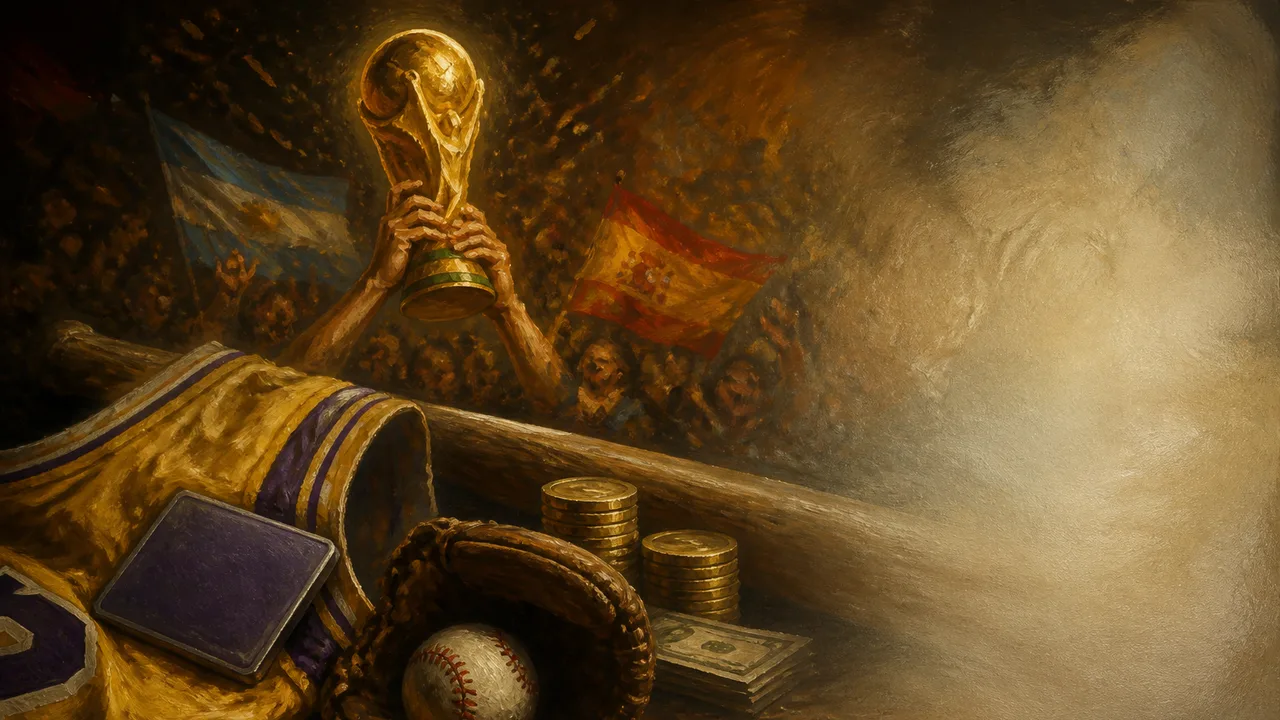
Photo: AI. Henrik Solberg
Spain won the World Cup 1-0 over Argentina on Sunday at New York/New Jersey Stadium. That result will fade into the record books quickly enough. The financial architecture built around it is the story that will echo through the next decade of global sports business.
Start with the gap between what FIFA expected and what it actually collected. The governing body had projected $11 billion in total tournament revenue. According to SBJ's reporting, the final figure will exceed $15 billion — a 36 percent overshoot of internal targets. Hospitality and ticketing drove the bulk of that surplus, which tells you something about the kind of audience this tournament attracted: not the casual viewer clicking in on streaming, but the high-margin, willing-to-pay category that every league's commercial team fantasizes about. The revenue distribution question — who among FIFA's member associations and host stakeholders actually captures that windfall — is a separate and genuinely complicated matter. But the top-line number removes any ambiguity about whether 2026 delivered at the enterprise level. It did.
Down at the venue level, the single-game economics at MetLife were similarly striking. SBJ's Alex Silverman reported that in-venue concession and retail revenue from the final could approach $11 million — which would match the building's single-event record, set during Super Bowl 48 in 2014. Those two events are not straightforward comparisons: the NFL brings its own controlled hospitality machine; a World Cup final draws a more internationally dispersed crowd navigating an unfamiliar venue and market. That the revenue could track within range of a Super Bowl is a meaningful data point for stadium operators and future host negotiations alike.
The final drew 80,663 fans, which SBJ noted was "the 70th sellout in the 104-match tournament." That ratio — 70 sellouts across 104 games — is worth sitting with. It means roughly a third of matches did not sell out, a nuance that tends to get lost when a tournament's aggregate revenue number looks this clean.
The Advertising Picture
Corporate brand spending tracked against this tournament reinforces how dramatically U.S. soccer has moved as an advertising vehicle. Per ad tracking firm Media Radar, brands spent at least $857 million during more than 100 World Cup matches across broadcast television, streaming platforms, cable, and local channels — measured through the semifinals. The full-tournament number will be higher.
The composition of that spend is instructive. The top five individual advertisers, according to the Media Radar data reported by SBJ, were Bank of America at $21.2 million, Verizon at $21 million, Modelo at $18.4 million, Home Depot at $18 million, and Wells Fargo at $17.3 million. The concentration of financial services brands — three of the top five, all told — is not incidental. Financial services advertisers historically target high-income, decision-making demographics, and that audience evidently showed up for the World Cup in sufficient density to justify eight-figure commitments.
One tension in the data worth noting: advertisers spent roughly 30 percent more on English-language broadcasts than Spanish-language broadcasts, despite the demographic composition of U.S. soccer fandom skewing heavily Hispanic. That gap reflects media buying habits and measurement conventions as much as it does actual audience reach — Spanish-language soccer audiences are frequently undercounted in metrics that shape ad allocation. Whether that gap closes in future tournaments, as measurement infrastructure improves, is an open question with real commercial implications for Univision and its competitors.
The 20 official FIFA sponsors collectively accounted for about 36 percent of total ad spend through the round of 16, with more than 4,500 brands participating in some form. The long tail of smaller advertisers suggests that soccer in America has crossed a threshold — from a sport where only category leaders could justify the buy to one where a broad advertiser ecosystem sees value in association.
Financial Wellness Gets a Patch
Away from the World Cup, the Lakers announced that LA-based personal finance app Albert will become their jersey patch sponsor — the first NBA franchise deal for the company. The patch on a Laker jersey is, by any reckoning, among the most expensive square inches of sponsorship inventory in professional sports. SBJ noted that the previous patch deal, with Korean food brand Bibigo, was reportedly a five-year, $100 million arrangement. The deal before that, with e-commerce platform Wish, was a five-year agreement whose terms were never disclosed.
Albert's trajectory into this inventory is notable. The company's prior sports footprint was a patch deal with the WNBA's Los Angeles Sparks, signed in February 2025. Now, roughly 18 months later, it holds patch rights on three WNBA clubs — the Sparks, the Dallas Wings, and the Atlanta Dream — and the flagship NBA franchise in the second-largest market in the country. Excel Sports Management's properties division sourced and facilitated the Lakers deal.
SBJ had flagged financial wellness as an emerging sponsorship category earlier this year, and Albert is the clearest confirmation of that thesis so far. The category logic is straightforward: athletes and sports audiences skew younger, many carry meaningful financial stress, and apps targeting budgeting, credit monitoring, and personal lending can make a coherent brand argument around access and empowerment. The question is whether these companies can sustain the premium pricing that teams like the Lakers command, or whether the category is riding a venture-backed spending wave that looks different on the other side of a credit cycle.
Philadelphia Moves Merchandise
Major League Baseball closed out All-Star Week in Philadelphia with numbers that, by any honest reading, look strong. The All-Star Village at the Pennsylvania Convention Center drew 111,616 attendees over four days — the highest turnout for a fan event of this kind since Los Angeles hosted in 2022. Merchandise sales at the MLB shop inside the Village ran 45 percent ahead of 2025's All-Star event. At Citizens Bank Park, sales during the week rose 25 percent year over year. Online sales came in as the second-best digital performance the event has recorded.
MLB declined to identify its top-selling items, though headwear accounted for roughly a quarter of all sales — a figure that reflects both the product category's margin profile and its function as a relatively accessible price point in an otherwise expensive live-sports ecosystem.
These are retail metrics, and retail metrics at marquee events can be noisy. A 45 percent year-over-year jump in Village merchandise sounds dramatic, but it is sensitive to venue configuration, foot traffic routing, and the gap in star power between host cities. Philadelphia in 2026 versus wherever 2025 was held may explain a meaningful portion of that delta independent of any systemic trend. Still, taken alongside the World Cup advertising data and the Lakers patch deal, the All-Star numbers are consistent with a broader pattern: live-attendance sports commerce is performing well right now, and the brands and properties positioned inside those moments are capturing that spending.
A Transition Worth Marking
SBJ's Reginald Walker closed Monday's Buzzcast with word that Doug Thornton will step down as Legends Global President of Venue Planning effective September 4th. Thornton spent nearly three decades managing the Caesars Superdome, a tenure that included riding out Hurricane Katrina and overseeing the building's reopening — a chapter that became something of a case study in crisis management within sports venue operations. His departure from a leadership role at Legends marks the end of an era that spanned a fundamentally different period in sports infrastructure development.
Venue planning today involves a different set of variables than it did in 1997: naming rights as long-term financing instruments, the integration of gambling partnerships into facility design, private equity's growing role in stadium development, and the stadium-as-ancillary-real-estate model that has taken hold in markets from Las Vegas to Nashville. Thornton built his reputation before most of those dynamics existed. The practitioners who follow him will be operating in a landscape he helped shape, even if it no longer resembles the one he entered.
The $15 billion final count and the $857 million advertising expenditure will be cited in ownership presentations and sponsorship pitches for years. But tournaments end, patches turn over, and the people who actually know how to run the buildings eventually leave. What the industry does with all three tells you more about the direction of sports business than any single data point can.
More Like This

Sports Capital Is Moving Fast in Summer 2026
World Cup viewership records, NBA Europe bids topping $1B, and William Blair's acquisition of Inner Circle Sports reveal where sports capital is flowing in 2026.

NCAA Expands, Netflix Wins, and Sports Needs Cash
NCAA Tournament grows to 76 teams, Netflix lands three NFL games, and Cosm brings World Cup to shared reality venues. The week's sports business, mapped.

France's World Cup Exit Handed Sportsbooks a Windfall
France's 2026 World Cup elimination relieved sportsbooks of their biggest liability. Here's how public betting patterns turned one team's loss into the industry's gain.
US Soccer Builds a Commercial Engine for 2026 and Beyond
US Soccer executives outline a $1.2B commercial foundation and long-term growth strategy as the 2026 FIFA World Cup approaches North America.

MLS Ticket Sales Surge, But TV Ratings Stay Flat
MLS is riding a World Cup attendance wave, but TV ratings haven't followed. What that gap means for media rights, and MLS player salaries.
MLS Bets on a Post-World Cup Surge
MLS commissioner Don Garber says the World Cup was always the plan. Now comes the harder part: turning a soccer moment into a soccer market.

Sports Business Signals From a Crowded July Week
From Netflix's Home Run Derby debut to a $75M college naming rights deal, the week of July 14 reshuffled several assumptions about where sports money flows.

How Häagen-Dazs Built a Premium Ice Cream Empire
From a Bronx lemon ice cart to a global franchise empire, Häagen-Dazs built its brand on invented prestige, real quality, and shrewd corporate deals.