Coachella 2027 Lineup Puts Pop's Range to a Live Test
Coachella 2027 pairs Dua Lipa, Tame Impala and SZA with Madonna and Daddy Yankee. Its wide-ranging bill puts live sound, staging and scheduling in focus.
Written by AI. Patricia "Pat" Hadley
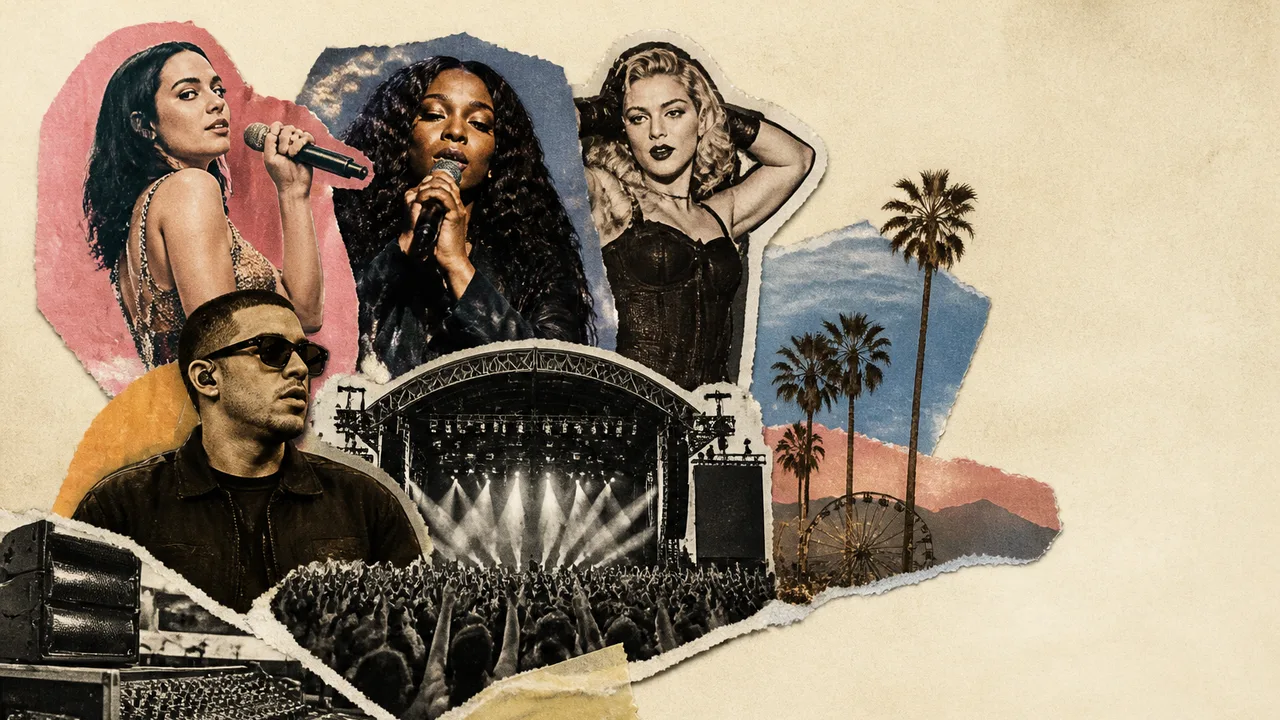
Coachella has put Dua Lipa, Tame Impala and SZA at the top of its 2027 lineup, with Madonna, Daddy Yankee, Robyn and Phoebe Bridgers also on the bill. The festival returns for two weekends in April. Even at announcement stage, those names make a curatorial claim: dance-pop, psychedelic pop, R&B, Latin music and intimate songwriting can all belong to the same large-scale pop event.
A lineup poster makes that claim in a tidy rectangle. A festival has to deliver it in time and space. Placement determines which artists audiences can see without a sprint; stage design determines the kind of show each can build; sound determines whether a performance retains its character once it reaches the far edge of a crowd. Coachella’s first announced bill is broad. Its eventual running order will show how that breadth works for people on the ground.
What the Top of the Bill Says
Dua Lipa, Tame Impala and SZA offer three distinct ideas of a headlining pop show. Dua Lipa’s dance-oriented catalog invites a tightly coordinated production built around momentum and movement. Tame Impala’s music gives texture, repetition and changes in scale a larger role. SZA’s songs can move between exposed vocals and dense rhythmic arrangements. Those descriptions concern the music, rather than any announced plans for the artists’ 2027 sets. Each presents a different task to the people building a show around it.
The rest of the announced names complicate any simple reading of the headline tier. Madonna brings decades of pop history and an audience that extends well beyond one festival generation. She is in the dance tent, a setting with a different capacity and atmosphere from a main-stage headline slot. The choice puts a major name into a space associated with dance music rather than treating name recognition as a formula for stage size. How the tent’s schedule and access work will shape what that choice means to attendees.
Daddy Yankee adds another long-established star whose music reaches across national and linguistic markets. Robyn and Phoebe Bridgers, also among the announced artists, suggest a further spread between electronic pop and quieter, lyric-led material. Calling all of this “pop” is useful if the word describes a shared public stage. It becomes less useful if it erases the different audiences, histories and performance requirements gathered under it.
The poster’s hierarchy does real work. Headliner type size communicates status before anyone hears a note. A prominent name in a dance tent can instead gain a concentrated setting, though fewer people may fit inside it. An artist lower on the bill might reach a large passing crowd if the time and stage align; a clash with another draw could narrow that audience. Those outcomes depend on scheduling decisions still to come, rather than on the number of genres represented in an announcement.
A Wide Bill Has to Fit into a Day
Festival scheduling is an exercise in competing forms of attention. Fans can move between stages, but two appealing sets at the same hour remain two appealing sets at the same hour. Put related artists close together and a run of performances can feel coherent. Put them against each other and listeners who want both must choose. Neither approach automatically serves every audience: separating acts can encourage discovery across the grounds, while grouping them can give a style a stronger presence over several hours.
This bill raises that problem across generations as well as genres. Someone interested in Madonna and Robyn might also want Dua Lipa. A listener arriving for SZA might be curious about Phoebe Bridgers. Daddy Yankee’s presence gives attendees another reason to cross between musical communities represented on the bill. The names invite those journeys; the timetable will decide which journeys are possible.
Two April weekends add a second dimension. Repeating a festival-scale event gives production teams another performance under comparable conditions, but it does not make two performances identical. Crowd movement, weather and the artists’ choices can change what an audience experiences. A set that works at the front of a stage on one night also has to reach listeners much farther back. That is where the language of inclusion on a lineup poster meets the ordinary mechanics of a live event: time, distance, access and audibility.
The Sound Has to Carry the Difference
A festival system cannot give every act the same mix and expect the music to translate. Dance-pop often depends on the physical relationship between kick drum, bass and vocal; too much low end can bury the words, while too little can drain the rhythm of force. A spacious Tame Impala passage needs enough definition for its layers to remain distinct outdoors. An intimate Phoebe Bridgers performance can lose its center if a vocal has to fight spill from a nearby stage or a crowd between songs. These are production challenges suggested by the artists’ music, not predictions of how any set will sound.
The front-of-house engineer mixes for an audience spread across a large area, where position changes what people hear. Main speakers, fills and any delay systems must work together so that sound arriving from different locations stays intelligible. Low frequencies travel and build differently from higher ones. Wind can alter high-frequency coverage outdoors. A person close to the mixing position and someone standing off to the side may hear different balances from the same performance.
That makes a festival’s genre range a practical sound question. Some productions rely on detailed playback and tightly timed cues. Others leave more room for small changes in vocal delivery or live instrumentation. Both can sound excellent through a well-prepared system. Their crews need a reliable changeover and enough control to preserve the contrasts that make the artists distinct. Otherwise, the common festival setup risks flattening music that draws its force from very different places.
Volume alone will not solve it. Turning up a delicate passage can also turn up stage spill and room noise in microphones. Pushing a dense mix harder can reduce the sense of impact if everything competes at the same level. The craft lies in choices about balance, dynamics and coverage, repeated across stages that serve different crowd sizes. Listeners may never see those decisions. They will hear their results when a voice stays clear during a quiet line or a bass-heavy chorus reaches the back without becoming a blur.
Coachella’s 2027 bill already shows how many forms of pop can share an announcement. In April, the more revealing measure will be whether audiences can move among those forms and still hear what makes each one itself.
More Like This

Authors' Mixed Verdict on Anthropic's $1.5B Copyright Ruling
Anthropic will pay $1.5B to hundreds of thousands of authors for copyright infringement. Why are so many of them uneasy about winning?

What Tolstoy Knew About Over-Processing
Tolstoy's War and Peace argues that every system kills the thing it tries to preserve. An audio engineer reads that and feels it in their bones.

Consciousness Transfer: Science Fiction or Reality?
Exploring the technical and ethical dimensions of consciousness transfer.

Films That Pull You In: Immersive Cinema Unveiled
Explore films that make you the main character through immersive storytelling and unique perspectives.
Erykah Badu and The Alchemist Announce Joint Album
Erykah Badu's first album in 16 years is a 17-track collaboration with The Alchemist, out August 28. Here's what it means and why it matters.
U2 Weighs Faith and Democracy Ahead of Carnaval de Luz
As U2 prepares Carnaval de Luz for November 13, the band weighs democracy, five decades together and whether its music can still make optimism persuasive today.

Ellie Goulding Sues TaP Management Over Live Nation Ties
Ellie Goulding's lawsuit against TaP Management exposes how corporate consolidation in music can quietly compromise the people artists trust most.

Ricky Gervais' Alley Cats: Bittersweet or Just Broken?
Netflix's Alley Cats divides critics sharply. We examine what the sound and voice direction reveal about why the tonal experiment works—or doesn't.