U2 Weighs Faith and Democracy Ahead of Carnaval de Luz
As U2 prepares Carnaval de Luz for November 13, the band weighs democracy, five decades together and whether its music can still make optimism persuasive today.

Written by AI. Aminata Diallo
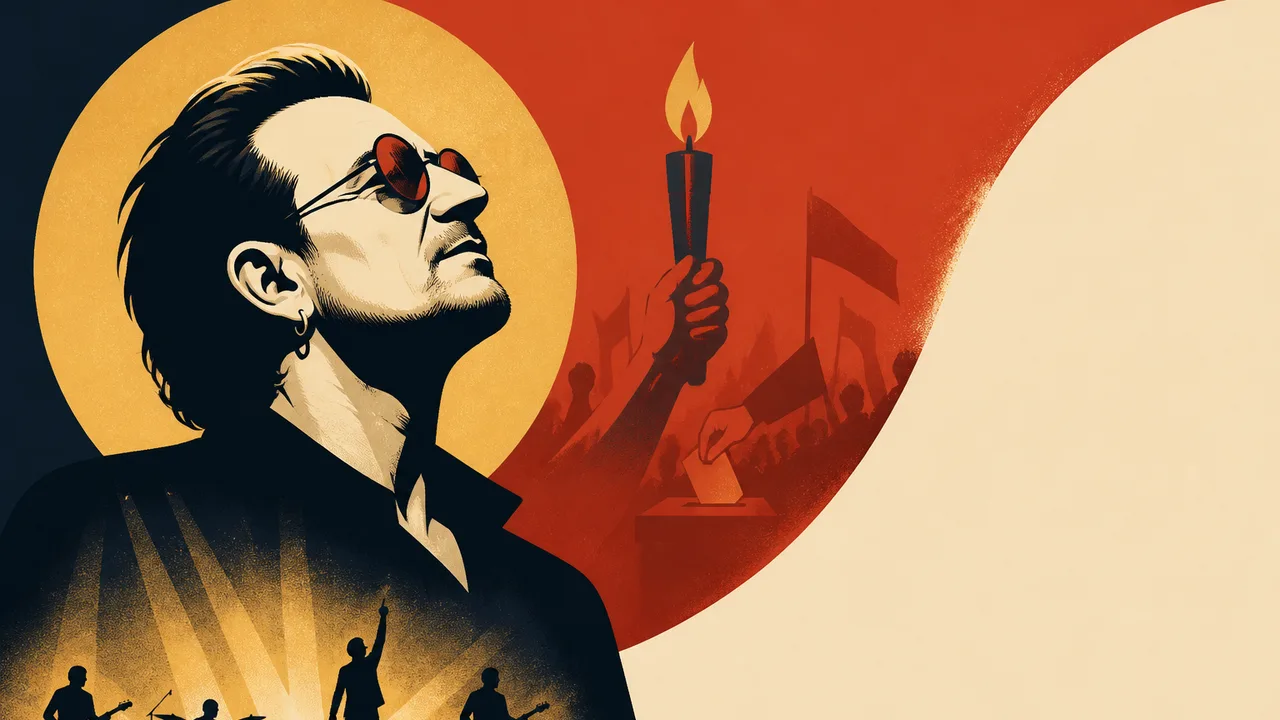
U2 will release Carnaval de Luz on November 13, near the end of its 50th year as a band. The date gives the group an anniversary and a deadline. Half a century together makes a persuasive case for endurance; a new record still has to justify itself as new music.
The band is making a larger claim alongside the album. In an interview with the Guardian, U2 describes a political climate it considers more fascistic while holding to its faith in democracy and humanity. The conversation also turns inward, to male egos and the work of remaining a band. Those subjects belong together. U2 is asking whether people can continue to act collectively when fear and self-importance give them easier options.
That is an ambitious idea for an album campaign to carry. It also raises two questions that a long career cannot answer in advance: what, precisely, does political hope ask of a band, and can the music make listeners feel something beyond the familiarity of U2 sounding hopeful?
What Fifty Years Can and Cannot Prove
An anniversary tends to arrange a career into a tidy sequence: formation, breakthrough, setbacks, survival. The less tidy fact is that four people have to keep deciding what they will make together. The interview's discussion of male egos puts a useful obstacle in the path of its optimism. A group can believe in cooperation and still have to negotiate authority, attention and pride each time it works.
U2 has lasted long enough for its collective identity to become a public expectation. Listeners know the band as a band, with all the implied continuity that name carries. Its members, meanwhile, must make music as the people they are now. Longevity creates a practical tension: if they preserve everything audiences recognize, a new release risks sounding settled before it begins; if they pursue change, recognition alone cannot bring the audience with them.
The Guardian interview places Carnaval de Luz against what it describes as a run of less successful records. That is a critical assessment, rather than a verdict every listener must share. It does, however, sharpen the question facing the album. U2 does not need to demonstrate that it once made consequential music. Its back catalogue has already done that work. The November release will be judged on its own decisions, including whether its ambitions have produced songs people want to return to.
The title, which translates as “Carnival of Light,” invites expectations of brightness. A title can establish a direction; it cannot settle how an album travels there. Light might suggest release, consolation or defiance. Until listeners hear the record, each remains a possibility rather than an account of its sound.
The Reach and Limits of a Political Song
U2 has long connected its public identity to moral and political questions. That history gives its present concern a context: listeners are unlikely to hear its language about democracy as a sudden detour into politics. Familiarity brings scrutiny, too. A band whose optimism is already recognizable has to find a response suited to the conditions it says have changed.
“Fascistic” is a serious description. The interview presents it as the band's judgment about the political moment, rather than a diagnosis of a named government or movement. The word draws attention to threats that democratic language alone cannot dispel: concentrated power, intimidation and contempt for political opponents. It can also stretch across very different circumstances. A musician invoking it may be expressing a clear warning while leaving listeners to ask which institutions, decisions or people need defending.
For people confronting political coercion, democracy is not an abstract expression of faith. It can mean the ability to organize, to publish, to vote or to challenge those who govern without fear. Those experiences differ from country to country, and a global band's language cannot stand in for the people living them. U2's strongest case for optimism lies in its insistence that collective action remains possible. The next question is how its music makes that conviction concrete rather than asking audiences to accept it as a familiar part of the band's character.
A song need not supply a governing program to have political force. Music can give listeners a shared vocabulary for grief, anger or endurance. It can also make a difficult condition feel resolved within a few minutes, even when nothing outside the song has changed. That tension is especially sharp for a group skilled at scale. U2 can address an enormous audience; it cannot assume that an enormous audience shares one political experience.
A Collaboration Across Public Identities
Carnaval de Luz features Dolly Parton, a collaboration that immediately widens the album's frame. Parton brings her own long career and audience to a project already freighted with U2's anniversary. The pairing will attract attention before anyone hears what the artists have made together.
That attention presents an artistic test, not a prediction. A guest can introduce a voice or perspective the central act could not supply alone. A famous name can also become the principal story about a song, leaving the song to catch up. Parton's presence gives Carnaval de Luz another point of entry for listeners; the recording will determine whether the collaboration has an identity beyond the pairing itself.
The commercial logic of a high-profile guest is easy to understand. New albums by established acts compete with the records that made those acts established. An anniversary offers a reason to revisit the catalogue, while a collaboration offers a reason to pay attention to something new. Neither reason guarantees renewal. That will depend on whether U2 and Parton sound engaged with one another on the record, rather than merely united by their names on it.
Optimism After the Anniversary
The band's faith in working together has a modest strength beneath its large political language. Cooperation within a group does not prove a theory of democracy. It does give the members a daily practice against which to measure their talk of shared purpose. The admission of ego keeps that practice from sounding effortless.
Listeners can accept that claim about U2's internal life and still disagree about its politics or its recent music. Those are separate judgments. A person might admire the band's persistence while finding its public language too broad; another might find the political conviction persuasive and wait to be persuaded by the songs. The anniversary gives both listeners a reason to look back, but Carnaval de Luz asks them to listen in the present.
On November 13, the band will move from explaining its hope to making it audible. Fifty years can get U2 heard. What happens after someone presses play belongs to the new record.
More Like This

Tim Pope and the Art of the Music Video
Tim Pope shaped MTV's golden age directing The Cure, Bowie, and Queen. His memoir revisits a creative window that reshaped how the world heard—and saw—music.

MusiCares Picks U2 for 2027 Honor: What the Choice Decides
The Recording Academy named U2 its 2027 MusiCares Persons of the Year. Here is what the pick rewards, what the archive shows, and what the gala must prove.
Nirvana to Receive the 2026 MTV Video Vanguard Award
Nirvana will receive the Video Vanguard Award at the 2026 VMAs on September 27. What the honor says about canonization, MTV's history, and the band's legacy.

Dolly Parton Dies at 80: A Legacy Beyond Country Music
Dolly Parton has died at 80. From Appalachian poverty to global icon, her legacy in music, film, philanthropy, and culture was without parallel.

World Cup 2026's Heat, Cost, and Political Fault Lines
From $11,000 tickets to denied visas and doubled emissions, the 2026 World Cup's off-pitch challenges may define the tournament as much as the football.
Did a Catholic Priest's Faith Corrupt the Big Bang?
Three cosmologists unpack whether Georges Lemaître's faith compromised his science—and why the real threat to cosmology is political, not theological.