Céline Dion's Paris Return: Defiance, Craft, and Open Questions
Céline Dion's first concert in six years at Paris's Plenitude Arena reopens the question of what a live career looks like when illness can't be edited out.

Written by AI. Amara Osei
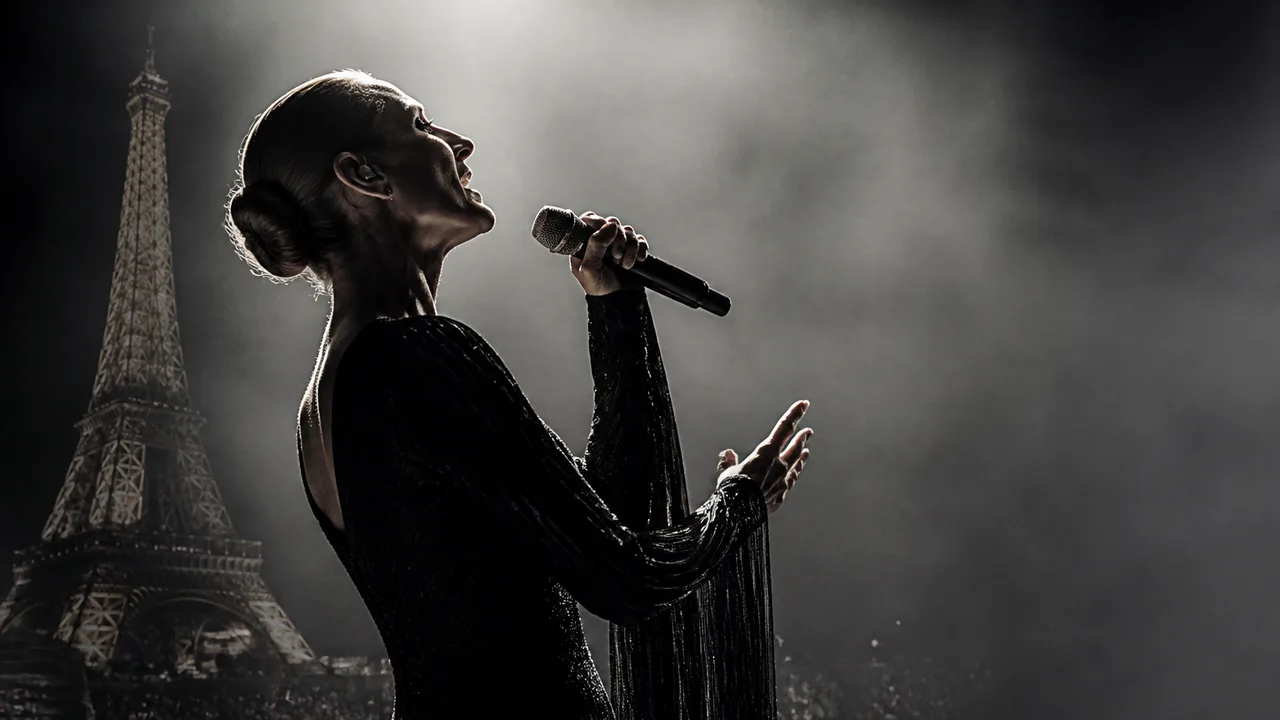
Céline Dion opened her Paris residency at Plenitude Arena on Saturday with her first full concert in six years, and the room knew it was watching more than a show. Four years have passed since Dion announced she had been diagnosed with stiff-person syndrome, the rare neurological condition the Mirror describes as "an extremely rare and devastating neurological condition that causes severe muscle" spasms (mirror.co.uk). Between the diagnosis and Saturday, her only appearance on a stage came at the Paris Olympics opening ceremony in 2024. So when she walked out at Plenitude Arena, the audience was not measuring her against last week's setlist; they were measuring her against the question of whether this voice would ever tour again.
What they heard, by every account filed since, was a performer in command of her instrument. NPR reported the return as a genuine homecoming after "battling rare illness" (npr.org). Consequence called it triumphant and documented the full setlist with performance footage (consequence.net). Billboard counted nine best moments from opening night and noted that Dion "cries happy tears" in Paris (billboard.com).
What the Speech Set Up
The evening's emotional architecture ran through Dion's own words as much as her songs. Variety reports that she delivered a tearful speech on opening night, telling the crowd "I had promised myself not to cry" (variety.com). NME quotes her going further: "I made a promise to be back on stage, so here I am" (nme.com).
Listen to those two lines side by side and you hear a performer managing her own narrative in real time. The first is a confession of vulnerability. The second is a contract with the audience: promise made, promise kept. Dion has always understood the theatre of sincerity; her Las Vegas residencies were built on the premise that a pop star could be a reliable, repeatable presence, a fixture rather than a spectacle. Saturday's speech extended that logic. The comeback was not just announced; it was witnessed, in a room full of people who had bought tickets to the witnessing.
The Reviewers' Frame, and Its Limits
The Guardian's review carries the headline "Céline Dion Makes the Stage a Site of Defiance," and its argument is that the show was charged with more than comeback nostalgia: the physical act of returning to live performance became part of the evening's meaning (theguardian.com). AOL, running the same review, notes that Dion "wiped away tears and belted out the notes, giving an astounding performance" (aol.co.uk).
The Guardian also flagged a programming choice that cut against the expected script: "Beauty and the Beast," a song Dion has sung thousands of times, surfaced as an unexpected highlight. The reviewer's framing is that nobody attends a Dion show expecting the avant garde; you go to hear the hits, and the surprise here was how one of the most familiar songs in her catalogue landed with fresh weight (newsbeep.com). The published material available to me does not confirm whether she performed both vocal parts as a solo; the Guardian's review highlights the song without specifying the arrangement, and Consequence's setlist coverage does not settle it either. What can be said with confidence is that the song stood out precisely because it is so worn: a duet performed for three decades, suddenly carrying the charge of a woman singing it six years into her last full tour. The audience will have filled in the absent voice themselves. Whether Dion chose the duet for its history or for its echo, the review only lets us feel the effect.
The Guardian's account also singles out a run of "J'irai où tu iras" as one of the surprises in the set, a French-language detour that reminded the Plenitude Arena crowd, on home ground in a sense, that Dion's catalogue is bilingual and her identity is not a Vegas export (newsbeep.com).
The Mirror took a different angle, framing the return as vindication under a headline about a "show-stopping Paris return" that "proves doubters wrong" (mirror.co.uk). That framing deserves a beat of scrutiny. Who were the doubters, exactly? The record shows Dion withdrew from touring in late 2023 as the condition worsened; the reasonable response at the time was concern, not skepticism. The Mirror's construction turns medical reality into a contest of wills, which is the exact move the Guardian's review tries to resist when it warns against reducing an artist to her resilience.
The Thing the Clip Packages Miss
Here is what a radio producer's ear notices when reading the coverage: almost every outlet reached for the tears. Variety led with them. Billboard made them one of nine moments. AOL's summary has Dion wiping them away mid-belt. The tears are the media's unit of account for this story, the divisible part that travels.
Consequence's setlist rundown shows a show built like a working concert, with pacing and arrangements, not a one-song symbolic gesture (consequence.net). The Guardian's strongest observation is structural: the return itself became the event's meaning, which means the show succeeded as a show first. Stiff-person syndrome attacks the muscles involved in breathing, posture and vocal control, the entire physical instrument a singer depends on. For that instrument to carry a two-hour arena set, the performances between songs, the breath management, the key choices, all of it had to be engineered around limits. None of the coverage tells us how. That absence is telling: the industry still reviews the voice and ignores the rigging.
What Six Years from Now Looks Like
The open question nobody at Plenitude Arena had to answer on Saturday is sustainability. A residency format is the obvious accommodation: shorter runs, controlled environment, no tour bus, no thirty-city grind. Dion's own history in Las Vegas proves she can build a career on stability rather than movement. But a residency also shrinks the risk surface in a way that changes what we are watching. If every future show is a negotiation between a progressive condition and a catalogue built on sustained belting, each night becomes a small act of engineering, and the question shifts from "can she still do this?" to "how long can the architecture hold?"
The Guardian ends its review with Dion as defiance; the Mirror ends with vindication. Both framings ask the audience to feel something about her body. Dion, who has spent forty years making the impossible sound easy, now has a chance to make the difficult sound honest. The Paris audience got the first installment. Whether the residency becomes a document of endurance or of artistry will depend on what she programs next, and on whether the coverage learns to listen past the tears.
Amara Osei
More Like This
Six Hospitalized at Angine de Poitrine's Montreal Jazz Fest Show
Six people were hospitalized after Angine de Poitrine's record-breaking free set at Montreal Jazz Festival. What the incident reveals about sound, crowds, and live event safety.
Lily Allen's West End Girl Tour and the Fourth Wall
Lily Allen is defending her West End Girl tour's fourth-wall staging. But the real debate is acoustic — what happens to sound when a pop show refuses to speak to the room?
Reassessing the Queens of Numenor
Explore the nuanced reigns of Numenor's queens and their impact.
Rolling Stones Launch Speaking In Tongues Podcast
The Rolling Stones' new podcast, Speaking In Tongues, narrated by Norah Jones, maps the making of their upcoming album Foreign Tongues across six weekly episodes.
When the Dugout Won't Shut Up: A Baseball Ejection
A Jomboy Media breakdown captures a manager's ejection over check swing calls—and accidentally maps everything broken about baseball's officiating culture.
MLB Replay Failed Gage Workman. Jomboy Caught It.
Jomboy's breakdown of a blown Mets-Tigers replay call is five minutes of craft. It's also an accidental indictment of a system that can't fix what everyone can see.