Britain's 19-Day September and the Politics of Time
In September 1752, Britain skipped 11 days overnight. The Calendar Act wasn't just a fix—it was a declaration about who controls time and who pays the price.

Written by AI. David Oyelaran
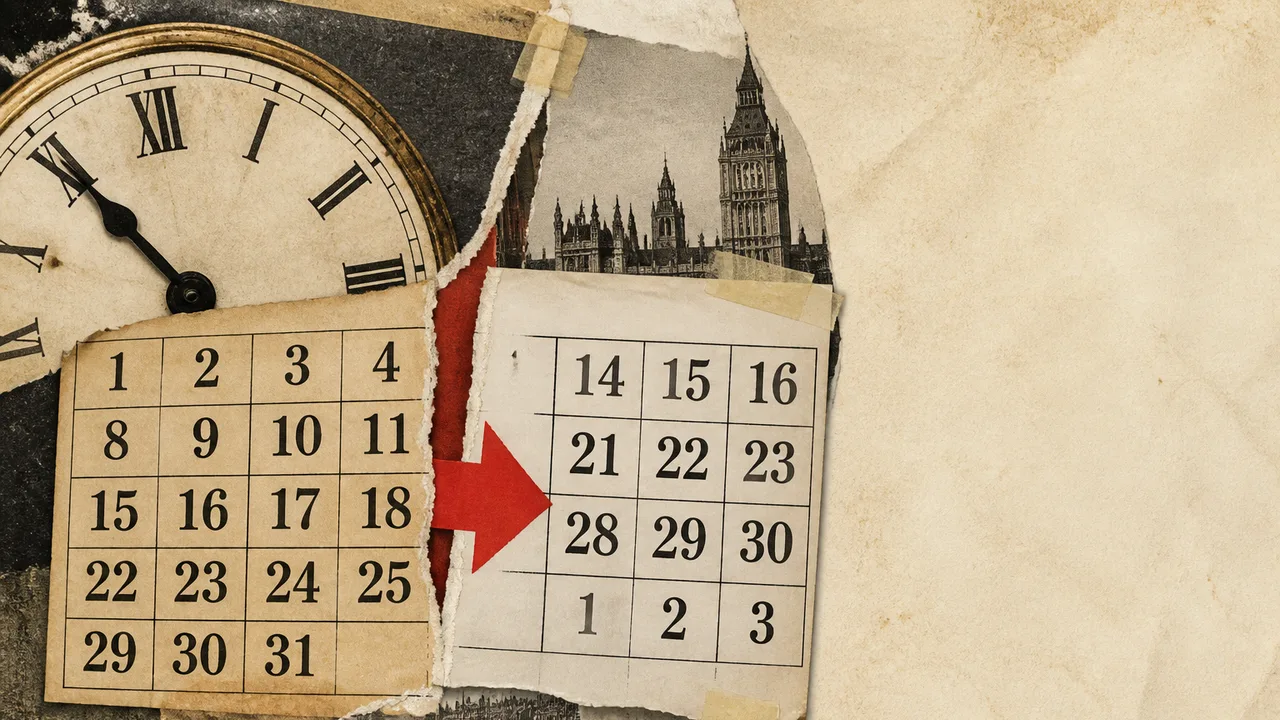
John Wesley went to bed on September 2, 1752, and woke up on September 14th. He didn't sleep for eleven days. Eleven days simply ceased to exist — not metaphorically, not bureaucratically, but in the fullest sense the calendar allows. If you looked for September 3rd, you wouldn't find it. September 10th: gone. The memoirist, the Methodist preacher, the man who rode 250,000 miles on horseback and filled his journals with meticulous daily record — Wesley kept writing through the transition as though the calendar were a minor administrative matter, which tells you something about the kinds of people for whom it was.
For everyone else, it was something else entirely.
Britain had been running on the Julian calendar — designed under Julius Caesar, refined by Augustus, anchored to a solar year of 365.25 days — for the better part of two millennia. The problem, known for centuries but politically inconvenient to address, was that the Julian year was slightly too long. By "slightly," I mean about eleven minutes per year. Eleven minutes sounds like nothing until you run the math across sixteen centuries, at which point those eleven minutes become ten full days of drift. The seasons crept forward. The astronomical spring arrived before the calendar said it should. The date of Easter, which the entire Christian liturgical year organized itself around, floated further from its intended anchor.
Pope Gregory XIII solved this in 1582, trimming the calendar and introducing the correction mechanism that makes the Gregorian system more accurate: century years would only be leap years if divisible by 400. Catholic Europe adopted it immediately. Britain, deep in the convulsions of Protestant identity and reflexively suspicious of anything emanating from Rome, declined. For 170 years, Britain and its colonies operated on a different counting of days than most of Europe, which created the exact kind of bureaucratic chaos you'd expect: dates that didn't match across the Channel, contracts that confused both parties, correspondence that arrived "before" it was sent depending on which calendar you used to read the postmark.
The Calendar (New Style) Act of 1750 finally forced the issue. Parliament legislated that September 2, 1752 would be followed immediately by September 14, 1752. Eleven days, vanished by Act of Parliament. The month of September that year ran to only 19 days, as the Grapevine Library's genealogy blog documents: "September 2, 1752 was followed by September 14, 1752. As a result, a problem arose regarding aligning the calendar in use in England with that of Europe. Britain was now eleven days out of sync, so it was necessary to correct it by dropping eleven days from the calendar."
Britain and its American colonies made the switch simultaneously — the Act applied across the empire — which is why George Washington technically had two birthdays, and why early American genealogical records produce dates that seem, to modern eyes, to contradict each other depending on which calendar the record-keeper was using at the time.
Wesley took it in stride. The tradesmen and tenants did not.
The popular legend — repeated for centuries, though historians debate its precise documentary basis — holds that crowds gathered in the streets demanding that Parliament "give us back our eleven days." The image is almost too good: ordinary people in the streets of London, furious about the theft of nearly a fortnight from their lives. The painter William Hogarth immortalized the slogan in his 1755 election series, scrawled on a banner in the chaos of An Election Entertainment. Whether the protests were widespread or isolated, panicked or theatrical, is genuinely unclear from the surviving record. What isn't unclear is why people would have been agitated.
Think about what eleven days meant to someone whose livelihood ran on time. A tenant whose lease expired September 3rd suddenly found that date had never arrived — but did his landlord agree about what that meant for the rent? A laborer owed wages for work done in the gap had no legal date attached to the work. A merchant who'd promised delivery by September 10th faced a delivery date that simply didn't exist. These weren't philosophical concerns about the nature of time. These were bread-and-butter disputes about money, obligation, and legal standing. Parliament tried to address some of this — the Act included provisions attempting to ensure that annual payments and legal terms would not be accelerated or extended by the calendar change — but legislation is a blunt instrument against the specific texture of individual arrangements that weren't written with a calendar crisis in mind.
The human cost distributed unevenly, as it always does. The men who drafted the Act — Lord Chesterfield, who championed it in the Lords; George Parker, the astronomer who provided the technical rationale — understood the astronomical problem clearly. What they couldn't fully anticipate was the experience of waking up on a September morning and discovering that the month had shed nearly two weeks while you slept. Wesley could absorb that. His calendar was largely spiritual, his schedule largely self-directed, his institutional standing largely secure. The people in the streets outside his preaching halls were working with tighter margins.
There's a novel buried in those eleven missing days — maybe several. The dates September 3 through September 13, 1752, are the only dates in British history that never happened to anyone. No one was born on September 7, 1752, in England. No one died on September 11th. No contract was signed, no letter dated, no prayer offered on those mornings. They are a gap in the record that is not a gap in the record — a kind of authorized absence. I find myself drawn to what sits in that absence: the stories that couldn't be told because the days to tell them in were legislated away before they arrived.
That's not just philosophically interesting. It's the shape of how power works on ordinary life. The calendar reform was genuinely necessary — the drift was real, the confusion with Europe was real, the astronomical misalignment was real. No serious historian argues that Britain should have stayed on the Julian system. But "necessary" and "costless" are not synonyms, and the costs of this particular correction landed on the people least able to negotiate around them.
Sovereignty over time is sovereignty. The power to declare which days exist — to determine, by legislative fiat, that September 3rd will not occur this year — is a remarkable kind of authority. Britain exercised it in 1752 with relatively little drama in the formal record, which is itself a historical statement. The people most disrupted left fewer letters, fewer diaries, fewer petitions that survived. Wesley's journals endure. The tenant whose lease evaporated into the gap between the 2nd and the 14th mostly did not.
The Grapevine Library blog, in its patient genealogical way, notes the practical downstream effects: researchers tracing family histories find dates that don't add up, ancestors who appear to have been born before their parents married, events recorded in sequences that seem impossible until you realize two different calendars are in play across the same document set. The eleven missing days created a seam in the archive that genealogists are still navigating nearly 275 years later.
"Thirty Days Hath September" has been a reliable mnemonic for a very long time. In 1752, it wasn't. The poem assumes a stability that Parliament briefly suspended — and the fact that we can treat that suspension as a curiosity rather than a grievance is probably a measure of how far we are from the people who lived through it.
I keep thinking about the laborer who showed up to collect wages owed for work done on September 9th, 1752, and had to explain — to whom? a foreman? a magistrate? himself? — that the day he worked no longer existed on the calendar. What do you call that? Not a theft, exactly. The days weren't taken. They were simply declared to have never arrived.
There's a difference. I'm not sure it's a comforting one.
More Like This
Middle Platonism's Hidden Role in Western Esotericism
ESOTERICA's new crowdfunded seminar argues Middle Platonism built the foundations of Hermeticism, Gnosticism, and early Christian theology. Here's what that means.

The Gods of Pre-Islamic Arabia, In Their Own Words
Ancient desert inscriptions reveal the polytheistic world before Islam—gods, prayers, sacrifice, and fate, recorded by the nomads who lived it.

Mexico's Radioactive Milk Scandal After Chernobyl
After Chernobyl, Mexico distributed Cesium-contaminated powdered milk to its poorest communities. The families who consumed it left almost no testimony behind.

JavaScript Date Handling: From Broken Basics to Temporal
A deep dive into JavaScript's notoriously broken Date object, the underrated Intl API, and why TC39's Temporal proposal took nearly a decade to arrive.

Permanent Standard Time vs. DST: A Public Health Debate
Congress wants permanent daylight saving time. Sleep scientists want the opposite. Here's what the health research actually says—and who bears the cost of getting it wrong.

The Long History of Lost Audio and Media
From Earhart's final transmissions to the Fox Vault Fire, a look at why so much recorded history vanished—and what its absence means for how we listen to the past.
Cicero and the Fall of the Roman Republic
Marcus Tullius Cicero defended Rome's Republic with words alone—and paid with his life. A look at history's most consequential orator and his impossible political moment.

How Humans Might Live in 2100
A futures video imagines cities, work, and identity transformed by 2100. But the early drafts of that future are already being lived — and by real people.