Bourbon Virus: What the First NY Case Reveals
Bourbon virus has reached New York. Here's what we know about this rare, untreatable tickborne illness—and what its spread reveals about emerging disease risk.

Written by AI. Samir Patel
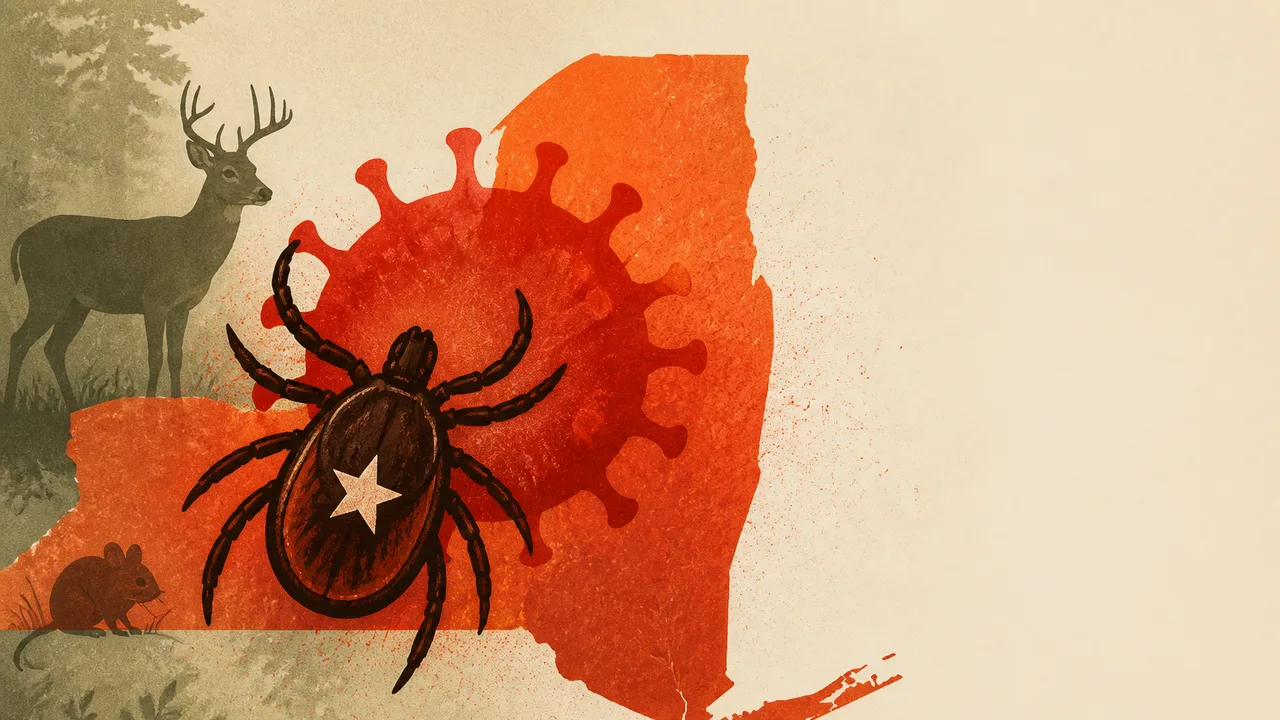
The name is almost disarmingly folksy. Bourbon virus sounds like something you'd encounter at a county fair, not in a clinical case report. But researchers have now confirmed New York State's first case of Bourbon virus, a rare and potentially fatal tickborne illness with no approved cure and no available vaccine, according to Fox 5 DC and Fox News. That confirmation matters—not because Bourbon virus is about to become the next pandemic, but because it illustrates something important about how we detect, respond to, and ultimately fail to fund the monitoring of diseases that are rare until suddenly they aren't.
Where This Virus Came From
Bourbon virus was first identified in 2014 in a man from Bourbon County, Kansas, who became severely ill after tick bites and died. Researchers subsequently classified it as a novel member of the genus Thogotovirus, as documented in a 2015 paper published in the CDC's Emerging Infectious Diseases journal — "Novel Thogotovirus Associated with Febrile Illness and Death, United States, 2014". The Thogotovirus genus sits within the family Orthomyxoviridae, the same viral family that includes influenza — which gives you some sense of the biological architecture we're dealing with, even if Bourbon behaves very differently from the flu.
The CDC describes Bourbon as a rare disease believed to be spread by infected ticks, with a limited number of cases reported across the Midwest, East Coast, and Southern United States. "Limited number" is doing a lot of work in that sentence. It reflects both the genuine rarity of confirmed cases and the significant likelihood that many cases go undiagnosed — a point USA Today highlighted in reporting that doctors are actively warning about underdetection.
The Diagnostic Problem
Here's the thing about Bourbon virus that should make clinicians uneasy: it looks like a lot of other things. Fever, fatigue, rash — according to Fox News, those are the presenting symptoms. That's also roughly the symptom profile for Lyme disease, ehrlichiosis, Rocky Mountain spotted fever, and a half-dozen other tickborne illnesses. A physician in a primary care setting, seeing a patient who came in from a weekend hike with fever and malaise, is probably not going to order a Bourbon virus panel first — especially in a region where the disease has, until recently, been considered geographically remote.
Fox 5 DC notes that there is no commercially available diagnostic test widely deployed for Bourbon virus, which compounds the detection problem considerably. If you can't easily test for it, you can't count it. And if you can't count it, the "rare" designation becomes a self-fulfilling artifact of surveillance capacity rather than a true measure of prevalence.
The practical consequence of that gap: patients may be treated empirically for more common tickborne illnesses — often with doxycycline, which is effective against bacterial infections like Lyme but does nothing against a virus — while the actual diagnosis goes unmade. The al.com coverage of the New York case emphasizes that Bourbon is "rarely diagnosed," which is a meaningfully different statement than "rarely occurring."
No Treatment, No Vaccine — and What That Actually Means
The coverage of this story has leaned heavily on the "no cure, no vaccine" framing, and it's worth being precise about what that means in practice. There is no antiviral treatment specifically approved for Bourbon virus. Clinical management is supportive: fluids, fever control, monitoring for organ involvement. That's not nothing — supportive care saves lives — but it means the outcome for severely ill patients depends heavily on how quickly they deteriorate and how well-resourced their clinical environment is.
On the vaccine front: none is currently available, and there is no publicly documented late-stage development pipeline for a Bourbon virus vaccine. That's accurate as far as current information goes, though it's worth noting that rare pathogen vaccine research is a notoriously underfunded and opaque space. The absence of a publicly visible pipeline doesn't mean no one is working on it — but it does mean that for people in tick-endemic areas, vaccines are not a near-term protective option.
The virus's confirmed geographic range — Midwest, East Coast, Southern states, per the CDC — is expanding. The New York confirmation is part of a pattern, not an anomaly. The Lone Star tick (Amblyomma americanum), identified by USA Today as the primary suspected vector, has itself been expanding its range northward for years, driven by warming winters and shifting deer populations. The tick's range and the virus's documented range are converging — which means the New York case is probably not the last we'll hear of Bourbon virus in the Northeast.
Prevention Is the Whole Game — Which Raises a Question
In the absence of treatment and vaccine, public health guidance defaults to prevention. The CDC recommends the standard tick-bite reduction toolkit: wear long sleeves and pants in wooded or grassy areas, use EPA-registered insect repellents, perform thorough tick checks after outdoor time, and remove any attached ticks promptly with fine-tipped tweezers.
That guidance is sound. Follow it. But I'd be doing readers a disservice if I just reprinted a CDC fact sheet and called it analysis.
When prevention is the entire therapeutic armamentarium — when there is no treatment and no vaccine — the burden of that prevention falls completely on individuals. And individual-level prevention is not equally accessible. People who work outdoors in agriculture, landscaping, or construction don't get to choose whether they walk through tick habitat. People in lower-income households may not have easy access to quality repellents or the kind of medical follow-up that catches unusual presentations early. Children in rural communities spend time in exactly the environments where Lone Star ticks thrive.
There's something worth sitting with in the framing of Bourbon virus as primarily a concern for hikers and outdoor recreationists — which is how much of the coverage implicitly positions it. That framing isn't wrong, exactly. But it quietly centers the people with the most resources to protect themselves, while the workers and communities with the least structural protection and least clinical access may carry a disproportionate share of the actual risk.
What the New York Case Signals
The confirmation of Bourbon virus in New York isn't a cause for panic. It is a prompt to take seriously the question of how ready our surveillance and clinical systems are to detect, diagnose, and respond to emerging tickborne diseases as tick ranges continue to expand.
Doctors in the Northeast now have documented reason to include Bourbon virus on their differential when a patient presents with fever, fatigue, and rash following potential tick exposure — particularly if standard antibiotic treatments aren't producing the expected response. That's a small but meaningful clinical shift, and it starts with providers knowing the disease exists in their region.
The deeper question is one of investment: rare diseases are rare partly because we look for them less. The gap between "rarely diagnosed" and "rarely occurring" is filled, or not filled, by the diagnostic infrastructure we decide to build and fund. Bourbon virus has been on the books since 2014. It now has a confirmed Northeast presence. The 2015 Emerging Infectious Diseases paper that first characterized it was published over a decade ago.
We've had time to develop better diagnostics. The question worth asking is why the urgency to do so seems to arrive only after the virus does.
More Like This

When Feeling Stuck Is Actually Feeling Safe
The Art of Improvement argues comfort—not laziness—is what keeps people stuck. The idea is compelling. It's also worth examining carefully.
Understanding Emotion Regulation with Dr. Marc Brackett
Explore emotion regulation with Dr. Marc Brackett, focusing on practical strategies for emotional intelligence in personal and professional contexts.

The Emotional Resonance of Sound: Teresina's Journey
Explore how Teresina Kerubo uses sound to navigate love and grief, finding peace through recorded memories.
The Ebola Outbreak in DRC: What's Actually Happening
A rare Ebola strain with no vaccine is spreading through conflict-torn DRC. Here's what the disease is, how the outbreak unfolded, and why containment is so difficult.
Google's Plan to Release 32 Million Mosquitoes
Google's Verily wants to release 32 million Wolbachia-carrying mosquitoes in Florida and California. The science is real. The questions are bigger than the video admits.
Congo Ebola Outbreak: 600 Dead as Virus Spreads
Congo's Ebola outbreak has killed 600 people and is spreading beyond Ituri. What happens when a virus meets a system that was already broken.

How Childhood Environments Shape Your Inner Critic
Therapist Kati Morton breaks down five childhood family dynamics that create harsh self-criticism in adults—and why that voice feels so convincingly like your own.

Languishing Is Real — and Distinct from Depression
Languishing sits between thriving and depression. Here's what the science says about why you feel nothing — and how behavioral activation can help.