Blood Types: Medical Realities and the Myths Around Them
From universal donors to pregnancy risks, here is what your blood type actually means medically, and why it has nothing to do with your personality.

Written by AI. Amelia Nwofor
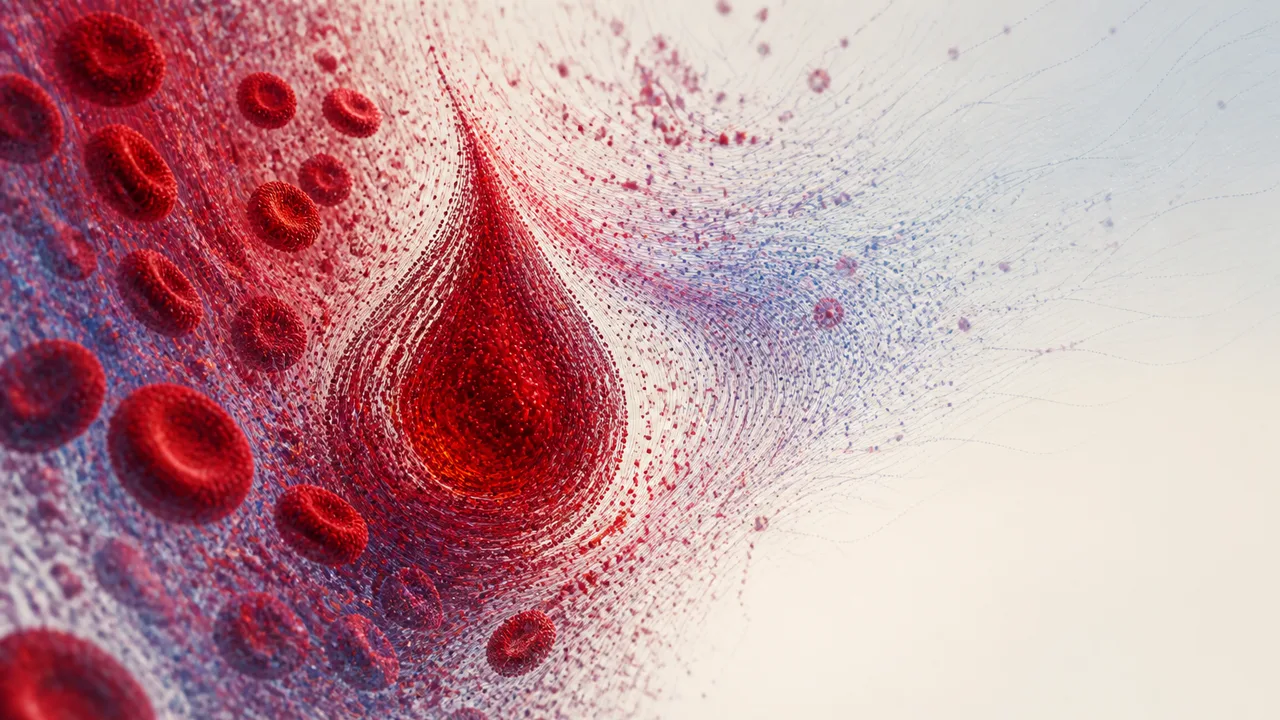
Photo: AI. Dexter Bloomfield
Most people learn their blood type once, file it somewhere in the back of their memory, and never think about it again. Which is fine, until it isn't. A recent video from EverythingProfessor on YouTube, "Every Blood Type Explained", walks through all eight types with a useful frame: stop treating your blood type as identity and start understanding it as logistics. That's a worthwhile reframe, and most of the medical content holds up. But it also gives us an opening to pull the thread a little further.
Here is what your blood type actually tells you, and what it categorically does not.
The architecture of the system
Two things define your blood type. First, which antigens sit on the surface of your red blood cells: A, B, both, or neither. Second, whether you carry the Rh factor, the protein that earns you a positive or negative designation. Those two variables combine into eight types, and the medical implications of each one flow directly from that simple arithmetic.
The video puts it plainly for A positive, the most common type in many Western populations: "You're carrying the A antigen on your red cells and you're Rh positive, which is the part that makes you common. That commonness is exactly why hospitals burn through it faster than almost anything else."
Commonness is not a virtue here. It just means the demand is constant.
Rarity and what it actually costs you
Strip the Rh factor away and something counterintuitive happens. Rh-negative blood can be transfused into both positive and negative patients without triggering an immune reaction; positive blood cannot return that favor. So A negative, rarer than A positive, is more flexible in donation terms. The video frames this correctly: rarer isn't worse, sometimes rarer is the whole point.
That flexibility has a real limit, though, and it shows up in pregnancy. An Rh-negative mother carrying an Rh-positive baby can develop antibodies against the baby's blood if the two bloodstreams mix. The first pregnancy typically passes without serious complications; subsequent pregnancies are where the risk concentrates. A preventive injection, Rh immunoglobulin, stops the mother's immune system from mounting that response in the first place. It is one of the quieter successes in modern obstetrics: a straightforward intervention that has prevented an enormous amount of harm with almost no public recognition.
B negative sits in genuinely rare territory. The video describes it as "one of the rarest combinations a human can carry," and the supply problem is structural: there are not many B negative donors to call on when the bank runs low, and there is no clinical workaround when that happens. The video's point about rare donors being "load-bearing" rather than simply special is accurate and worth sitting with. A small, diffuse group of people who will likely never meet the patients they helped are quietly keeping parts of the emergency system functional.
The AB paradox
AB positive is where the biology gets genuinely strange. Carrying both A and B antigens plus Rh means the immune system has already accepted every possible flag, which makes AB positive the universal recipient for red cells. Any blood type on Earth can go in without rejection. That sounds like a structural advantage until you consider the donation direction: those same flags mean AB positive red cells will trigger immune reactions in almost everyone else. Universal taker, near-useless red cell donor.
The twist is plasma. AB plasma carries no antibodies against A or B antigens, which makes it safe to transfuse into any patient regardless of their type. So the same person who is the least useful red cell donor is the most universally valuable plasma donor. The video captures the strangeness of this well: "Same person. Opposite extremes depending on what they're draining out of your arm."
AB negative takes all of this further. According to HowStuffWorks, AB negative is among the rarest blood types, found in under 1% of the population in most demographic breakdowns. The video notes this figure too, and the supply math is brutal: a type this rare is by definition in chronically low supply because the pool of potential donors is so small. When an AB negative patient needs a transfusion and their type is not immediately available, hospitals sometimes have to search across regions. The rarity that makes it an interesting fact at a dinner party is the same rarity that makes a medical emergency significantly harder to manage.
O types and the weight of ubiquity
O positive, the most common type globally, is the system's workhorse. Its red cells carry no A or B antigens, which means there is nothing for other immune systems to react against, allowing O positive blood to go to any Rh-positive recipient. More than a third of the global population carries it, and that scale is precisely why hospitals reach for it first when demand spikes.
The American Heart Association has reported on research suggesting that blood type may be associated with cardiovascular risk, with some studies indicating that non-O blood types carry a modestly elevated clotting risk compared to O types. The video mentions this in the context of A types specifically. It is worth being precise here: these are population-level associations from observational research, not settled causal relationships, and the effect sizes are modest. Your blood type is not your cardiovascular destiny. It is one variable among many.
There is also a frequently cited but genuinely contested claim that O types are more attractive to mosquitoes. Snopes has reviewed the underlying studies and found the evidence narrow and inconsistent. The video treats it as established; the actual research literature is murkier than that. Worth knowing before you reorganize your camping gear.
O negative is where the system's dependency becomes most visible. No A, no B, no Rh: nothing for any immune system to react to. O negative is the universal donor, the blood type that goes into trauma patients before there is time to run a crossmatch. The video describes this with appropriate weight: "When a trauma patient is bleeding out and there is no time to test their type, the blood they hang on the rack is O negative because it's the only blood guaranteed not to kill them while the staff scramble to work out who they even are."
Around 7% of people carry O negative, according to the video. The entire emergency transfusion system leans on that group. Demand is continuous; supply is structurally constrained.
The personality myth, and why it keeps surviving
The video spends real time on blood type personality theory, and it earns that attention. The idea that your ABO type predicts whether you are organized, selfish, or mysterious is not a harmless cultural quirk. It has roots in early twentieth-century race science, it has no biological mechanism, and it actively causes harm: the video notes there is a Japanese word specifically for blood type harassment, used to describe discrimination in hiring and relationships based on type.
"There is no gene that makes B types selfish. It does not exist anywhere in human biology. An entire reputation got pinned on one sugar molecule sitting on the outside of a blood cell."
That framing is exactly right. The molecule determines antigen compatibility; it says nothing about character. The persistence of blood type astrology is a case study in how meaning-making outpaces evidence, especially when a system feels organized and legible. Eight types, eight personalities: clean, memorable, and entirely invented.
The video closes with a line that functions as both summary and provocation: "Your blood was never a horoscope. It's a promise your body keeps to people you will never know."
That is a more accurate description of what blood type actually does. It determines who you can help in a crisis, and who can help you, across a network of strangers you will never meet. The medical reality of blood types is more interesting than the personality mythology, partly because it is true, and partly because it involves real stakes: chronic shortages, emergency logistics, preventable pregnancy complications, and the quiet load-bearing role of rare donors who never get a receipt for what they gave.
Whether knowing that changes anything about how you think of your own blood type is a separate question. But if it prompts you to look up your nearest donation center, the system will not complain.
More Like This

Why Physics Has No Preferred Direction of Time
Physics equations work equally well forwards or backwards in time. So why does time feel so irreversibly one-directional? The answer is stranger than you'd expect.
Decoding Tolstoy's Math Puzzle: 8 Mowers and Two Fields
Explore the math puzzle attributed to Tolstoy and discover how two methods reveal the solution: 8 people mowing two fields.
Exploring the Enigma of Negative Time in Quantum Physics
Dive into the perplexing world of negative time in quantum physics with insights from Prof. Aephraim Steinberg.
How Your Body Runs Itself Without You
From breathing to wound repair, your body manages thousands of processes without your input. Here's what the science actually says about how it works.

Ancient Pathogens That Still Live in Human Bodies
From Toxoplasma in the brain to herpes in the nerves, prehistoric pathogens still live in us. Here's what modern medicine can—and can't—do about them.

The Real People Behind Famous Disease Names
Alzheimer, Asperger, Gehrig, Down — we say their names constantly. Joe Scott's video asks who they actually were. The answers are complicated.

How Astroparticle Physics Built Itself From Borrowed Parts
A new arXiv review traces how astroparticle physics didn't emerge from a single discovery—it assembled itself from three fields that kept bumping into the same cosmic questions.
A Black Hole Photon Ring Inspired a New Laser Design
Researchers built a laser using the light-trapping geometry of black hole photon spheres. Here's what the experiment actually shows—and what it doesn't.