Baking Soda as a Mouth Rinse: What the Science Says
Thomas DeLauer's baking soda mouth rinse video gets the oral microbiome science mostly right. Here's what holds up, what to skip, and why your body already does this.

Written by AI. Kira Yoshida
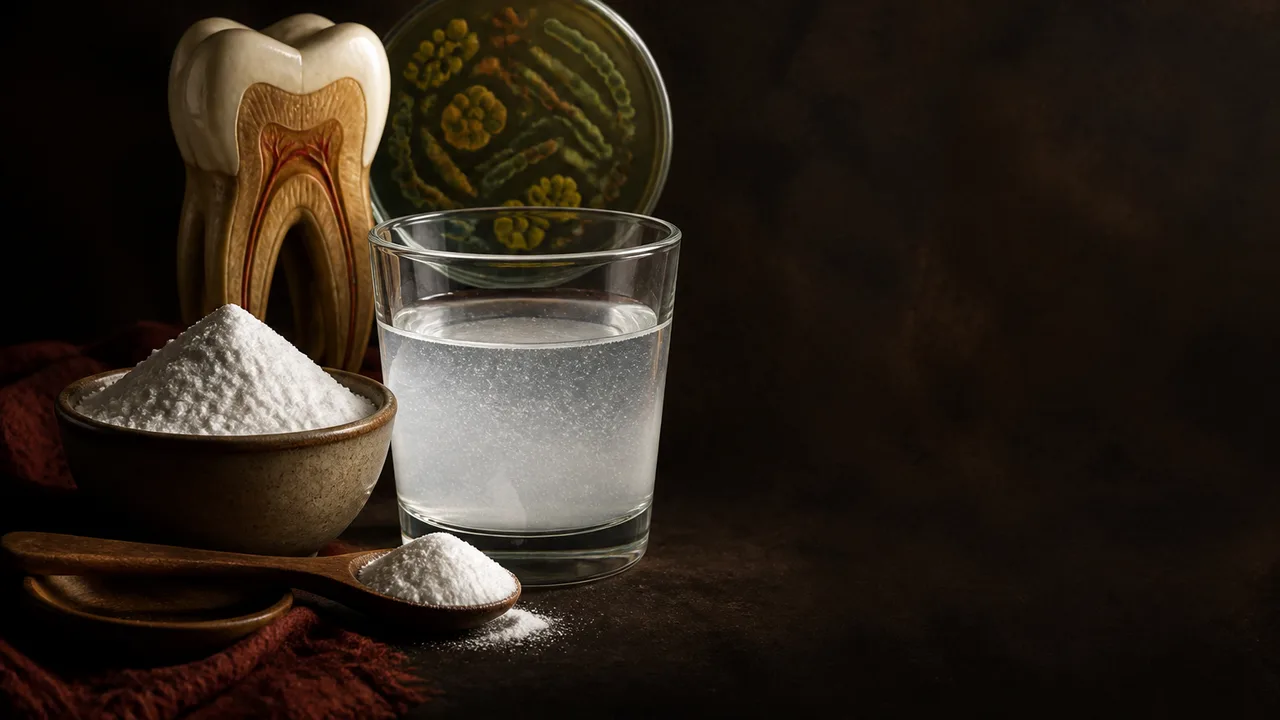
Photo: AI. Soraya Hadid
There's a specific flavor that hits after a long morning run — coffee breath, dried-out mouth, the faint tang of effort. If you've ever wondered what's actually happening in there, biologically speaking, the answer is more interesting than you'd think. Your mouth just ran a little pH experiment on itself, and it probably didn't win.
Which is why I was genuinely curious when Thomas DeLauer's latest video started circulating — the one about using baking soda as a mouth rinse to fight tooth decay and gingivitis. DeLauer is a big-audience fitness creator, so when he posts something with "natural" in the title, the skeptic in me twitches. But the underlying science here is real, and it's worth separating the actual physiology from the parts of the video that are doing something else entirely.
Your Mouth Is Already Doing This
Here's the thing nobody tells you: your body already makes bicarbonate. Your saliva produces it specifically to buffer the acids your mouth generates after you eat. Baking soda — sodium bicarbonate — is chemically identical to that compound. So when DeLauer says baking soda "shifts the pH," he's not describing some exotic intervention. He's describing your body's own system, just with reinforcements.
That framing is genuinely kind of delightful to me? The wellness industry works very hard to convince you that your body is broken and needs expensive products to fix it. And here's a case where the solution literally is what your body already does — scaled up with a pantry staple that costs under two dollars. That's not a hack. That's just physiology.
The mechanism DeLauer lays out is accurate. When you eat sugars and carbohydrates, bacteria in your mouth metabolize those foods and produce organic acids. That pH drop creates conditions that favor acid-tolerant bacteria — the kind associated with plaque buildup and enamel erosion. Rinsing with a dilute baking soda solution raises the pH, which makes the environment less hospitable to the decay-causing species and more hospitable to the beneficial ones. As DeLauer puts it: "Instead of sterilizing your mouth, it changes the environment. It shifts the whole pH."
The contrast with antiseptic mouthwash matters here. Chlorhexidine and alcohol-based rinses are indiscriminate — they kill the harmful bacteria, but also the beneficial ones that help maintain a healthy oral ecosystem. Baking soda doesn't do that. It's not antibacterial in the traditional sense; it's environmental. The oral microbiome research increasingly supports the idea that managing the environment is more sustainable than repeatedly nuking it. That's the same logic behind why gut microbiome science has moved away from "kill the bad stuff" and toward "create conditions where good stuff thrives."
What the Research Actually Says
DeLauer references two studies. The plaque removal data comes from an RCT published in BDJ Open that tested sodium bicarbonate formulations against conventional non-baking soda toothpaste. The result: after a single brushing, baking soda formulations removed significantly more plaque (p < 0.0001 — that's a very clean result). The biggest gains showed up in the lingual interproximal areas, the surfaces between your teeth on the tongue side. Those are notoriously hard to reach, and the researchers noted that baking soda likely works there not just through mechanical scrubbing but by disrupting the plaque biofilm's structure — making it easier to dislodge even where your toothbrush can't get good leverage.
That last part is what makes the science interesting beyond the "baking soda is cheap and good" headline. It's not just abrasion. It's chemistry interacting with the biofilm itself.
According to Healthline, baking soda-based toothpastes are generally considered effective for plaque removal and well-tolerated, which tracks with what the research shows. The professional consensus isn't controversial here.
Where I'd pump the brakes slightly: DeLauer presents this as a near-universal upgrade to everyone's oral care routine, and that's probably true for most people, but if you have active gum disease, specific dental work, or a condition that affects saliva production, your situation is more complicated. He does acknowledge that antiseptic rinses still have a role "if you have an active gum disease or a very specific dental issue" — which is the right caveat, and I'm glad it's there.
About That Armra Segment
Look, I have to say something about the mid-video pivot. DeLauer spends a meaningful chunk of the video pivoting from oral microbiome science to selling Armra colostrum — a sponsored product — by connecting oral health to gut health. The connection itself isn't wrong; the oral and gut microbiomes are genuinely linked, and systemic health does affect oral health. But the segue is doing real work here, and not all of it is scientific.
Colostrum has a legitimate research base around gut mucosal support. It also has a "this will fix everything" marketing wrapper that the evidence doesn't fully support, and DeLauer leaning into phrases like "the evidence is very strong" while linking to a sponsored discount code is the exact pattern worth noticing. The science and the sales pitch are occupying the same sentence, and that's worth knowing when you're parsing what to take seriously.
DeLauer's audiences — and if you found this article, you're probably at least adjacent to his content — have gotten good at clocking this. The microbiome angle is real. The specific product attached to it is a business decision. Those are two different things.
The Actual Protocol (Which Is Fine)
Here's what DeLauer recommends, and it holds up: dissolve half a teaspoon of baking soda in a full glass of water. Swish for 30 seconds. Do it after acidic meals — coffee, citrus, soda — when your oral pH has just taken a hit. You're essentially giving your saliva's natural buffering system a boost right when it needs it most.
He's also clear that this isn't a replacement for brushing or flossing. "The whole idea is not to replace your brushing or your flossing. It's an additional layer." That's the correct framing. Baking soda rinse as a daily-ish add-on after you eat something acidic is a low-cost, low-risk, evidence-supported choice. It's not a protocol that requires purchasing anything. You probably have baking soda in your kitchen right now.
Hydration matters here too — saliva flow depends on it, and saliva is doing the heavy lifting in your oral microbiome every hour of every day. If you're someone who trains hard and isn't great about fluid intake, your mouth is dealing with that. Dry mouth shifts oral pH toward acidic. It's a small thing, but it compounds.
The Larger Pattern
What I find most useful about DeLauer's video — beyond the specific baking soda content — is how it illustrates something the wellness industry usually gets backwards. The default assumption is that your body needs to be corrected, supplemented, overridden. The actual story of oral pH is almost the opposite: your body has a sophisticated buffering system, stress and diet can overwhelm it, and the cheapest possible intervention is to support what's already there rather than replace it.
That's not a particularly monetizable insight. Which is maybe why it took a creator with a sponsorship deal for a colostrum supplement to sneak it into a video.
Half a teaspoon. Glass of water. Thirty seconds. Your mouth was already trying to do this — you're just giving it a hand.
More Like This

Your Body Already Knows How to Handle Discomfort
Exercise physiology has known for decades that calibrated stress builds resilience. So why does the wellness industry keep selling you comfort instead?

How Sports Actually Bring People Together
Sports are celebrated as a universal unifier—but how does that actually work, and when does it fall short? We map the real science and the real limits.

Ten Surprising Biological Facts About the Human Body
From ancient viral DNA to self-digesting stomachs, these ten well-established biological facts reveal a body far stranger than most people imagine.

6 Sunscreen Myths That Could Cost You Your Skin
From DIY recipes to oxybenzone fears, sunscreen myths spread fast online. Here's what the science actually says—and what's genuinely worth questioning.

Practical Productivity Strategies That Actually Hold Up
A YouTube channel called Simple, Actually argues productivity is about wasting less, not doing more. Here's what the framework gets right—and where it gets complicated.

5 Life Regrets That Are Actually Real (With Caveats)
The Art of Improvement's viral regret video gets a lot right — but the gap between what you *should* do and what you *can* do is where self-improvement content always falls apart.
The Sardine Fast: Metabolic Reset or Wellness Trend?
Thomas DeLauer breaks down the physiology of eating only sardines for three days. Here's what the science actually supports—and where the gaps are.

Eckhart Tolle Says Know Less. Your Body Already Does.
Eckhart Tolle's case for 'not knowing' as spiritual awakening has real overlap with movement science—and a $139/year subscription attached to it.