6 Sunscreen Myths That Could Cost You Your Skin
From DIY recipes to oxybenzone fears, sunscreen myths spread fast online. Here's what the science actually says—and what's genuinely worth questioning.

Written by AI. Amelia Nwofor
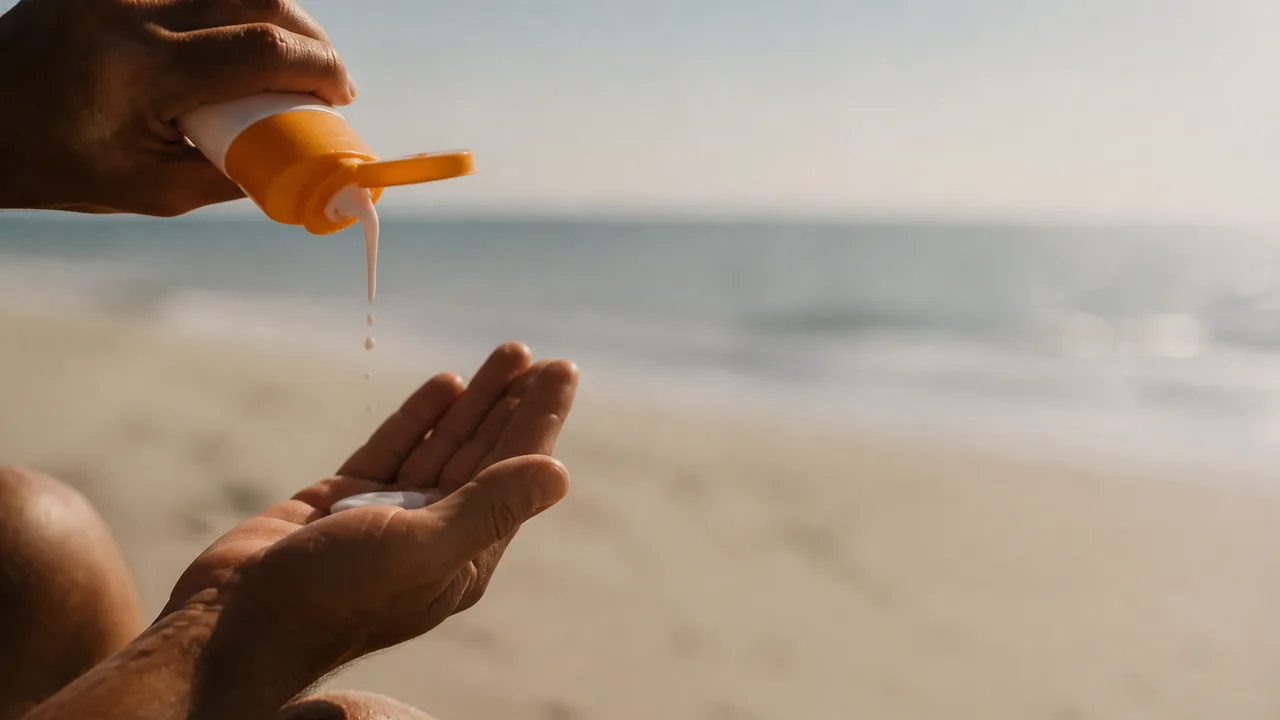
Photo: AI. Renzo Vargas
There's a particular category of wellness misinformation that I find most frustrating—not the obviously unhinged stuff, but the kind that sounds almost reasonable. The kind where someone takes a real, legitimate concern and stretches it just enough to land in dangerous territory. Sunscreen discourse on the internet sits squarely in that zone.
A recent SciShow video hosted by Reid Reimers works through six of the most persistent sunscreen myths, and while much of the science here is well-established, the framing matters. Because the myths in question aren't just wrong—some of them carry real clinical consequences.
The "I don't need it" myth has a racial dimension that doesn't get discussed enough
The baseline myth—"I don't need sunscreen"—predictably gets addressed first. UV radiation causes sunburns and skin cancer, sunscreen blocks most of it, one blistering burn may increase lifetime melanoma risk by 50%. That part, most people have heard.
What gets skipped in a lot of sunscreen conversations is who specifically is being harmed by the myth that melanin is adequate protection. As the video notes: "This myth has led to a lot of people of color thinking that they can't get skin cancer, which leads to later diagnoses and disproportionately poor outcomes."
This is worth sitting with. Melanin does provide some UV protection—that's not contested. The physics of it is real: melanin absorbs radiation before it can damage DNA, which is why equatorial populations evolved higher baseline melanin concentrations. But "some protection" and "sufficient protection" are not the same claim, and the gap between them has historically cost lives. Skin cancer in darker-skinned patients is frequently diagnosed at later stages, partly because clinicians and patients alike have internalized the melanin-as-armor myth, and partly because the visual presentation of skin cancer on darker skin differs from the pale-skinned norm that dominates dermatology training materials. The American Academy of Dermatology and the Mayo Clinic are unambiguous: the sunscreen recommendation applies to everyone.
SPF numbers lie to you—but only because you let them
The SPF section is where the video gets genuinely useful in a way most sunscreen coverage doesn't bother with.
The number on the bottle is not a performance guarantee. It's a lab measurement obtained under precise conditions: 2 mg of sunscreen per square centimeter of skin, applied uniformly. In practical terms, that's roughly a quarter teaspoon for your face and about an ounce—two-thirds of a shot glass—for your full body. Most people are applying roughly a quarter of that amount. Which means the "SPF 50" you think you're wearing might be functionally delivering something closer to SPF 12.
The math on higher SPF numbers also deserves more attention than it gets. SPF 30 blocks 96.7% of UVB rays. SPF 60 blocks 98.3%. Doubling the number yields a 1.6 percentage point improvement—meaningful at the margins of UV protection, not the dramatic leap the packaging implies. The FDA in 2021 updated its proposed marketing cap from SPF 50 to SPF 60, acknowledging that the difference is real enough to matter, while still signaling that SPF inflation beyond that is marketing more than medicine.
There's also a chemist's footnote that gets buried in most public-facing coverage: SPF specifically measures UVB protection—the burning rays. UVA radiation, the kind that drives premature aging and also contributes to cancer, isn't captured in the SPF number at all. If your sunscreen doesn't say "broad-spectrum" or carry a PA+ rating, you may be blocking burns while leaving the slower, cumulative damage entirely unaddressed.
The DIY sunscreen myth is where "natural" becomes actively hazardous
The naturalistic fallacy—the cognitive shortcut that equates "natural" with "safe" and "synthetic" with "dangerous"—runs through most sunscreen skepticism like a thread. It's the logic animating fears about oxybenzone, resistance to supplements, and the thriving cottage industry of homemade sunscreen recipes circulating on Pinterest and wellness blogs.
On oxybenzone specifically: the concern traces to a 2001 rat study in which animals were fed large quantities of the compound and showed hormonal disruption. The video does the math on what equivalent human exposure would look like—277 years of topical application to match what those rats received orally. That doesn't mean oxybenzone deserves no scrutiny. It's banned in Hawaii and other jurisdictions because of documented harm to coral reef ecosystems, and it does cause allergic reactions in some people. Those are legitimate, evidence-based reasons to avoid it if you choose to. They are not evidence that it causes endocrine disease in humans using it as directed.
The DIY recipe problem is more straightforward, and the numbers are damning. A 2020 study analyzed 15 homemade sunscreen recipes sourced from the internet. Three had no measurable SPF whatsoever. The remaining twelve topped out at below SPF 6. The dermatological minimum recommendation is SPF 30.
The failure mode is mostly about zinc oxide—the mineral UV-blocker that DIY recipes tend to center. As the video explains: "Although zinc oxide is a sun-blocking ingredient in many mineral sunscreens, its quality and concentration is crucial for the safety of the final product. And the zinc oxide formulation also affects its sun-blocking abilities. Like, in the pigment form, it hardly does a thing."
The particle size, purity, and homogeneity of zinc oxide in a commercial sunscreen are not variables a home kitchen can control. There's also a safety issue that rarely makes it into the recipe posts: regulatory agencies explicitly warn against inhaling zinc oxide powder in any concentration. Working with loose zinc oxide in an unventilated home environment carries real respiratory risk. The batch-to-batch inconsistency means every application could deliver a wildly different dose—which is a polite way of saying you might as well be rubbing oil on yourself, which, per the video, delivers roughly the same SPF.
The vitamin D question is the one where I'd push back slightly on the framing
The video addresses the fear that sunscreen blocks vitamin D production, and its conclusion—keep using sunscreen, supplement if concerned—is reasonable and consistent with AAD guidance.
But I think it's worth flagging that this is one area where the research conversation is genuinely ongoing, and "scientists haven't found evidence that SPF significantly hinders vitamin D production" partly reflects how people actually use sunscreen (underappliying it dramatically, as established above) rather than confirming that proper application leaves vitamin D synthesis unaffected. The operative mechanism—UVB converting a skin lipid into a vitamin D precursor—is the same mechanism that sunscreen is designed to block.
This isn't an argument against sunscreen. Vitamin D is available through diet and supplementation; melanoma is not something you can supplement your way out of. The tradeoff is clear. But the honest scientific position is "the evidence under real-world conditions is reassuring, and further research would be useful"—not "this concern is definitively resolved."
What the myths have in common
Every myth covered here has the same basic architecture: a grain of legitimate biology, stretched past what the evidence supports, usually in the direction of reassurance. Melanin does protect—just not completely. High SPF does provide more protection—just not proportionally. Oxybenzone does have documented effects on some biological systems—just not the ones most people are worried about. Natural oils do have some UV-absorbing properties—just nowhere near what you need.
The wellness information ecosystem is very good at taking the first part of each of those sentences and quietly dropping the second. Understanding what the evidence actually says—including where it's strong, where it's preliminary, and where it's being misrepresented—is the only reliable inoculation.
The skin you're in is the only one you get. Spending 277 years earning the right to skip the SPF doesn't seem like a great use of your time.
More Like This

How Childhood Trauma Shapes Adult Relationships
Explore how childhood trauma influences adult relationships and discover pathways to healing.

Turkey's Olive Oil Soap Maker Bets on Patience
Doktoroğlu Soaps makes 8 million bars a year the old way. The real story is what a year-long production cycle does to your cash flow—and your nerve.

R21 Malaria Vaccine: A Breakthrough With an Uncertain Future
The R21 malaria vaccine hit 73% efficacy and earned WHO approval. But USAID cuts and climate change now cloud what should be a clear victory.

Loneliness Is Wrecking Your Biology, Not Just Your Mood
Dr. Molly Maloof joins Dave Asprey to explain how isolation damages your cells, why connection is medicine, and what peptides may support longevity.

Fasting and Connective Tissue: What the Science Shows
A 2024 Nature Metabolism study tracked 3,000+ proteins during a 7-day fast. The findings on collagen remodeling and muscle preservation are harder to dismiss than you'd expect.

Your Weird Habits Are "Genius"—Or Are They?
Psych2Go says replaying conversations and laughing alone proves you're highly intelligent. The science says: it's more complicated than that.
Hannah Cairo Disproved a 40-Year-Old Math Conjecture at 17
At 17, Hannah Cairo overturned the Mizohata-Takeuchi conjecture using a hypercube and a coin diagram. Here's what she actually did—and why it matters.

How Language Shapes Thought, According to Lera Boroditsky
Cognitive scientist Lera Boroditsky explains how the language you speak shapes memory, color perception, and thought—and what's lost when languages disappear.