Baba Is You and UFO 50 Are Becoming Board Games
Baba Is You and UFO 50's Party House are heading to Kickstarter on Sept. 15 as board games. Here's what that translation actually demands.

Written by AI. Lily Tsai
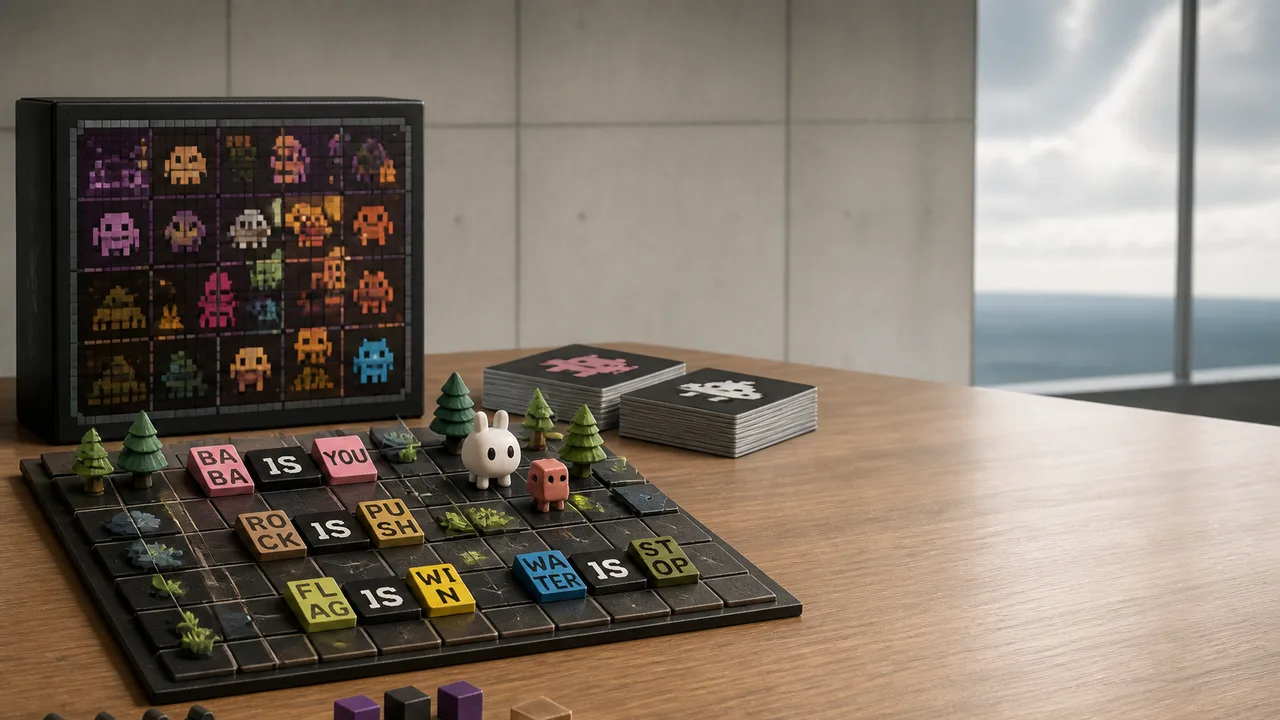
There's a specific kind of double-take that comes from reading an announcement and having to re-parse the sentence. Baba Is You — the solo-developed logic puzzle game built entirely around rewriting the rules of reality — is becoming a board game. The thing that made the original so conceptually electric was that the rules weren't just constraints; they were objects. Pushable, rearrangeable, destructible. Now someone has to put that on a table with cardboard.
The joint Kickstarter campaign for Baba Is You: The Board Game and Party House: Deckbuilding Game — adapted from the anthology title UFO 50 — launches September 15th, 2026, according to GoNintendo. The two games are being released as companion campaigns, which is unusual enough to be worth noticing: a puzzle game and a deckbuilder, sharing a launch window, both drawing from the same corner of the indie canon.
The team making it
The collaboration assembling these adaptations reads like someone deliberately tried to get the right people in the room. ResetEra's announcement thread lays out the lineup: Hempuli Oy (Arvi Teikari's studio, the developer of Baba Is You), board game designer Peter C. Hayward — per Bleeding Cool, the designer behind the 2021 hit That Time You Killed Me — and publisher Bitewing Games. Thinky Games confirms that Bitewing is the publisher bringing both titles to physical form.
The credentials matter here less as résumé flex and more as signal about what kind of adaptation this is likely to be. Hayward's design work leans toward games that reward lateral thinking — a sensibility that maps reasonably well onto Baba Is You's particular flavor of puzzle logic. Bitewing operates in the thinky-game space where production values and mechanical fidelity tend to be taken seriously. This isn't a licensing deal handed to whoever offered.
The design problem neither game can avoid
Prism News puts the challenge plainly: both adaptations are coming with "the same hard problem: how do you turn a digital system that thrives on constant change into a board game that still feels elegant at the table?"
For Baba Is You, that problem is acute in a way that's almost philosophical. The original game's core mechanic — rearranging word-tiles to rewrite the rules mid-puzzle — works in digital form partly because the engine handles the cascade of consequences instantly. Push "BABA IS YOU" apart and the game recalculates reality in milliseconds. At a table, with physical tiles, players have to hold that logic in their own heads. That's either going to be deeply satisfying or deeply frustrating, and probably both depending on who's sitting across from you.
The deckbuilding route for Party House is a different kind of translation. UFO 50, released in 2024 per the Steam page, is a fifty-game anthology created by a small collective of developers including Spelunky creator Derek Yu — an act of collective game-making that's almost absurd in its ambition. Party House is one of those fifty games, and it's the one that apparently has the structural bones to survive the move to cardboard. Deckbuilding is a well-mapped genre in tabletop; the question is whether Party House brings something specific enough to the format to justify the adaptation rather than just wearing the IP as a costume.
Polygon notes that both games are described as "unexpected" adaptations, which feels accurate — not because board game adaptations of video games are rare, but because these particular games are the ones that would seem hardest to adapt without losing what makes them worth adapting.
What Hempuli is actually handing over
The Kickstarter angle deserves more than a boilerplate caution note, and it's not the usual crowdfunding-risk story that makes it interesting.
Hempuli — Arvi Teikari — built Baba Is You largely by himself. The game's logic system is intimate in a way that solo-development projects often are: it's a single person's model of how rules can be objects, expressed through years of iteration. Bringing in a board game designer, a publisher, and a crowdfunding campaign means handing that system to other people's hands and trusting that what comes out the other side is still recognizably the thing. That's a specific kind of creative exposure that isn't really about production timelines or pledge tiers.
What Kickstarter does in this context is make the trust question public and financial at the same time. Backers aren't just pre-ordering; they're voting on whether the translation is worth attempting. If the campaign funds well, that's partly a signal that the Baba Is You community believes Hempuli and Hayward found the right shape for the physical version. If it struggles, the failure is legible in a way that a quiet retail underperformance wouldn't be.
For Hempuli specifically, there's also something worth sitting with about a solo developer's creation moving into a production pipeline with multiple stakeholders. Indie games at their most interesting are often the product of one or two people's uncompromised vision — and board game development, even with great collaborators, is structurally collaborative in ways digital solo development isn't. The game that comes out the other side will be a negotiation. Whether that's a loss or a gain probably depends on what Hayward understood about the source material going in.
Why these two games, together
The pairing of Baba Is You and Party House in a joint campaign is worth a beat of attention. They're not obviously linked — different genres, different development contexts, different formal challenges. What they share is a kind of conceptual legibility: both are games where the design idea is clean enough to state in a sentence, which is useful when you're asking someone to back a board game they haven't played yet.
"You rearrange word-tiles to rewrite the rules" and "it's a party-game deckbuilder from a fifty-game indie anthology" are both pitches that work in a Kickstarter context. They're high-concept in the right direction — not complicated to explain, but clearly not generic either.
There's also something in the timing. The board game market has spent the last several years absorbing digital IP — Wingspan demonstrated that games with distinct identities could move significant units in tabletop form, and the thinky-game shelf has gotten genuinely crowded with interesting stuff. Baba Is You and Party House are entering a market that has more appetite for this kind of adaptation than it did five years ago, and landing with a publisher like Bitewing means they're not entering it naively.
Whether the adaptations are good — actually good, mechanically — is a question September will start to answer and reviews will finish. The design challenge is real, the team is credible, and the source material is strong enough that getting it wrong would be a genuine waste.
That last part is probably what makes the announcement feel higher-stakes than most. Failing to translate Baba Is You to cardboard isn't just a product failure; it's a fumbled opportunity to show that the game's central idea is portable enough to outlast its medium. Hempuli built something that proved rules could be objects. The board game has to prove it twice.
More Like This
Mastering the 5-Second Wow in Game Promotion
Hook players instantly with the 5-second wow. Discover strategies for game promotion.
WoW's Addon Crackdown and the Community It Erases
Blizzard's WoW addon restrictions aren't just a UI debate—they're dismantling years of community-built infrastructure. Here's what's actually at stake.
Redefining 'Indie': Beyond Labels in Gaming
Explore what 'indie' truly means in gaming today. Is it a genre, a spirit, or something else entirely?
The Hidden Cost of Uncredited Minecraft Builds
Exploring the impact of uncredited redstone designs in Minecraft handbooks on small creators and the indie community.
Do You Need a Game Design Document? A History Weighs In
Imphenzia says a one-page GDD is all you need. The history of game documentation—and what gets lost without it—says the stakes are higher than that.
Dragon Quest Monsters: The Withered World Revealed
Square Enix's Dragon Quest Monsters: The Withered World drops December 3. Here's what the new creatures, Synthesis system, and platform bet actually mean.
Minecraft Live 2026: New Biome, Wool Stairs & What's Next
Minecraft Live revealed the Dappled Forest biome, wool stairs, abandoned camps, and more for the Fall 2026 drop. Here's what it means for builders and creators.
Minecraft Java Multiplayer in 2026: Who Pays the Price?
Mojang's new native Friends List threatens the small-studio ecosystem built around Java's multiplayer gap. Here's what that means for how you play.