Dragon Quest Monsters: The Withered World Revealed
Square Enix's Dragon Quest Monsters: The Withered World drops December 3. Here's what the new creatures, Synthesis system, and platform bet actually mean.

Written by AI. Derek "D-Block" Washington
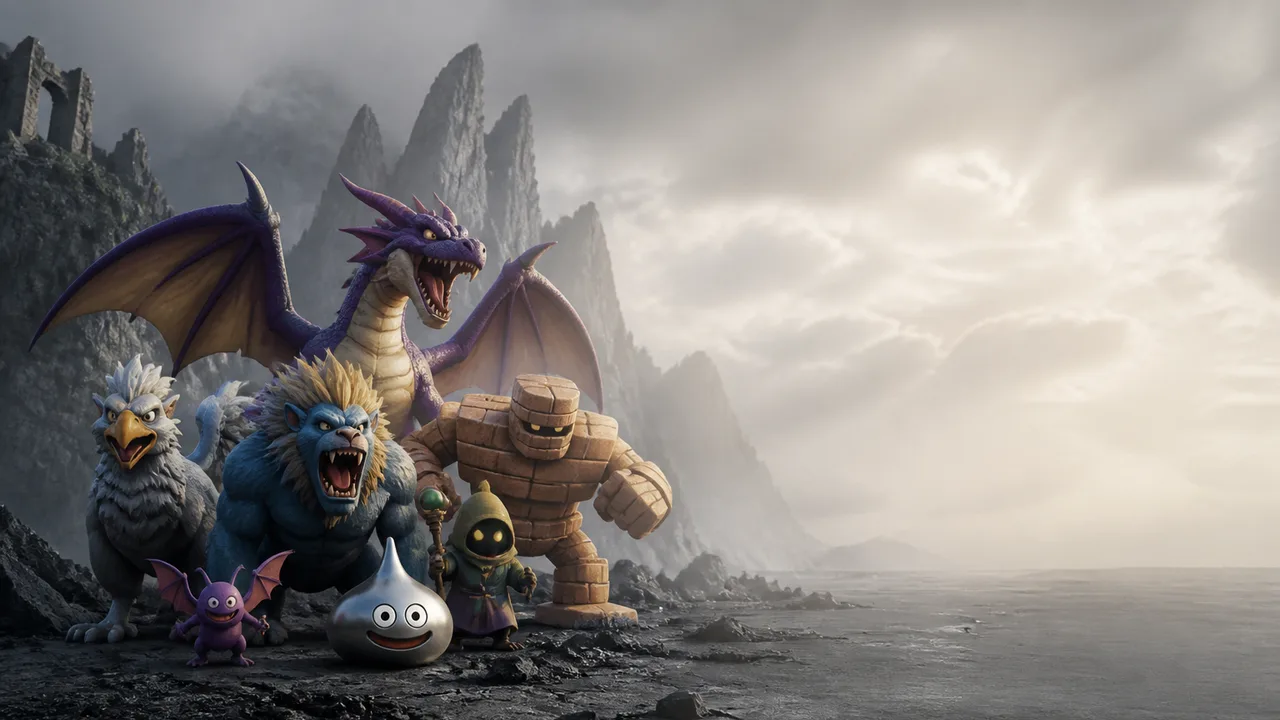
Where you land on Slimeborg pretty much tells me everything I need to know about you as a Dragon Quest fan.
Slimeborg — one of the newly revealed creatures in Dragon Quest Monsters: The Withered World — is a mechanical re-skin of the franchise's most iconic mascot, the humble Slime. Imagine the classic blue teardrop body, but bolted onto a chassis of exposed pistons, gear-work, and industrial plating. It's Slime as steampunk war machine. The "fresh design" camp sees exactly that: a clever subversion of a beloved icon that signals the game is willing to play with legacy rather than just coast on it. The "mobile gacha reject" camp looks at the same image and sees the visual language of every monetization-first creature design that's cluttered the genre for the past decade — chrome and rivets where there used to be soul. The argument isn't really about Slimeborg. It's about whether you trust Square Enix to know the difference.
That tension sits underneath everything worth paying attention to in the Withered World reveal.
What We Actually Know
Square Enix — co-developing with TOSE, according to Gamebastion — has been rolling out details in waves. The December 3 release date was confirmed during a Nintendo Direct, as Anime News Network reported, and the platform list is notably broad: Nintendo Switch, Nintendo Switch 2, PlayStation 5, Xbox Series X|S, and PC. Gamenguide confirmed that full slate.
The most substantive mechanical information concerns the battle system and, more interestingly, Synthesis — the series' long-running creature-breeding mechanic. Nintendo Everything and Siliconera both covered the Synthesis details at length: combining two monsters produces a new creature that is more powerful than either of its parents, with the specific result remaining hidden until the combination is complete. That "mystery output" design is a franchise staple, but it carries real implications for how the community engages with the game at launch.
On the creature side, Polygon highlighted the range of new designs — calling them "weird new creatures" and "adorable new buddies" in the same breath, which is about as accurate a description of DQM's design philosophy as you're going to get. Gematsu went deeper on the specific new monsters revealed alongside the battle and Synthesis info.
Early on, details were thin. When the game was first announced, Nintendo Life noted plainly: "The teaser was admittedly pretty light on details. We saw a bunch of monsters, two young protagonists and... that's about it." The subsequent reveals have filled in some of that picture, but meaningful gaps remain.
The Synthesis Question Nobody Is Asking Loudly Enough
Synthesis has always been the mechanical heart of this franchise, and the way Withered World is building anticipation around it is smart — maybe too smart.
The "surprise" output design keeps players guessing and organically generates community content: spreadsheets, wikis, Discord channels dedicated to mapping every possible combination. That's not an accident. It's architecture. The mystery is the engagement loop.
Here's what's got some corners of the DQM community genuinely buzzing: there's a theory floating around that Slimeborg itself is a late-game Synthesis endpoint — meaning it's not something you find in the wild but something you build through a specific, possibly complex chain of combinations. The theory, still community speculation rather than confirmed info, would recast that controversial design in a completely different light. A creature that earns its existence through player investment is a different proposition than one that just shows up in a roster. If Slimeborg is the prize rather than the starting point, the "mobile gacha reject" reading falls apart almost entirely. That's the theory. It hasn't been confirmed. But it's the kind of thing that makes the Synthesis reveal worth watching closely.
mxdwn Games noted that synthesized creatures will be available for both single-player and online battles — which is the other piece of this puzzle. If Synthesis outputs feed directly into competitive play, the optimization community is going to be ferocious about charting every path to the strongest possible results. That's a feature. It's also a potential balance nightmare, depending on how much variance the "surprise" mechanic actually allows at the top tier.
The Creature Design Argument, Honestly Mapped
Let's give both sides their due here, because the discourse deserves more than a scoreboard.
The case for Withered World's new designs is rooted in what the series has always done best: take familiar visual shorthand and put it through a blender. The classic Dragon Quest creature vocabulary — round shapes, expressive eyes, just enough menace to be interesting — was built on the foundational design work of Akira Toriyama, whose death in March 2024 (Kanzenshuu) left a real question about how the franchise would steward that legacy. The new designs, Slimeborg included, represent an answer of sorts: not imitation, but extrapolation. The series' DNA is still legible; the direction is just newer.
The skeptical read isn't really about any single design. It's about pattern recognition. Creature-collecting games have been strip-mined by mobile monetization for years, and that has produced a visual aesthetic — maximalist, chrome-heavy, designed to look impressive in a 2-inch thumbnail — that is now deeply associated with disposable content. When a mainline release borrows from that visual language, even unintentionally, it sets off alarms. The concern isn't that Slimeborg looks bad. It's that it looks familiar in the wrong direction.
What I'd actually want to hear from Square Enix is how these designs were arrived at — what the brief was, what the constraints were, whether the team was explicitly trying to push the Toriyama legacy forward or playing it safer than the final product suggests. We don't have that. What we have is screenshots and community speculation.
The Platform Bet
The multi-platform release deserves a paragraph because it's genuinely interesting strategically. DQM has historically been Nintendo portable territory — the association runs deep. Putting Withered World on PS5, Xbox Series X|S, and PC in the same window as Switch and Switch 2 is a real statement about who Square Enix thinks this game can reach.
The Switch 2 version specifically is worth flagging. Square Enix is making a visible bet that the Switch 2's install base will be meaningful by December, and that DQM is a title worth using to plant a flag there. That's confidence, or at least calculated optimism.
What We Still Don't Know
There's a decent amount of territory the reveals haven't touched. Story context for the two young protagonists remains minimal. The lore implications of "the Withered World" — what it means, what caused it, how the monster ecosystem fits into it — are still vague. The competitive online balance question is entirely unaddressed. And the full creature roster is nowhere near complete in terms of public information.
None of that is unusual for a December release being rolled out in July. But it does mean we're working with roughly half the picture.
Whether Slimeborg ends up being a controversial roster filler or the thing you've been chasing through forty hours of Synthesis chains is actually the best version of this story — because the answer will tell you something real about how Square Enix is thinking about legacy right now. December 3 is the only place that question gets resolved.
More Like This
A Warcraft Franchise Leak That Keeps Checking Out
A dismissed Warcraft franchise leak keeps proving itself right. Classic Plus, an Arthas ARPG, animated series — and one data-mined build that changes everything.
Total War: Warhammer 40K Battle Gameplay Breakdown
New gameplay footage from the PC Games Show reveals Total War: Warhammer 40,000's cover system, unit cards, planet generation, and campaign structure.
Jubilee Joins Marvel Rivals Season 9 as a Strategist
Marvel Rivals adds Jubilee in Season 9 as a Strategist with firework-based healing—a bold design choice that reframes a fan-favorite for a role her fans never expected.
Zelda Ocarina of Time Remake: Confirmed and Coming
Nintendo confirmed an Ocarina of Time remake for Switch 2 in 2026—but the rumor cycle that got us here reveals something about how gaming communities process hope.
Sword x Staff: The Mobile RPG That Ate VanossGaming
VanossGaming and crew went down a Sword x Staff rabbit hole for 2+ hours. Here's what that actually tells us about mobile RPG design in 2025.

Peter Molyneux's Final Game: Masters of Albion
Peter Molyneux calls Masters of Albion his last game. The Fable creator reflects on legacy, AI in gaming, and why the UK industry needs more respect.

GTA 6's $100 Ultimate Edition Is Outselling the $80 Version
GTA 6's $100 digital-only Ultimate Edition is topping PS Store charts in nine markets. Here's what the pre-order data actually tells us—and what it doesn't.
London Games Festival 2027 Gets a New Central Venue
London Games Festival moves to the Business Design Centre for April 2027. Here's what the venue shift means for fans, devs, and the festival's global ambitions.