Total War: Warhammer 40K Battle Gameplay Breakdown
New gameplay footage from the PC Games Show reveals Total War: Warhammer 40,000's cover system, unit cards, planet generation, and campaign structure.

Written by AI. Helen Papadopoulos
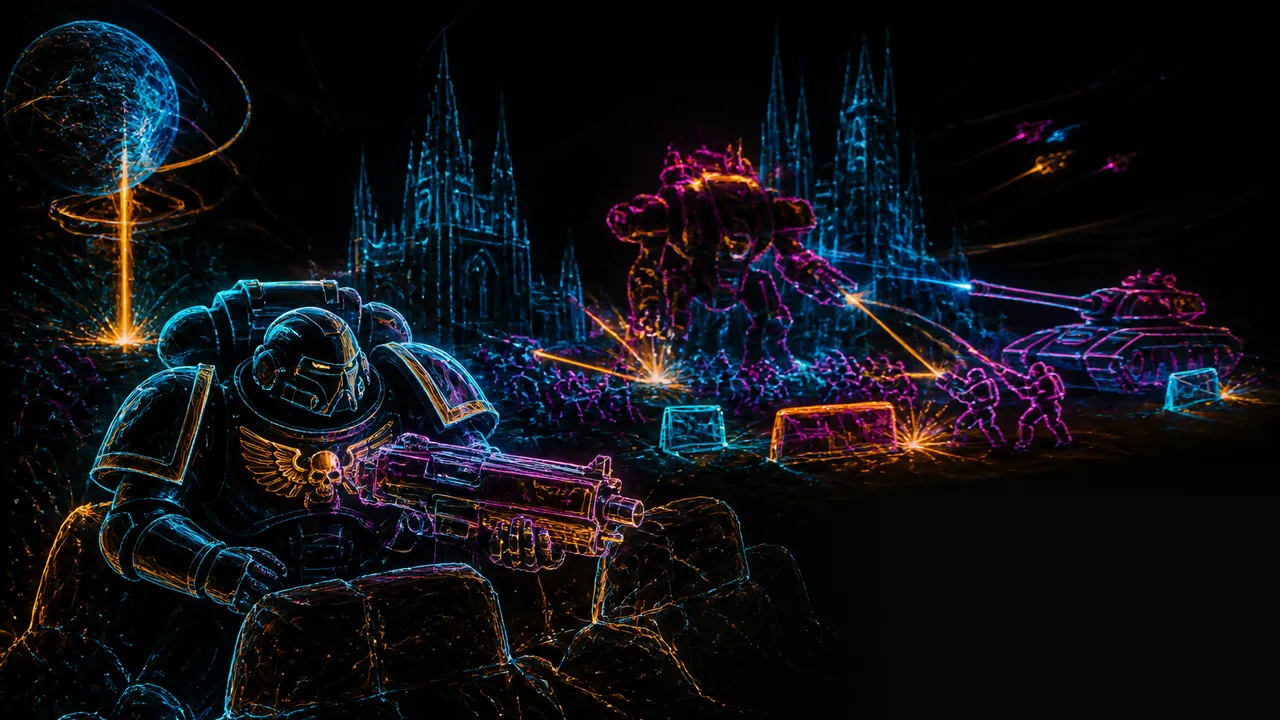
Photo: AI. Phaedra Lin
I cover the ancient world for a living, which means I spend most of my professional hours thinking about how civilizations wage war, manage territory, and eventually collapse under the weight of their own overextension. So when a game arrives promising a galaxy-spanning war of attrition fought across procedurally inflected planets — with hive cities whose spires claw into cloud cover and infantry units whose tactical positioning actually matters — I find myself paying closer attention than my beat strictly requires.
The PC Games Show footage for Total War: Warhammer 40,000 is the kind of reveal that tells you less through what developers say than through what they choose to show. Invicta's breakdown of the presentation, a fifteen-minute exercise in freeze-framing and close reading, does the work of a patient analyst with a magnifying glass — and it surfaces some genuinely interesting design decisions worth examining on their own terms.
A Soft Landing for a Hard Universe
The 40k setting is, by design, relentless. Ten thousand years of perpetual war, a theocratic empire rotting from within, threats from every direction and dimension. It is not a universe that invites leisurely orientation. Creative Assembly's solution — a tight, story-driven opening campaign centered on Armageddon — is a pragmatic concession to the reality that Total War: Warhammer 40,000 will attract two distinct audiences who share almost no prior knowledge: Total War veterans unfamiliar with the grimdark lore, and 40k enthusiasts who have never commanded a real-time battle line.
Armageddon, as Invicta notes, has become something of a canonical entry point across recent 40k media, and it makes structural sense. The planet's famous wars — principally the Ork invasions repelled by the Space Marines — offer a contained, legible conflict with clear factions and established stakes. The Imperial Guard and the Orks are precisely the units Creative Assembly is showing off, which means the tutorial campaign and the gameplay demo are speaking the same language.
Whether a "curated" opening translates to genuinely good onboarding or merely a gilded corridor before the game opens up is a question the footage cannot answer. But the intent is clear, and the logic is sound.
Planets as Argument, Not Backdrop
The dynamic planet generation system is where the design philosophy gets interesting. Rather than pure procedural generation — which, as Invicta observes, "could have some pretty bad experiences" when applied to battlefields — Creative Assembly is working with constrained inputs. Development type (hive, agri, mining, frontier) intersects with biome (ice, arid, temperate, waste) to produce outputs that are varied without being chaotic.
The distinction matters. An arid-ice planet looks different from an arid-waste planet, and that difference is meant to carry through to the battlefield terrain and the visual language of the campaign map. The ambition is a galaxy that reads as cosmologically coherent rather than randomly shuffled.
The battlefields themselves sit outside this procedural logic: they are, per earlier Creative Assembly communications, handcrafted and then reskinned according to planetary context. This is a considered trade-off. Handcrafting costs resources and limits variety in the abstract, but it allows designers to build maps where sightlines, chokepoints, and open ground are deliberately calibrated rather than accidentally produced. In a game where ranged combat, visibility, and movement are load-bearing mechanics rather than secondary concerns, that calibration is not a luxury.
The Cover Problem
The cover system is where the fanbase has focused its anxiety, and reasonably so. The Total War formula — thousands of soldiers clashing in open formation — sits in some tension with the 40k setting's emphasis on tactical positioning, fortifications, and the particular horror of exposed infantry under fire.
What the footage shows is a system still finding its footing. Units move in traditional line formations while in transit, which raised alarms for some observers, but Invicta's frame-by-frame reading suggests this is a transitional state: once a unit reaches available cover, it conforms to it, pressing against walls and stacking two or three deep. The stat bonuses — range resistance, evasion, suppression resistance — represent meaningful mechanical rewards for positional play.
The more interesting questions are the ones the footage doesn't settle. Invicta puts them plainly: "If a building collapses, yes, it should now turn yellow. If a crater is formed from an impact, yes, it should turn yellow. But I didn't see that in this video." Dynamic cover generation — cover created by destruction rather than pre-placed — is the difference between a system that rewards tactical thinking and one that merely rewards map memorization. The former would represent a genuine step forward for the franchise; the latter would be an improvement on the sword-and-board titles while still falling short of what the setting demands.
Vehicles interact with cover terrain differently, apparently incurring movement penalties as they push through it — a "cover speed reduction high" flag appears in one frame — though the precise meaning is still opaque. Whether that represents terrain slowing the vehicle or the vehicle destroying cover as it passes remains unconfirmed. Both interpretations have tactical implications.
Reading the Unit Cards
The unit card UI redesign rewards attention. The most substantive change is the replacement of a single armor-piercing stat with a three-tier visual representation of effectiveness against light, medium, and heavy targets. The practical consequence is that a player glancing at their Leman Russ versus a Baneblade versus a squad of Kadian Shock Troopers can immediately understand the matchup logic rather than doing mental arithmetic from abstract numbers.
As Invicta notes, this is "actually very easy to intuit just how well your unit is going to perform" — which sounds modest but represents a real improvement in information design. Strategy games live or die by the quality of feedback they give players, and surfacing armor matchup data at the card level rather than burying it in stat screens is the kind of decision that shapes how a game feels to play over dozens of hours.
The unit scales are also worth noting. Kadian Shock Troopers — the Imperial Guard's line infantry, famously mortal and expendable — run to squads of 100. The Ork Nobz cap at 40. The implication is that unit size will track lore logic rather than imposing artificial parity, and that the eventual arrival of Tyranid swarm units could push squad counts considerably higher.
Strategic reserves and orbital bombardment rounds out the tactical layer: the footage shows a button for calling in off-map support, with the delivery method (drop pods for Space Marines, less certain for others) still partly unresolved.
What the Blurriness Means
There is something telling about a game reveal conducted, as Invicta observes, through footage that is partly obscured by design. Creative Assembly showed a galactic campaign map that is "very blurry on purpose" — enough to confirm the crusade theater structure (galactic map, solar system campaigns, individual planets) but not enough to reveal its full scope or content. The campaign map visuals read, at this stage, as placeholder.
This is normal for a title still in development. It is also a reminder that what Creative Assembly is selling right now is not a finished product but a design argument — a set of promises about how these systems will cohere. The planet generation looks great in isolation; whether it produces meaningfully different strategic experiences at scale is unknowable until the game ships. The cover system addresses a real problem; whether it addresses it fully depends on questions the footage deliberately leaves open.
Invicta's frame-by-frame methodology is, in this sense, the right tool for this moment. There is more information in what is shown than in what is said, and that information is worth extracting carefully.
The closed beta is now accepting sign-ups. That is where the argument will actually be tested.
More Like This

Verdant Manager Promises an AI CTO—Read the Fine Print
Verdant Manager wants to be your AI CTO. The workflow pitch is genuinely interesting. The security questions it doesn't answer are more interesting.
Diablo IV: Lord of Hatred Expansion Review
Explore Diablo IV's Lord of Hatred expansion. New classes, zones, and a thrilling campaign await.

When Your Partner Calls Your Dream "Loser Stuff"
Dr. K unpacks what it really means when a partner dismisses your gaming ambitions—and why rigidity, not the hobby, is the real red flag.
Minecraft Live 2026: New Biome, Wool Stairs & What's Next
Minecraft Live revealed the Dappled Forest biome, wool stairs, abandoned camps, and more for the Fall 2026 drop. Here's what it means for builders and creators.

Markiplier's Subnautica 2 Shows Why Survival Games Hook Us
Markiplier's Subnautica 2 Part 5 is a masterclass in survival game pacing — lost footage, the Tadpole sub, and lore that's genuinely unsettling.
Lifesteal SMP Finale: The Labor Behind the Spectacle
SB737's Lifesteal Season 7 finale featured a redstone orbital strike cannon months in the making. What does that prep work actually cost — and who pays?
Baiae: The Sunken Pleasure City of Ancient Rome
Beneath the Bay of Naples lie the ruins of Baiae, Rome's most scandalous resort. New 3D scanning reveals what volcanic geology buried and the sea swallowed.
Alexandria's Library Was More Than a Library
Dr. Roy Casagranda's lecture on the Great Library of Alexandria reveals a research institute, innovation hub, and the ancient world's most powerful idea engine.