AI-Guided TMS for PTSD Shows Promise, With Open Questions
AI-guided TMS reduced PTSD symptoms over two weeks. Learn how to assess the result, a separate 68% remission claim, and the questions to ask about care.

Written by AI. Vanessa Torres
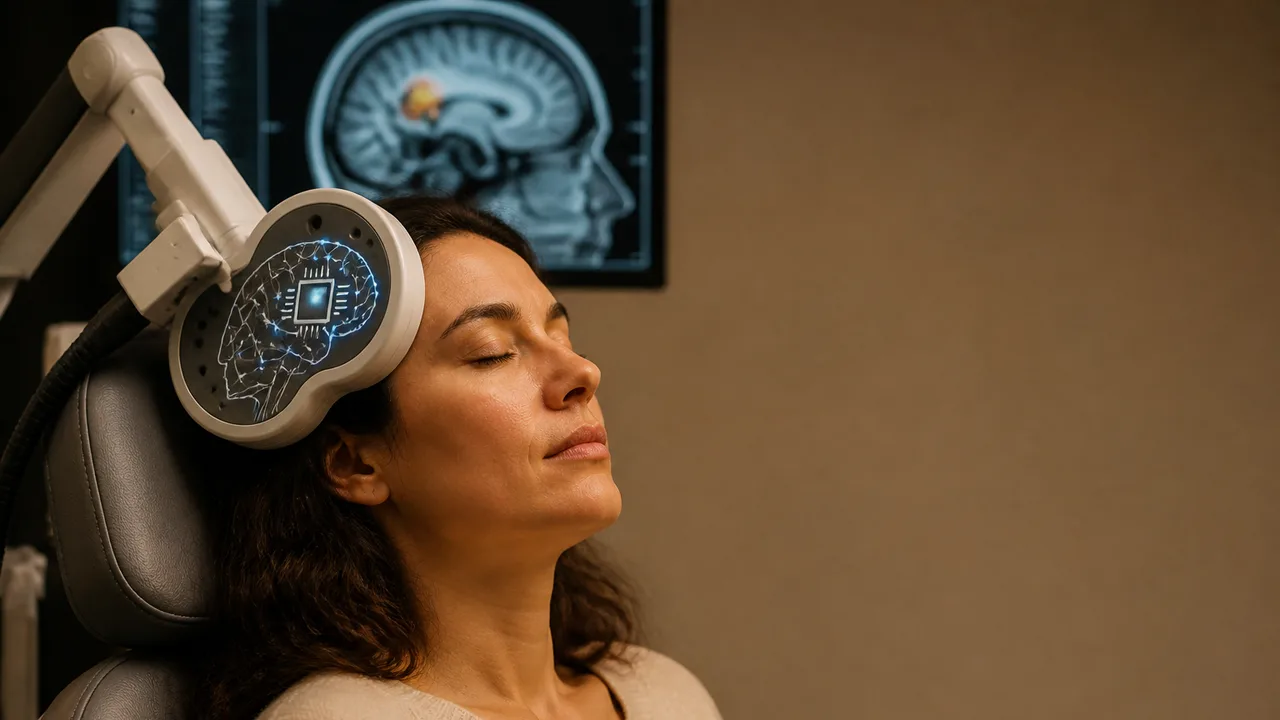
An AI-guided brain stimulation study reported reduced PTSD symptoms over two weeks. For someone whose symptoms have resisted treatment, two weeks sounds mercifully short. The finding gives researchers a reason to keep testing the approach. It does not, on its own, tell a patient how likely it is to help them: the study description does not specify the participant count, the control comparison or how long any improvement lasted.
The treatment combines artificial intelligence with repeated transcranial magnetic stimulation, or TMS. TMS uses magnetic pulses to stimulate targeted brain regions without surgery. Researchers are investigating whether AI can help choose where to aim those pulses or otherwise tailor treatment. That is a plausible use for the technology. It also creates a practical question for anyone reading the headline: How much of the improvement came from stimulation, how much from the way it was personalized, and how much might have occurred under a different treatment schedule?
Those questions are familiar in medicine. The AI label makes them easier to skip.
What a Two-Week Result Can Tell Us
PTSD symptoms can affect sleep, concentration, relationships and a person's sense of safety. A rapid reduction could make a substantial difference to daily life. Speed is one reason an intensive stimulation schedule attracts attention: someone struggling now has little comfort in the promise that researchers may have an answer years from now.
A two-week measurement captures the treatment period, though, rather than the months in which a patient needs to live with the result. A person considering repeated appointments would reasonably want to know whether improvements persist after treatment stops, whether additional sessions are needed and how often symptoms return. Those are questions about the course of care, not demands that every early study answer everything at once.
The comparison group is just as consequential. If participants receiving AI-guided TMS improve, a trial must still test how they fare against people receiving an appropriate control treatment. The comparison helps separate the effect of the new approach from the effects of receiving intensive attention, following a schedule and having symptoms fluctuate over time. Researchers can then ask a narrower question: Does the AI-guided protocol improve outcomes beyond what another credible option achieves?
Participant numbers and selection shape what a result means, too. A protocol that works for people meeting one trial's enrollment criteria may perform differently in a clinic treating people with different histories, concurrent conditions or treatment needs. No patient is an average participant, and the average participant may be a rather carefully chosen person.
The AI Question Has Its Own Control Group
TMS offers researchers adjustable choices, including the region targeted and how treatment is delivered. AI could potentially help make those choices using information about an individual patient. That is the strongest case for the combination: personalization might improve a treatment that already depends on selecting a target.
To test that proposition, researchers would need to compare AI-guided targeting with a clearly specified alternative, such as a standard targeting method, while keeping other relevant parts of care as similar as possible. If one group receives more sessions, different clinical support or a different stimulation schedule, a better outcome cannot easily be credited to the algorithm. The question is whether its decisions improved a patient's outcome.
Clinics and researchers also need to explain what “AI-guided” means in a given protocol. Did a model choose a stimulation target, recommend treatment settings or sort patients into groups? Was a clinician able to review its recommendation? Those are different jobs, with different opportunities for error. An algorithm can make a treatment plan more individualized while still making the wrong choice for some individuals.
This is where the technology conversation meets an ordinary clinical reality: a protocol has to be repeatable. If a successful result depends on specialized equipment, a carefully selected patient group or a tightly managed schedule, adopting it elsewhere requires more than buying a machine and adding “precision” to the brochure.
Keep the 68% Figure with Its Trial
A PTSD clinical-trial report cites a 68% remission rate. That figure should stay attached to the trial, treatment and definition of remission that produced it. Readers should not transfer it to the AI-guided TMS result without confirming that they refer to the same study.
Remission also asks a different question from symptom reduction. A participant might improve substantially yet still meet a study's threshold for PTSD; another might cross that threshold after a smaller change. Both measures can be useful, but each needs its own definition and time point. A percentage without those details is a poor basis for choosing care.
The temptation to combine the most exciting number with the most exciting technology is understandable. PTSD treatment can be difficult, and an apparently fast intervention offers a concrete alternative to waiting. But a patient's decision will turn on the protocol a clinic can actually offer, the outcomes it can support and the burdens that come with it. A remission rate from another trial cannot answer those questions for this one.
What Patients Can Ask a Clinic Now
Someone considering brain stimulation for PTSD does not need to conduct a journal-club meeting at the front desk. They do deserve answers in plain language. Start with the proposed protocol: What will happen at each appointment, how many visits are planned, and what part of the plan uses AI? Ask whether the clinic is offering an established service or enrolling patients in research.
Then ask about outcomes. Which study supports this protocol? Who took part, what treatment did they receive for comparison, and when were symptoms measured again? If the clinic cites a remission percentage, ask how remission was defined and whether that number comes from the same protocol being offered. Ask what side effects were recorded and what the plan is if symptoms do not improve or return after treatment.
Finally, put the proposal next to the other care options available to you. PTSD treatment may involve psychotherapy, medication or a combination, depending on a person's circumstances. A clinician can explain how a proposed stimulation course fits with an existing plan, including whether it would replace anything, run alongside it or require a change in scheduling. The comparison should include practical costs as well as hoped-for benefits: time away from work, travel, payment and the effort of repeated visits can decide whether a treatment is feasible.
That last calculation rarely makes the headline. It matters to the worker trying to arrange two weeks of appointments, the caregiver coordinating someone else's transport and the patient deciding how much uncertainty they can carry. A promising short-term result deserves serious research. A patient deserves to know what would happen on Monday morning, after the final appointment, and if the symptoms come back.
More Like This
Your Phone Is Training You. So Is Your Job.
Monami Banerjee's TEDx talk on tech and the subconscious mind hits differently when you're a professional whose job requires being permanently interruptible.
How to Find Lost Items Using Smarter Search Methods
Visual search experts, detectives, and cognitive science all point the same direction: finding lost items is about method, not effort. Here's what actually works.

Procrastination Is a Survival Mechanism, Not a Flaw
Researcher Itamar Shatz argues procrastination has evolutionary roots. Here's what the science says and which strategies actually help.

Microplastics: The Unseen Invaders in Our Lives
Explore the hidden world of microplastics in our daily lives and what you can do to minimize exposure.
Why Traumatic Memories Feel Present, Not Past
New research explains why traumatic memories feel so immediate—and what that means for how PTSD is treated. A look at the brain science and its clinical limits.
Virtual Nature Shows Promise for Hospital Blood Pressure
A hospital study links virtual river scenery and classical music to rapid blood pressure drops, but key design details and lasting benefits remain unclear.

Body Image and GLP-1s: What the Drugs Don't Fix
GLP-1 drugs can change your body, but not how you see it. Here's what psychologists say about building real body image flexibility in the Ozempic era.

ADHD Study Strategies That Actually Work
Traditional study methods fail ADHD students by design. Here's what the research actually says about study strategies built for how these brains work.