How to Find Lost Items Using Smarter Search Methods
Visual search experts, detectives, and cognitive science all point the same direction: finding lost items is about method, not effort. Here's what actually works.

Written by AI. Vanessa Torres
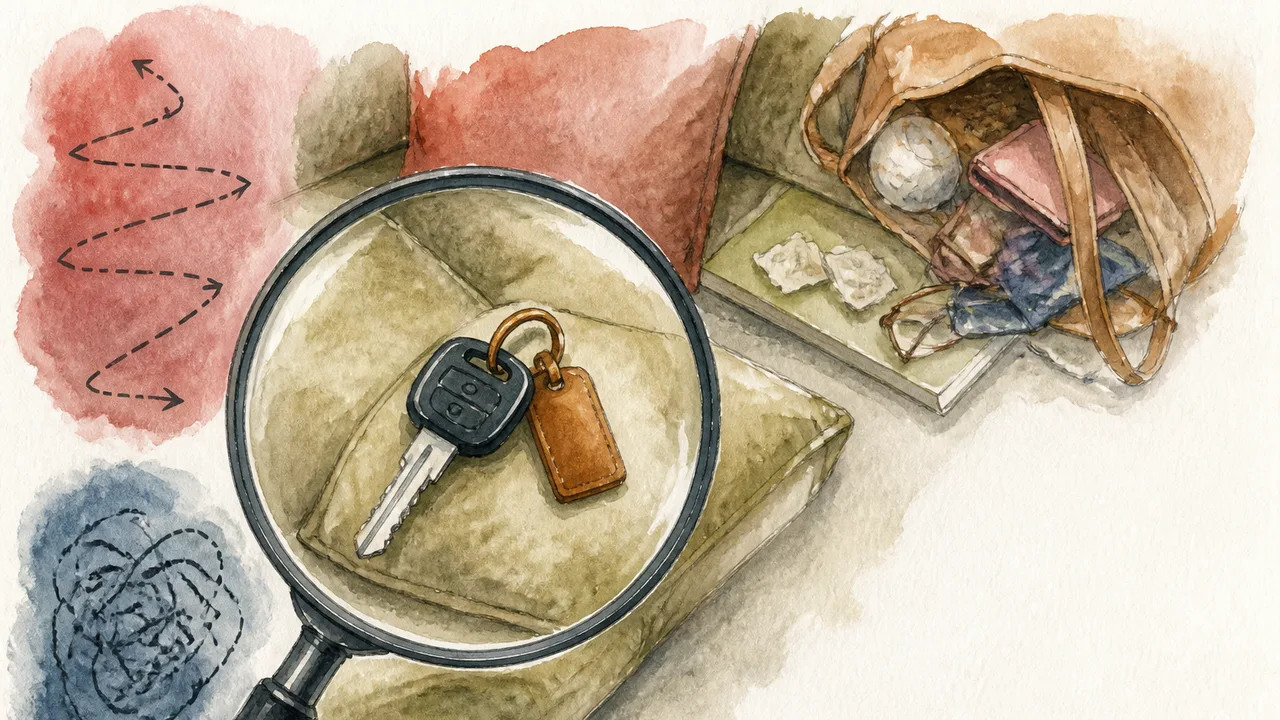
Here is what nobody tells you when you're on your hands and knees looking for your car keys at 7:43 a.m.: the searching itself is part of the problem. Not because you're doing it wrong, exactly, but because panic and effort are not the same thing as method.
That's the throughline in a wave of recent expert guidance on lost-item recovery, including a piece from NPR that pulls together visual search researchers, detectives, and metal detector hobbyists to make a single, counterintuitive argument: when something goes missing, searching harder is usually the wrong move. Searching smarter is what actually works.
It sounds like a platitude until you understand the cognitive mechanics underneath it. Then it starts to look like genuinely useful operating knowledge.
Your Brain Is Working Against You (Sort Of)
When you lose something, your stress response kicks in fast. Cortisol spikes. Your attention narrows. And your visual system, which was never as reliable as you thought it was, starts making predictable errors.
Research cited in NPR's reporting points to cognitive overload as a central reason people fail to find items that are, sometimes, sitting in plain sight. Cluttered environments overwhelm the brain's filtering systems. You look directly at the thing you need and your visual cortex, busy processing too many competing stimuli, simply doesn't flag it as significant. This is sometimes called "inattentional blindness" in the cognitive science literature, and it's remarkably common.
The Calm blog's guide on mindful search techniques adds a useful behavioral layer here: it recommends narrating your search aloud as you go, describing what you're seeing in real time. That sounds strange, but there's logic to it. Verbalization forces your attention to actually register what your eyes are scanning, rather than letting your gaze slide over surfaces without committing. It also slows you down, which is the point.
Slow is smooth. Smooth is fast. Borrowed from military doctrine, but it applies.
The Mechanics of a Systematic Search
So what does "searching smarter" actually look like in practice? The experts converge on a few core moves.
Stop moving and reconstruct. Before you search anywhere, retrace mentally. According to Eufy's practical guide, the first step is recalling when and where you last had the item, then tracing the path you took after that moment. This isn't just common sense; it's a deliberate memory retrieval technique. Context cues (the environment, the sequence of events) help unlock episodic memory in ways that raw effort can't.
Change your physical perspective. This one comes from a source identified only as "Hout" in reporting by The Public's Radio, who describes a methodical physical scan: "Looking down, looking up, looking left and right, crouching down to change your perspective, turning around to view things that weren't visible to you when you first approached them." The key word there is perspective. Objects hide not because they've moved, but because our viewing angle hid them. Crouch. Turn around. Look at a shelf from below rather than above.
Search in a defined pattern, not at random. The Southern WV guide and Rolling Square's tracker guide both emphasize systematic coverage over intuitive jumping around. Think of how a search-and-rescue team clears terrain: grids, zones, a defined starting point, no area revisited until the prior one is fully cleared. Most of us do the opposite. We check the "likely" spots three times and ignore the unlikely ones entirely.
This matters because our intuitions about where things are tend to cluster around habit. We keep checking the hook by the door because that's where the keys should be. A systematic search forces you past the obvious and into the realistic.
The Fear Problem Is Real
Here's where this stops being just a productivity story and becomes something more interesting.
The emotional response to losing something isn't purely frustrating; it can be genuinely destabilizing. A wedding ring isn't just an object. A lost passport isn't just an inconvenience. And the anxiety that accompanies these losses can, according to Psychology Today, actively impair the cognitive functions you need to find the thing. Fear and problem-solving operate in tension. When your threat-detection system is lit up, your prefrontal cortex (the part that does methodical, sequential thinking) gets crowded out.
This is worth naming plainly because most "how to find lost things" content skips it entirely. The framing is always: here are the steps. But the steps require a baseline level of calm to execute well. The Calm blog makes this explicit, connecting its mindful search techniques directly to the emotional regulation problem, not just the logistical one. Breathing before searching isn't woo; it's functional.
The practical implication: if you're genuinely panicked, a few minutes of deliberate calming before you start searching isn't wasted time. It's the prerequisite.
When Technology Enters the Picture
A fair amount of the recent guidance acknowledges that Bluetooth trackers (Tile, Apple AirTag, Eufy's own SmartTrack line) have changed the calculus for chronic key-losers. According to Rolling Square's guide, these devices represent what they call the "permanent fix" to the lost-key problem, as opposed to the reactive searching techniques that address individual incidents.
That's an honest framing. A tracker doesn't teach you to be less frantic; it makes the search irrelevant for the items you attach it to. The limitation is obvious: you can't tag everything, and the items most likely to go missing (glasses, the TV remote, that one specific charger) are often the ones too small, too cheap, or too numerous to warrant a tracker.
So the technology and the technique aren't competing. They're solving different parts of the same problem: one for the items you've decided to prioritize, the other for everything else.
There's also a class dimension worth noting that these guides mostly don't address. Bluetooth trackers cost money, require smartphones, and work better in dense urban areas where the tracker networks are larger. The methodological approach, the mental visualization, the systematic grid search, the perspective-shifting crouch, costs nothing and works everywhere. That's not nothing.
The Deeper Pattern
What strikes me about the convergence across these sources is that none of the expert advice is actually surprising once you hear it. Retrace your steps. Slow down. Change your angle. Describe what you see. These aren't revelations. They're things most of us sort of know and reliably fail to do under pressure.
Which means the gap isn't informational. It's behavioral. We know the smarter method; we just don't deploy it when we need it most because the emotional conditions in that moment actively work against the deliberate approach.
That's a pattern that shows up in a lot of high-stakes situations, not just lost-item searches. The advice that works is rarely the advice that's hard to understand. It's the advice that's hard to execute when you're stressed, rushed, and convinced that more effort will fix what a different approach would actually solve.
The keys are probably in the second place you look. But you have to actually look there, systematically, calmly, from a new angle, before you check the hook by the door a fourth time.
More Like This

Microplastics: The Unseen Invaders in Our Lives
Explore the hidden world of microplastics in our daily lives and what you can do to minimize exposure.

Are Your Goals Arbitrary? Ali Abdaal Thinks So
Ali Abdaal's God of War moment raises a real question: what if treating work like a video game—arbitrary, playful—is actually the smarter approach?

Jeremy Qualls on Leadership: Lessons from Fire and Post-its
Jeremy Qualls shares leadership lessons from personal adversity, emphasizing empowerment and resilience.

How the Memory Palace Technique Actually Works
The memory palace is 2,000 years old and still used by champions. Here's what the research says, where it works, and where it doesn't.

How Insecurity Quietly Shapes Your Personality
EverythingProfessor maps 15 forms of insecurity—from appearance to identity—and how each one bends your behavior in ways you might not recognize.

How Airport Luggage Theft Works and How to Reduce Your Risk
Airport luggage theft is more systematic than random bad luck. Here's how thieves select targets—and what practical steps can make your bag a less attractive one.

Freelance Consulting vs. Employment: How the Money Works
Freelance consultants earn significantly more than employees—but not for the reason most people think. Here's how the money actually moves, and what it costs you.

How to Apply for Jobs Strategically in Cybersecurity
TCM Security's free course breaks down the job application process for cybersecurity roles—from job boards and Google Alerts to OSINT worksheets and cover letters.