How the Memory Palace Technique Actually Works
The memory palace is 2,000 years old and still used by champions. Here's what the research says, where it works, and where it doesn't.

Written by AI. Ellis Redmond
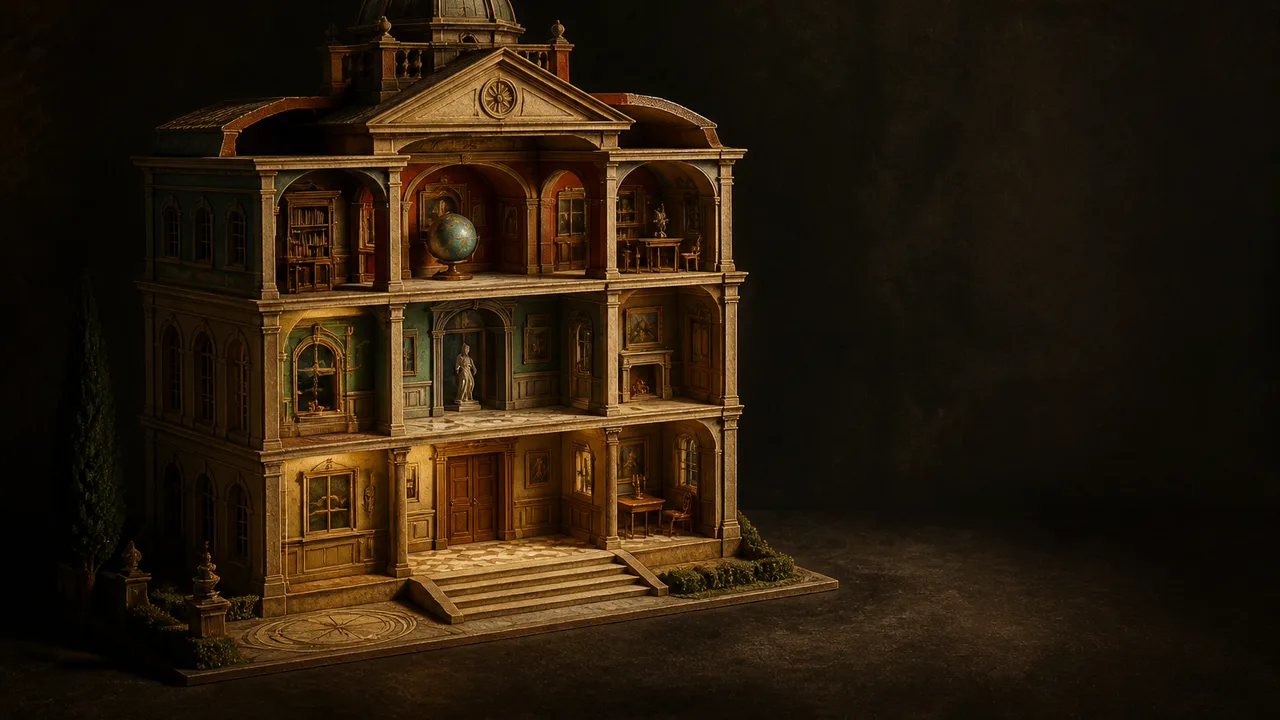
Photo: AI. Soraya Hadid
Here's a question that doesn't get asked enough: if a study technique has been around for over 2,000 years, why are most people still highlighting textbooks with a neon yellow marker and hoping for the best?
The memory palace—also called the method of loci—predates the printing press, the university system, and basically every other "learning innovation" we've collectively decided to ignore. Greek and Roman orators used it to deliver hours-long speeches from memory. Medieval scholars used it to organize vast bodies of theological knowledge. Today, it's the open secret of competitive memorizers—people who recite the order of multiple shuffled decks of cards or memorize hundreds of digits of pi on a Tuesday afternoon for fun.
A recent video from the channel Simple, Actually walks through how to build one. It's a clean, well-organized explainer, and it surfaces something worth sitting with: the memory palace isn't really a trick. It's an interface. And understanding why it works changes how you think about memory itself.
Your brain is a cartographer, not a filing cabinet
The foundational claim in the video is this: your brain doesn't remember information—it remembers places.
This isn't motivational framing. It's cognitive neuroscience. The hippocampus, the brain region most associated with memory consolidation, is also deeply implicated in spatial navigation. John O'Keefe, May-Britt Moser, and Edvard Moser won the 2014 Nobel Prize in Physiology or Medicine partly for discovering "place cells" and "grid cells"—neurons that fire in response to specific locations and help construct mental maps of space. The architecture of memory and the architecture of navigation are, quite literally, intertwined.
This is why you can walk into your childhood kitchen with your eyes closed and know exactly where the drawer with the weird batteries lives. You've never studied that drawer. You just... know.
The memory palace exploits this. Instead of asking your brain to store "KMnO₄ = potassium permanganate" as a free-floating fact with no context or location, you park it somewhere specific—your front door, your couch, your refrigerator. Your spatial memory, which is ancient and robust, takes over the job from your declarative memory, which apparently has the organizational habits of a college sophomore during finals week.
As the video puts it: "Floating information sinks quickly. The memory palace gives every piece of information a home."
The weirdness requirement
The mechanics are straightforward, which is probably why so many people try them wrong.
You choose a familiar location. You identify 10 or so fixed points along a consistent route through it. Then you place vivid, sensory, preferably absurd mental images at each stop—one image per piece of information you want to retain. You mentally walk the route, again and again, until it's grooved in.
The absurdity isn't incidental. It's load-bearing.
Psychologists call it the Von Restorff effect: we remember things that deviate from a pattern far better than things that conform to one. Your brain is constantly filtering input, deciding what to encode and what to let slide. Ordinary gets discarded. Bizarre gets flagged. A giant beauty queen spraying perfume on your television to represent Venus doesn't just entertain—it survives the filter.
The video makes this point explicitly, and it's one of the more honest things in memory-technique content: "Your memory doesn't care whether something is realistic. It cares whether it's memorable."
This is also why sensory engagement matters. Most people, when they try a memory palace, construct a vague visual—a flat mental image, like a photograph. But memory encodes through multiple channels simultaneously. The more sensory hooks you attach to something, the more retrieval pathways you create. Smell, sound, texture, movement—each one is another thread you can pull to get back to what you stored.
What the video gets right, and what it glosses over
Simple, Actually is admirably honest about the technique's limits. The memory palace, it notes, is best for retrieval of discrete facts—vocabulary, historical dates, anatomical terms, ordered sequences. It does not help you understand calculus. It does not build conceptual models. It does not replace the kind of slow, difficult practice that produces genuine expertise.
"Think of the memory palace as a storage system, not the entire learning process."
That's the right call, and it's a more careful framing than you get from the memory-technique hype machine, which sometimes implies that with the right mnemonic system, you can download any skill straight into your brain like a USB drive. You can't. Procedural knowledge—how to solve differential equations, how to code, how to write—isn't a list of facts. It's a set of internalized processes that only develop through repetition and application. No palace stores that.
What the video spends less time on is the upfront cost. Building a memory palace that actually functions—one vivid and specific enough to reliably surface information under exam pressure—takes more creative effort than most explainers acknowledge. The images need to be your images, generated by your associations, strange in ways that are strange to you specifically. This is not a passive activity. It's active construction.
There's also a skill curve that compounds in interesting ways. Your first palace will probably feel awkward and fragile. The technique rewards practice not just in the sense that you get faster—it rewards practice in the sense that your imagery gets richer and more automatic, your spatial routes more stable, your sensory engagement more instinctive. Memory champions who use this at competitive levels have often been building palaces for years. That context matters.
The spaced repetition piece
The video correctly identifies that a memory palace alone isn't enough. Time degrades memory—Hermann Ebbinghaus mapped the "forgetting curve" back in the 1880s, and it's still one of the more humbling graphs in cognitive science. Without review, even vivid spatial memories fade.
The solution it recommends is spaced repetition: reviewing material at increasing intervals (roughly 10 minutes, 1 day, 3 days, 1 week, 1 month). Each successful retrieval strengthens the memory trace and pushes the next review further into the future. The memory palace gives information a location; spaced repetition keeps the lights on.
This combination—spatial encoding plus distributed retrieval practice—is where the research gets genuinely compelling. Retrieval practice alone (the "testing effect," documented repeatedly in cognitive psychology since at least Roediger and Karpicke's 2006 work) is one of the most robust findings in memory science. Pairing it with spatial encoding that makes retrieval easier and more reliable isn't magic. It's just using two strong tools together.
What the video doesn't mention—and what's worth flagging—is that spaced repetition software like Anki can replicate the spacing schedule automatically, without requiring a physical or mental palace. For some types of content (language vocabulary, medical terminology), the combination of SRS software and the memory palace is genuinely formidable. But for learners who find the image-construction process effortful or uncongenial, SRS alone may deliver most of the benefit at a fraction of the setup cost.
Memory is personal. Systems that work brilliantly for one person can feel like cognitive purgatory for another. The memory palace has 2,000 years of evidence behind it, but "evidence it works" and "evidence it works for everyone" are different claims.
The interesting question isn't whether the memory palace works. It does, with enough practice and the right applications. The more interesting question is why most of us were never taught this—and what that says about an education system that largely defaulted to "read it again, more slowly" as the primary memory intervention.
Most people don't have a bad memory. They have a bad storage system. That distinction isn't just motivational. It's diagnostic—and it points toward something fixable.
More Like This

How to Stop Losing Time Without Realizing It
Not a time management overhaul—just a clearer look at where your hours actually go, and what's worth doing about it.
Mastering Memory: The Ladder to Lasting Knowledge
Explore Dr. Justin Sung's Memory Ladder framework to learn effectively and retain knowledge forever with neuroscience-backed strategies.

The Power of Starting Conversations with 'What'
Discover how asking 'what' instead of 'why' can transform communication and influence.

Small Behaviors That Build Genuine Respect
A YouTube channel breaks down 7 micro-habits for earning respect. The science is real—but the framing raises questions worth sitting with.
Active Recall: The Study Method Worth Knowing
Active recall means testing yourself instead of re-reading. Here's what the science actually says — and what the tidy frameworks leave out.
Boost Your Memory: Strategies That Actually Work
Discover six evidence-based strategies to improve memory by actively engaging with information. It's all about handling, not capacity.

Surrender as a Leadership Strategy, Not a Weakness
Dr. Jessica Kriegel argues that letting go of control makes leaders more effective. The research behind the claim is worth taking seriously.

How Geography Traps Russia and China in Old Thinking
Military historian Sarah Paine explains how Russia and China are prisoners of continental-power logic — and what that means for the rest of us.