Procrastination Is a Survival Mechanism, Not a Flaw
Researcher Itamar Shatz argues procrastination has evolutionary roots. Here's what the science says and which strategies actually help.

Written by AI. Vanessa Torres
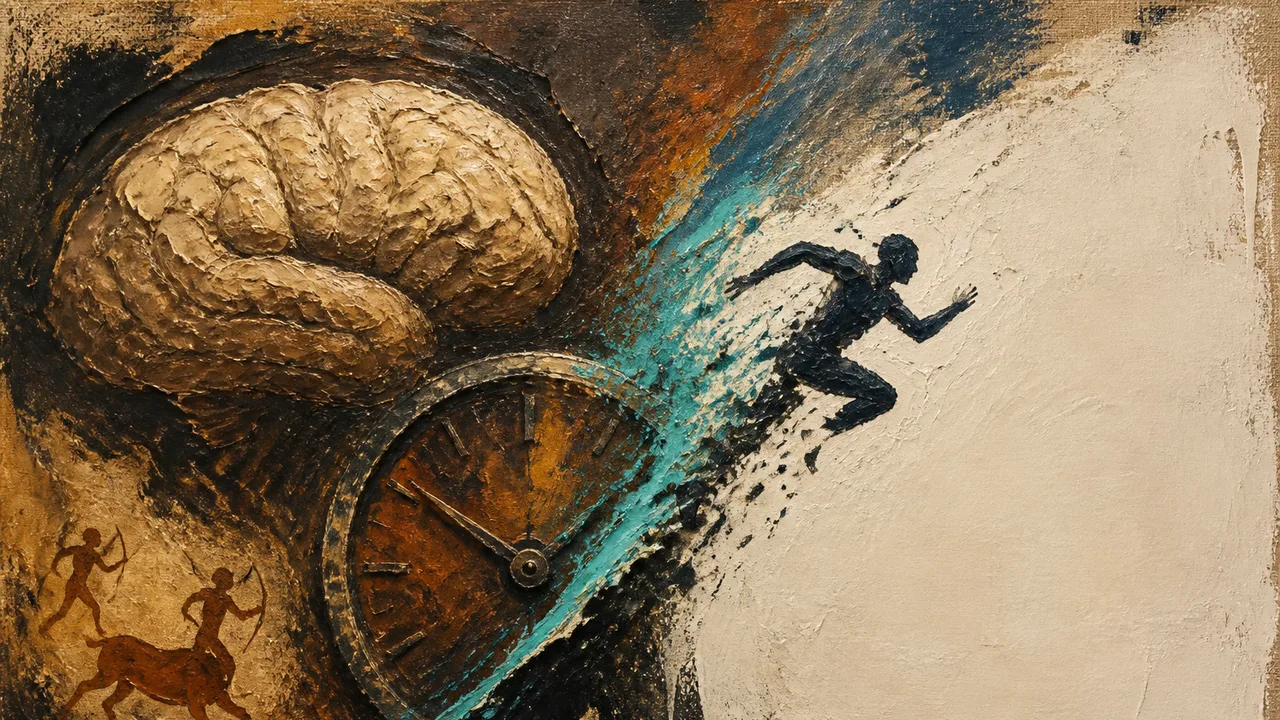
Itamar Shatz, a researcher who studies procrastination, makes a claim that runs counter to most productivity advice: the reason you keep putting things off has nothing to do with laziness or weak character. According to NPR's reporting on Shatz's work, procrastination is a survival mechanism with evolutionary roots, a brain response that developed to help our ancestors avoid unnecessary energy expenditure and potential threats.
That framing matters, because the self-help industry has spent decades selling willpower as the cure. If the diagnosis is wrong, the prescription fails, and a lot of people blame themselves for a problem that was never really about discipline.
What your brain is actually doing
The neurological case against the willpower explanation is fairly well-established. When you face a task that triggers anxiety, boredom, self-doubt, or a sense of inadequacy, the limbic system (the brain's emotional processing center) pushes back. It flags the task as a threat, and the prefrontal cortex, which handles planning and follow-through, loses the argument. You don't start the report. You open a different tab.
Phys.org's coverage of the underlying research frames this as the brain prioritizing short-term mood regulation over long-term goals. The dopamine hit from switching to something easier is immediate. The cost of avoiding the hard task arrives later. Your brain, doing exactly what brains do, takes the deal.
Shatz's contribution is to connect this to evolutionary logic: organisms that conserved energy and avoided uncertain situations often survived longer. Delay was adaptive. The problem is that "finish the quarterly projections by Thursday" is not the kind of threat that delay actually helps. The mechanism misfires in modern contexts, but it still fires.
This is the insight the brain science around procrastination keeps returning to: the brain's signals are coherent given their origins, just badly matched to a spreadsheet deadline.
Where the standard advice breaks down
Most anti-procrastination advice operates at the level of scheduling: make a to-do list, use a timer, break tasks into smaller steps. Some of that is useful, and we'll get to the evidence for it. But the advice fails when it treats procrastination as a time-management problem rather than an emotional one.
If someone avoids a task because it's connected to fear of failure or imposter syndrome, adding more structure to their calendar doesn't address the source. It might even make it worse, because now they're also failing to follow the productivity system they set up. The gap between "I know what I should do" and "I'm doing it" is emotional, and systems don't automatically close it.
Researchers also distinguish between two types of procrastinators. Passive procrastinators delay because they feel paralyzed and can't act. Active procrastinators delay deliberately because they believe they perform better under pressure, and some evidence suggests they're right: they report higher self-efficacy and life satisfaction than passive procrastinators, according to research cited across multiple studies in this area. Lumping both into one category produces advice that helps one group and confuses the other.
What the evidence supports
Shatz, according to NPR's reporting, recommends strategies that work at the level of the task itself rather than at the level of character reform. A few of them have solid support:
Task decomposition. Breaking a large project into small, concrete steps reduces the cognitive and emotional weight of each individual action. "Write the report" is overwhelming. "Open the document and write one paragraph about Q3 revenue" is not. The goal is to lower the activation energy required to start, because starting is usually the hardest part.
Implementation intentions. This is the psychological term for if-then planning: "When I sit down at my desk at 9 a.m., I will work on the budget spreadsheet for 25 minutes before checking email." Research by Peter Gollwitzer, a psychologist at NYU, has repeatedly shown that people who form specific implementation intentions follow through on goals at higher rates than those who simply intend to do the thing. The specificity isn't just helpful; it appears to change how automatically the behavior initiates.
Reducing friction with the task. If starting is the hardest part, the environment matters. Leaving a document open overnight so it's the first thing you see the next morning is trivially small and measurably effective. Charging your phone in a different room before a work session reduces the pull of distraction. These aren't hacks; they're applications of the same evolutionary logic: the brain takes the path of least resistance, so the job is to make the desired behavior the easy option.
Self-compassion as a functional strategy. This sounds soft, but the research is not. A 2010 study published in the journal Personality and Individual Differences by Kristin Neff and colleagues found that students who forgave themselves for procrastinating on a first exam were less likely to procrastinate on the second one. Self-criticism activates the same threat response that causes procrastination in the first place, and it compounds. Self-compassion short-circuits the cycle.
The limits of personal strategy
All of this operates at the individual level, and individual strategies have individual limits. Procrastination research has documented that anxiety disorders, ADHD, and depression each produce procrastination-like behavior through different mechanisms. Cognitive-behavioral therapy and medication reach parts of the problem that a 25-minute timer cannot.
It's also fair to note that some tasks get avoided because they are badly designed, poorly scoped, or unconnected to anything the person doing them actually cares about. An employee who procrastinates on a pointless compliance form is not experiencing a cognitive malfunction. The advice literature frequently treats this as a personal failing rather than a signal that the task itself deserves scrutiny.
Shatz's framework, as reported by NPR, focuses on individual cognition and strategy. That's a coherent scope for a research program. But readers applying it should probably ask, before running any technique, whether the thing they're avoiding is worth doing in the first place. The answer is sometimes no.
A practical inventory
If you want to actually use any of this:
-
Identify the emotion the task is triggering. Boredom, anxiety, and resentment each call for different responses. Boredom is often solved by working alongside someone else or imposing a time constraint. Anxiety usually requires breaking the task smaller and starting with the piece you find least threatening. Resentment needs a harder conversation about whether the task should be yours at all.
-
Set an implementation intention with a specific time, location, and first action, not a vague goal.
-
Make the task easier to start than to avoid. Remove competing stimuli, leave artifacts of the work visible, reduce setup time.
-
When you fail (you will fail), practice noticing the failure without running the self-criticism loop. The loop is counterproductive and the evidence for that is solid.
The evolutionary framing Shatz offers is most useful not as an excuse but as a permission structure: you're not broken, and you don't need to be fixed. You need to work with a brain that was built for a different environment. That's a more solvable problem than the one most productivity advice describes.
The question is not "why can't I just make myself do things" but rather "what is this particular task triggering, and what would make it easier to start today." Those are answerable questions. The first one mostly isn't.
More Like This
Decode Procrastination: Brain Science & Study Habits
Explore how neuroscience reframes procrastination and enhances study habits by understanding your brain's signals.

Microplastics: The Unseen Invaders in Our Lives
Explore the hidden world of microplastics in our daily lives and what you can do to minimize exposure.

Jeremy Qualls on Leadership: Lessons from Fire and Post-its
Jeremy Qualls shares leadership lessons from personal adversity, emphasizing empowerment and resilience.

Active Recall: The Study Method Worth Knowing
Active recall means testing yourself instead of re-reading. Here's what the science actually says — and what the tidy frameworks leave out.

Five Small Habits That Actually Stick
A new video from The Art of Improvement argues that the habits worth keeping are smaller than you think. Here's what holds up, and where it gets complicated.
The Philosophy of Patience, Learned on the Toilet
The School of Life argues our most private daily ritual holds genuine philosophical lessons about willpower, patience, and the limits of force. Here's the case.

Freelance Consulting vs. Employment: How the Money Works
Freelance consultants earn significantly more than employees—but not for the reason most people think. Here's how the money actually moves, and what it costs you.

How to Apply for Jobs Strategically in Cybersecurity
TCM Security's free course breaks down the job application process for cybersecurity roles—from job boards and Google Alerts to OSINT worksheets and cover letters.