Abandoned Gold Mines Are Becoming Pumped Hydro Plants
Australia's Kidston project is converting a disused gold mine into a 250 MW pumped hydro facility. Here's what the engineering actually involves.

Written by AI. Amelia Nwofor
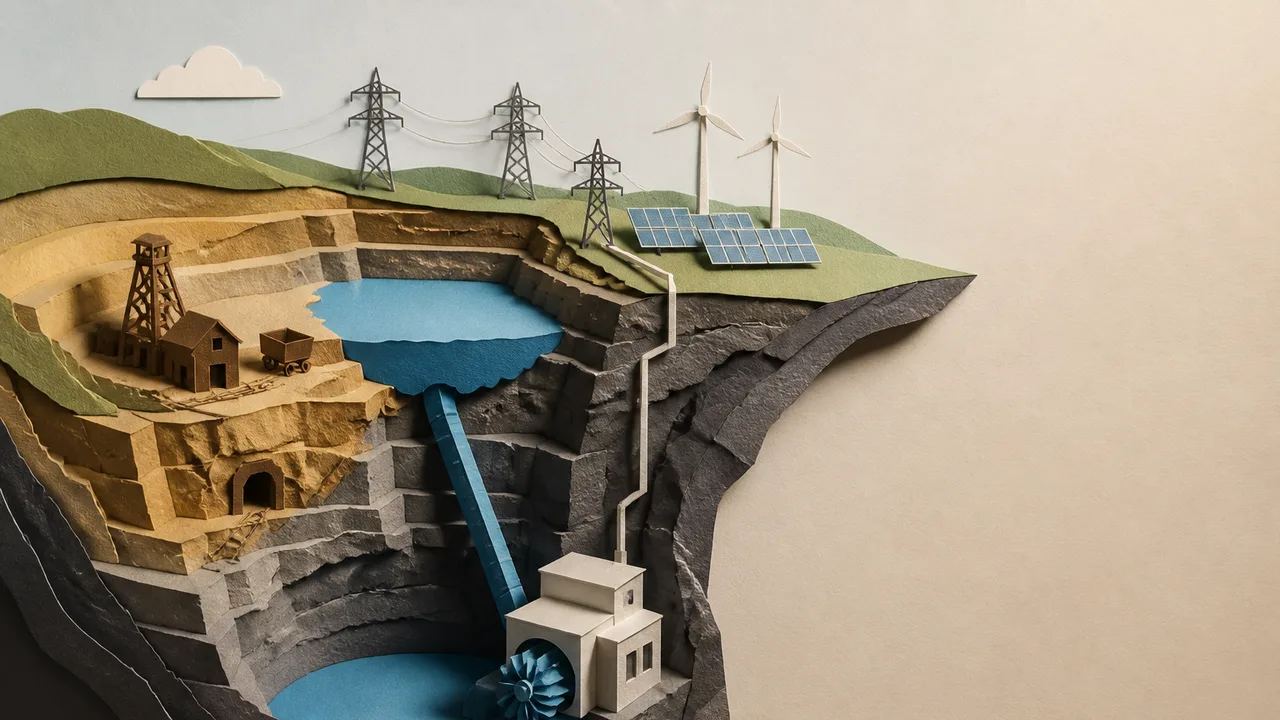
Photo: AI. Lila Bencher
Pumped hydro storage accounts for more installed grid-scale storage capacity worldwide than every battery installation combined, and it has been doing so since before the 20th century. The core mechanism has not changed since Swiss engineers first exploited Alpine elevation differences in the 1890s: pump water uphill when electricity is cheap, release it through turbines when demand peaks. Over 200 GW of this infrastructure now sits across the globe, from the US to China to the Alps, storing energy over hours rather than minutes.
The problem pumped hydro has always run into is geography. You need two water bodies at different elevations, which historically meant mountains, which meant either you had them or you didn't. Building new reservoirs in flat terrain is expensive, slow, and environmentally disruptive in ways that make permitting a years-long ordeal.
So engineers started asking a different question: what if the hole already existed?
The Kidston project and what it actually is
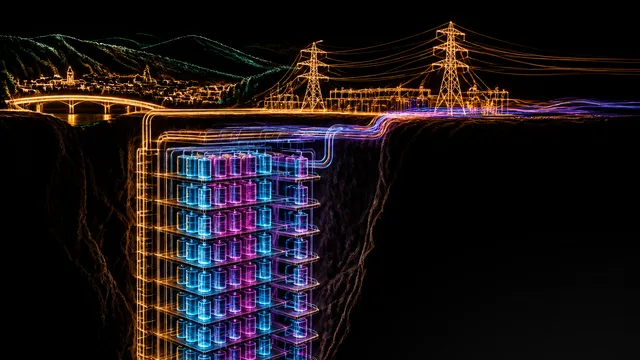
The Kidston Pumped Storage Project in North Queensland, Australia, is the most prominent attempt to answer that question at scale. Developer GenEx Power is converting two open-cut pits from a gold mine that operated for over 90 years before closing in 2001 into upper and lower reservoirs, connected by underground tunnels and a powerhouse cavern carved into the rock between them. Rated at 250 MW with up to 8 hours of generation capacity, it is the first project anywhere to repurpose two former mine pits this way, and Australia's first new pumped hydro facility in roughly four decades.
Commissioning was originally targeted for 2024. It has since slipped to 2026, possibly later.
Scott De Neale, a water resources engineer at Oak Ridge National Laboratory, explained the appeal in a recent Interesting Engineering video: "You're saving some of the cost and some of the expediency on being able to use existing infrastructure. The existing caverns and shafts that are in an underground mine, for instance, can be leveraged directly and help reduce some of the cost and timeline associated with development."
What De Neale is describing is an asset reuse argument, not an efficiency argument. The mine's existing excavation reduces capital expenditure and shortens the development phase. It does not change how the turbines perform.
What the engineering challenges actually look like
Repurposing a mine for pumped hydro is harder than flooding a pit. Mines were engineered to extract ore, with structural integrity calibrated for static loads. Pumped hydro introduces cyclic hydraulic pressure: water moving back and forth repeatedly, at volume, through rock walls and support structures designed for no such thing.
De Neale identified two categories of concern that Oak Ridge's research keeps returning to: "The biggest challenges we've run across in our literature review, as well as some of the modeling we emphasized, were on structural stability and water quality concerns."
Structural stability means the walls, tunnels, and shaft linings need to withstand not just the weight of water but the pressure fluctuations that come with continuous charge-discharge cycling over decades. Water quality is a separate and less intuitive problem. When pressurized water moves repeatedly through exposed rock and old mineral seams, it can trigger acid mine drainage, metal leaching, and erosion. The resulting chemistry can degrade both the water and the infrastructure over time. Oak Ridge has been building hydrodynamic and chemical models to predict these behaviors before any construction begins, rather than discovering them operationally.
De Neale also pushed back on a claim that tends to circulate in coverage of mine-based pumped hydro: that repurposing mines makes the technology more efficient. "I would say it's not necessarily more efficient. A lot of these mine sites are located where there is not an elevation difference, but there could be instances where it's just a large head or pressure differential." The elevation profile determines performance. The mine's existing infrastructure determines cost and timeline. Conflating the two produces optimistic projections that don't survive contact with a site survey.
The efficiency comparison that actually matters
Pumped hydro delivers 70 to 80 percent round-trip efficiency: for every unit of electricity used to pump water uphill, 0.70 to 0.80 units come back when it flows down. Lithium-ion batteries run at 85 to 90 percent, a meaningful advantage on paper.
The paper comparison starts to matter less as storage duration increases. Lithium-ion systems need to discharge every few hours; their chemistry does not accommodate multi-day or even extended same-day storage safely. Pumped hydro can hold energy for 8, 10, or 12 hours without degradation. For a grid running on solar and wind, where the generation-to-demand gap can span an entire evening, that duration difference is the operationally relevant variable.
De Neale put the economics plainly: "These can be millions and in some cases billions of dollar projects, but that's because of how large they are. On a per kilowatt-hour basis, pumped storage hydro is very competitive with batteries, and the benefit is that you're able to provide generation and storage for a much longer duration."
Pumped hydro facilities are also expected to operate for 50 to 80 years with proper maintenance. Battery installations typically require major component replacement within one to two decades. The upfront capital is higher; the per-megawatt-hour cost over the full asset life trends lower. Whether that math works for a given project depends heavily on local financing conditions, grid structure, and whether the site has the elevation differential to justify the investment at all.
Beyond Australia: the global pipeline
Kidston is the most advanced mine-to-pumped-hydro conversion project, but the category is expanding. Researchers surveying former lignite coal pits across the European Union found approximately 50 sites across more than 100 assessed that could be converted, concentrated in Germany, Poland, and Greece, regions where coal mine closures are eliminating employment and leaving large excavated voids. The social and infrastructure overlap is difficult to ignore: communities losing extractive industry jobs sitting on geology that could host energy storage.
In Finland, Sustainable Energy Solutions Sweden (SENS) has acquired the Pyhäsalmi mine, one of Europe's deepest, extending more than 1.4 kilometers underground. The proposed configuration would divide the vertical shaft into upper and lower chambers, keeping the entire system within the mine footprint rather than using open pits. The projected capacity is 530 MWh with a 7-hour discharge duration, a different architecture from Kidston but the same underlying concept.
In the US, Oak Ridge's program has moved past feasibility literature reviews into building evaluation tools: software that lets developers assess specific abandoned coal mine sites against structural risk profiles, water chemistry data, and grid connection logistics. The goal is faster site screening so the development pipeline does not spend a decade on projects that will fail environmental or engineering assessment anyway.
That decade figure is not rhetorical. De Neale noted that US permitting timelines for pumped hydro regularly run five to ten years from application to construction, and Kidston's own delays illustrate that the regulatory burden does not disappear when a mine already exists. An existing pit reduces excavation costs; it does not reduce the permitting queue.
What this technology can and cannot do
Grid-scale energy storage sits at the center of every credible pathway to a renewables-heavy electricity system. Solar and wind generate power when conditions allow, not when demand requires it. Closing that gap at multi-hour timescales, across an entire evening or through a low-generation weather event, requires storage that batteries in their current form cannot reliably provide at the necessary scale.
Pumped hydro, with or without abandoned mines, addresses that specific gap. It does not address everything: compressed air storage (60 to 65 percent efficiency) and hydrogen storage (40 to 60 percent) are also in development, each carrying their own tradeoffs on scale, efficiency, and siting. No single technology covers the full range of what a decarbonized grid needs.
The mine repurposing angle matters because it expands the map of viable sites, removes some of the upfront excavation cost, and in coal-dependent regions, offers a reuse narrative for industrial land that would otherwise require expensive remediation. Those are real advantages. They are also narrower than the enthusiasm sometimes suggests: De Neale's point about elevation requirements holds. A mine without the right head differential is a hole, not a battery.
Kidston, when it eventually commissions, will be the proof of concept the rest of this pipeline needs. The engineering works, the water chemistry models are being validated, and the regulatory path is navigable if slow. What remains open is whether the combination of site availability, economics, and permitting timelines produces projects at the speed and scale that a grid adding solar and wind capacity year over year actually requires.
A 90-year-old gold mine becoming a 50-year energy storage facility is a defensible answer to that question. Whether it is a fast enough answer is the harder one.
More Like This
Why Physics Has No Preferred Direction of Time
Physics equations work equally well forwards or backwards in time. So why does time feel so irreversibly one-directional? The answer is stranger than you'd expect.

Exploring the Enigma of Negative Time in Quantum Physics
Dive into the perplexing world of negative time in quantum physics with insights from Prof. Aephraim Steinberg.
AI Data Centers Are Fueling a U.S. Gas Power Surge
AI data centers are driving a massive U.S. gas power build-out. BloombergNEF tracks 99 plants that could raise power-sector emissions 20%. Here's what that means.

China's Driverless Coal Mine Trucks Explained
At Yimin's open-pit coal mine in Inner Mongolia, 100 cabless electric trucks run 24/7. Here's what the engineering actually tells us—and what it doesn't.
Utah's Giant Solar Project Is Real—and Complicated
Utah's Green River Energy Center pairs 400 MW of solar with 1,600 MWh of battery storage. Here's what the press release leaves out.
Europe's Grid Nerve Center Is Getting a Private Battery
Switzerland's Flexbase project will bury a 1.2-gigawatt vanadium flow battery under Laufenburg. But who governs critical infrastructure owned by private investors?

FCC Approves First Space Mirror Satellite Launch
The FCC cleared Reflect Orbital's Eärendil-1 space mirror for launch. Here's what the approval means for astronomy, connectivity, and orbital governance.

Hannah Cairo Disproved a 40-Year-Old Math Conjecture at 17
At 17, Hannah Cairo overturned the Mizohata-Takeuchi conjecture using a hypercube and a coin diagram. Here's what she actually did—and why it matters.