China's Driverless Coal Mine Trucks Explained
At Yimin's open-pit coal mine in Inner Mongolia, 100 cabless electric trucks run 24/7. Here's what the engineering actually tells us—and what it doesn't.

Written by AI. Zara Chen
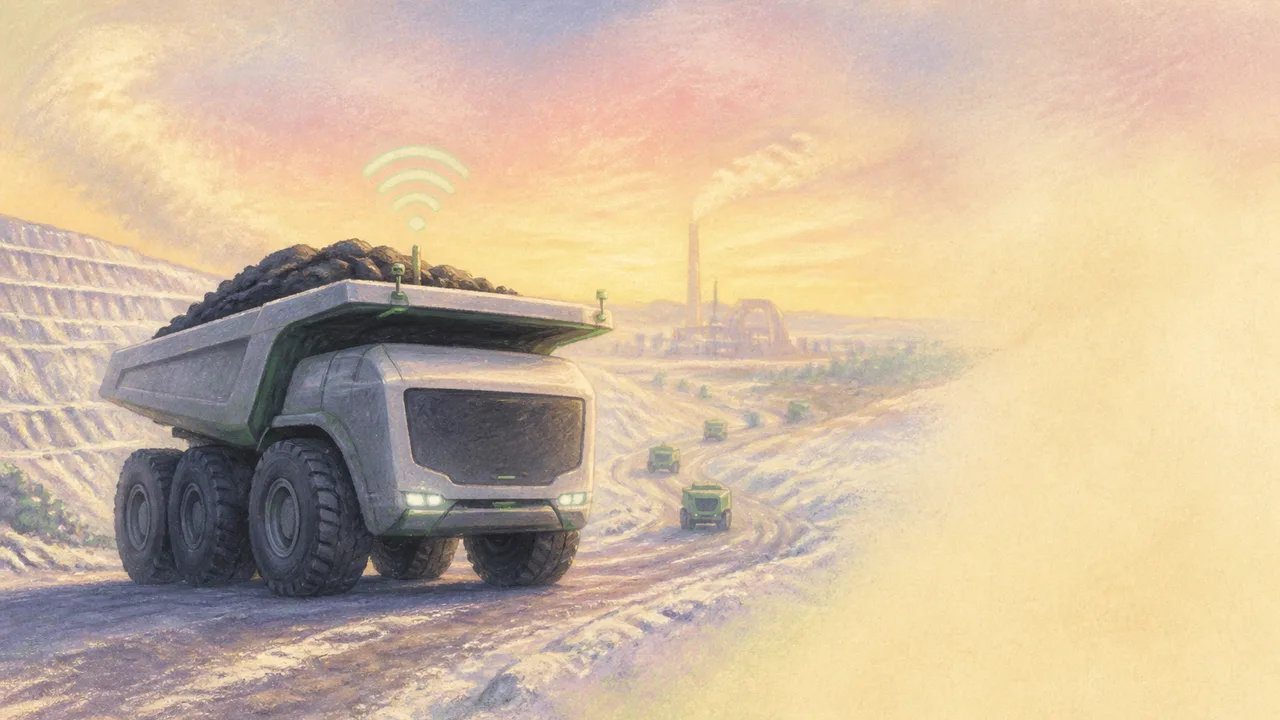
Photo: AI. Aiyana Stone
There's a truck operating right now in Inner Mongolia that has no cab, no windows, no seat, and no driver. It hauls close to 100 tons of coal through a pit that drops to minus 40°C in winter, and it does not care even a little bit. In May 2025, Yimin Open Pit Mine near Hulunbuir switched on 100 of these machines simultaneously—the largest single fleet of driverless electric haul trucks anywhere on Earth.
A year later, according to IE Explains, each truck is delivering around 120% of the output of a human-driven diesel equivalent. That number deserves a second read. These aren't just matching human-piloted performance. They're beating it.
So how does a coal pit in northern China end up running what might be the most technically sophisticated clean haulage fleet on the planet? And what do we actually make of that?
From 90 to 4,000 in Five Years
In 2020, China had roughly 90 autonomous vehicles working across its open-pit coal mines. By 2025, that figure passed 4,000. The IE Explains video attributes this directly to two forces: government mandate and body counts.
China's National Development and Reform Commission ordered a push toward "intelligent mining" in 2020, with a target for automated baseline operations by 2035. But the video argues the safety imperative was sharper: "After years of fatal accidents, regulators recognized that the single fastest way to prevent injuries in a pit was to remove human operators entirely." Hard to argue with that logic when you consider that, according to the video, haul truck accidents at Rio Tinto and BHP sites fell by roughly 90% after autonomous deployment.
China wasn't first. Rio Tinto started testing autonomous haulage in Australia's Pilbara region back in 2008. But the speed of China's scale-up is something else entirely. Between 2024 and 2025, the global autonomous haulage fleet grew 84%, climbing from roughly 2,000 trucks to nearly 3,800. China drove most of that growth, overtaking Australia, Canada, and Chile to become the largest autonomous haulage market on Earth.
The Engineering Behind the Truck
The Yimin trucks were built through a collaboration involving XCMG and Huawei, among others, and they were designed from scratch to be driverless—not retrofitted. No cab means no mirrors, no heater, no windshield. The video points out this isn't just an aesthetic choice: "That saves weight, cost, and one entire category of failure."
Power comes from a 568 kWh lithium iron phosphate battery pack—and here's where the design gets interesting. Charging a truck this size would gut its duty cycle. So the mine doesn't charge; it swaps. An automated station pulls a depleted pack and drops in a fresh one in about five minutes. By late 2025, XCMG reported nearly 47,800 swaps at Yimin with a success rate above 98%.
Then there's the connectivity layer, which is where Yimin genuinely breaks new ground. The video describes it as "the first open pit mine running on a 5G advanced network," with 500 megabits of uplink and 20-millisecond latency. The trucks stream HD video up; the cloud sends dispatch commands back down. A control room watches the whole fleet over the Huawei network, while Huawei's cloud builds a live, crowd-sourced map of the pit from data contributed by every truck in real time.
That last part is the actual architectural departure from Western autonomous mining. As the video frames it: "The Chinese model pushes perception and dispatch out to the network. That is a real architectural fork, and it only works if the radio never drops." Western fleets—Rio Tinto, BHP, Caterpillar—largely keep the intelligence onboard each vehicle. The network dependency at Yimin is a bet on infrastructure reliability. If the 5G drops, you've got a very expensive traffic jam.
Does the Money Actually Work?
This is where it gets complicated, and the video doesn't flinch from it.
An autonomous-capable haul truck costs somewhere between $1.5 million and $2.5 million before you add the network and control room infrastructure. In Australia, where haul truck drivers earn roughly $100,000–$120,000 USD per year and a big pit runs hundreds of them, the math on automation is essentially a no-brainer. Payback in three to six years, according to industry estimates cited in the video.
In China, the same driver earns $16,000–$25,000 a year. That stretches the payback window to seven to twelve years. So labor savings alone don't explain Yimin.
What does? The video's analysis points to three factors stacking on top of the labor equation. First, 24/7 continuous operation—a driverless fleet doesn't stop for shift changes, breaks, or fatigue regulations. Yimin's advisers reportedly indicated the site previously required substantially more trucks and over a thousand drivers to maintain round-the-clock operations. Second, fuel costs, which typically represent 20–30% of a mine's operating budget. Going electric at Yimin is projected to cut diesel consumption and meaningfully reduce CO2 emissions annually. Third, equipment longevity. Evidence from Australian autonomous mines suggests autonomy cuts tire costs by 15–20% and extends equipment life by 20–30%, simply by eliminating harsh braking.
Put all three together and the case for automation in China starts looking less like a labor play and more like a total operating cost play.
Two Philosophies, One Race
Outside China, the Western benchmark remains Australia. Rio Tinto runs over 300 autonomous trucks across multiple sites. BHP operates around 360. Fortescue signed a $2.8 billion deal with Liebherr covering zero-emission autonomous haulage machines targeted for delivery by 2030. Komatsu has commissioned over 1,000 ultra-class autonomous haul trucks. Caterpillar is targeting over 2,000 by 2030.
The size difference matters for this comparison. Chinese fleets are mostly 60-to-100-ton class machines. Western fleets run 220-to-360-ton ultra-class behemoths. Count vehicles and China dominates easily. Count tons moved and the gap narrows significantly.
And the unsolved problems, the video notes, are "unglamorous"—interoperability between trucks from different manufacturers, maintaining satellite positioning deep inside a pit, and rebuilding haul roads originally engineered around human judgment calls.
What's really happening, the video argues, is two different architectural philosophies running parallel experiments: "The West is automating a small number of very large machines, keeping the intelligence on board. China is automating a very large number of medium machines and wiring the whole pit into one network. Whichever ends up cheaper per ton moved is the one the rest of the world may copy."
The Inconvenient Frame
Here's the tension this story can't escape. The video names it directly: "The uncomfortable truth is that most of the advanced electric haulage fleets on Earth exist to dig up coal faster and cheaper."
Clean trucks. Dirty fuel. Coal—roughly 80% of China's autonomous fleet deployment—is not on a green trajectory by virtue of being hauled by a battery-electric vehicle. The environmental math on EVs is well-established for passenger cars, where the carbon debt from production is typically paid back within a few years even on coal-heavy grids. But the video notes that efficiency gains diminish as vehicle size increases, and that "a strong case has been made for larger vehicles to run on hydrogen" for exactly that reason. The electric choice at Yimin, the video is candid about, is "more about modernization and accessible technologies here, rather than eco-conscious practices."
That's an honest framing. The technology is genuinely impressive. The engineering is real. The safety gains are documented. None of that changes what's being dug up.
Whether the spread of this model—and Chinese suppliers are reportedly targeting Australia, the Middle East, and Europe—represents progress probably depends less on your view of autonomous systems and more on your view of where coal is actually headed.
More Like This

This Creator Got Shadowbanned on YouTube in 25 Days—On Purpose
A vidIQ creator deliberately shadowbanned their channel with AI-generated content to expose how YouTube's algorithm actually works. The results are wild.
Master Remote Access with Comet Pro KVM
Explore the Comet Pro KVM for seamless remote PC access: Wi-Fi 6, out-of-band management, and Tailscale security.

AI Chip Smuggling and the US-China Tech Divide
FT's Eleanor Olcott investigates the black market for Nvidia AI chips reaching China despite US export controls — and what it reveals about the tech race.
Mountain Pass Mine and the U.S. Rare Earth Supply Gap
The Mountain Pass mine once supplied 70–80% of global rare earths. Here's how the U.S. surrendered that dominance—and what it actually takes to rebuild it.
AI and Robotics Are Reshaping Air Cargo Logistics
Singapore's Speedcargo is using 3D computer vision and gantry robotics to fix a surprisingly analog problem at the heart of global air freight.
China's Robotaxi Push and the Workers in Its Path
China's robotaxi companies are expanding globally on EV supply chain strength—but what does that mean for the drivers whose livelihoods disappear in the process?

Flock Cameras Track Far More Than License Plates
Flock Safety's AI-powered cameras are spreading fast across U.S. cities—and they're capturing far more than license plates. Here's what's at stake.

A YouTuber Got a Sequence Into the OEIS With XOR Math
Gary Explains got an original integer sequence accepted into the OEIS by XOR-ing numbers in loops. Here's why that's genuinely fascinating—and what it connects to.