AI and Robotics Are Reshaping Air Cargo Logistics
Singapore's Speedcargo is using 3D computer vision and gantry robotics to fix a surprisingly analog problem at the heart of global air freight.

Written by AI. Marcus Chen-Ramirez
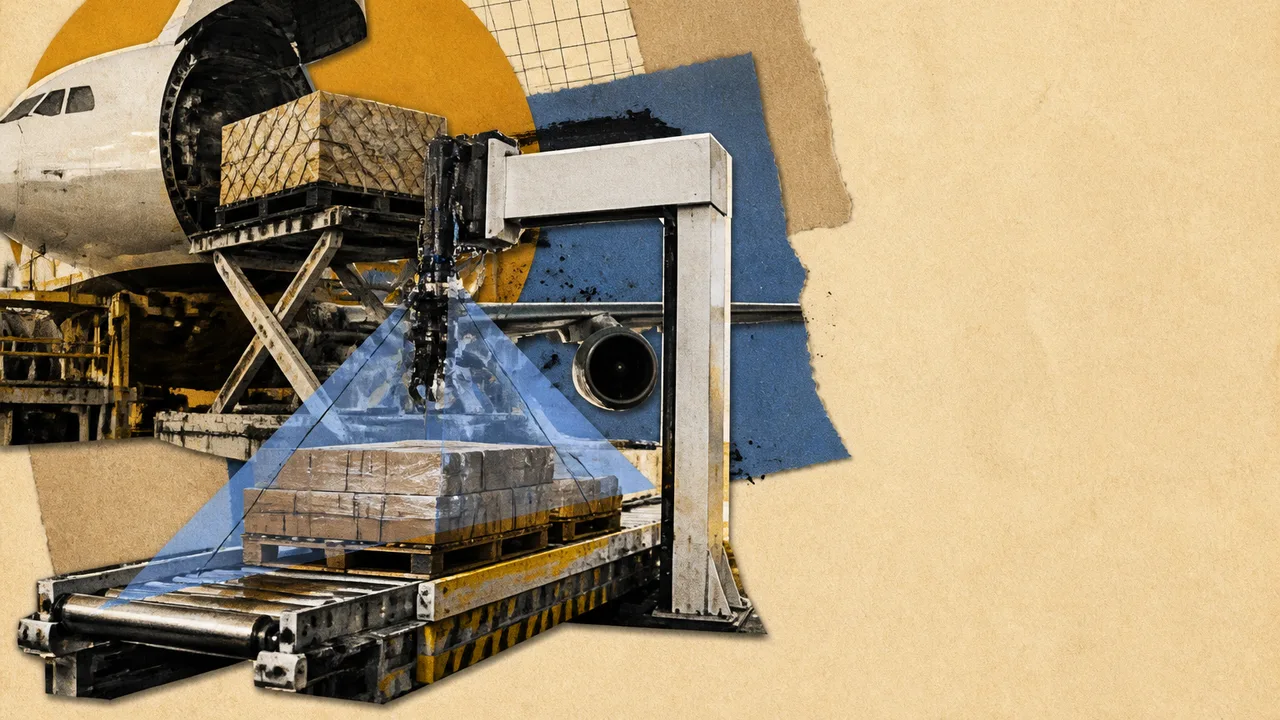
Here's a number worth sitting with: a significant share of air cargo space flies underutilized on every route, every day, because nobody actually knows, with precision, how much space the freight will take up until it's already at the dock. The industry has run on estimates—tape measures, human judgment, legacy software that was new when cargo planes still had propellers. The gap between what an aircraft could carry and what it does carry represents money left on the tarmac, quite literally, at scale.
That's the problem Speedcargo, a Singapore-based logistics technology company, is built to solve. And the approach—deploying 3D computer vision and gantry robotics to measure, analyze, and optimize cargo loading—turns out to be a useful lens on a broader transformation happening across the air freight sector.
The Measurement Problem No One Talks About
Before you can pack a plane efficiently, you need accurate data about what you're packing. This sounds obvious. It is, somehow, still not standard practice.
Traditional cargo intake relies on shipper-declared dimensions, which are frequently wrong—not always through bad faith, but because measuring irregular freight with manual tools is hard, slow, and introduces human error at every step. The downstream effects compound: suboptimal unit load device (ULD) builds, wasted belly space, revenue leakage, and planning systems running on bad inputs.
Speedcargo's system, featured in OpenCV Live's episode 220, addresses this at the intake stage. Gantry-mounted sensors capture precise 3D scans of incoming freight, generating accurate volumetric and dimensional data before anything gets near an aircraft. Optimization algorithms then use that data to generate better load plans. The appeal is straightforward: garbage in, garbage out has always been the enemy of logistics efficiency, and this removes a major source of garbage.
Dr. Nair of Speedcargo, quoted by Stat Times, puts the design philosophy plainly: "our automation solution, too, is modular and scalable, so that ground handlers can choose the degree of automation that would be appropriate for them. The robots are quite versatile, too." That's a deliberate pitch to an industry that is, frankly, wary of wholesale disruption—the modularity framing lets potential customers step in without committing to a full rip-and-replace.
A Sector-Wide Inflection Point
What makes Speedcargo's work interesting isn't that it's unique—it's that it's one data point in a broader pattern that's been building for several years.
The International Air Transport Association's 2025 Vision for Air Cargo Facilities frames automation not as an option but as an operational necessity, noting that robotics are playing a central role in improving efficiency, precision, and safety across the sector. IATA doesn't tend toward hyperbole, so when the trade body frames automation as structural rather than experimental, it's worth paying attention.
Germany is running live trials. Air Cargo Week reports that a project led by the IML—part of the Digital Testbed Air Cargo (DTAC) initiative, funded by the German Federal Ministry for Digitalization—is actively testing robotics in real airport cargo environments. The distinction between "testbed" and "live operation" matters: this isn't a controlled lab scenario. It's robots working in the actual, chaotic environment of a functioning cargo terminal, where the freight doesn't arrive in neat sequences and the timelines don't respect experimental parameters.
Meanwhile, on the software and sensing side, CargoAI's analysis of industry digitalization describes an ecosystem of interconnected tools: sensors tracking shipment location and condition in real time, 3D scanning, digital identification, AI-led machine learning applied to real-time data streams, and crucially, software architectures designed to interface with legacy systems rather than replace them. That last piece is non-trivial. Air cargo infrastructure is old, layered, and deeply heterogeneous. Technology that can't talk to the incumbent stack doesn't get deployed, regardless of how elegant it is.
The Computer Vision Layer
What ties these initiatives together technically is computer vision—the ability to make machines see and interpret physical reality with enough fidelity to act on it usefully. OpenCV.ai's overview of AI in logistics and storage describes applications spanning package tracking, warehouse monitoring, robotic picking, and inventory scanning, all built on real-time image processing. Modern segmentation models—the kind that can identify and isolate individual objects in a cluttered scene—have made these applications significantly more capable in recent years.
The practical implication for air cargo is that vision systems can now do things that would have required expensive, specialized hardware a decade ago. A gantry-mounted camera array paired with modern depth-sensing and segmentation software can generate a point cloud of an irregular pallet, derive accurate dimensions, and feed that data directly into a load optimization engine—in the time it used to take someone to walk over with a tape measure.
The Coforge analysis of ground handling challenges projects that robotics, drones, and AI-enabled ground vehicles will transform warehouse and ramp operations by 2028. That's a relatively near horizon. The question isn't whether this transformation happens—the capital is already flowing, the pilots are already running—but how unevenly it distributes.
What the Efficiency Story Leaves Out
Every technology story about efficiency deserves a second question: efficient for whom, and at what cost to whom else?
The sources here are candid about the benefits and appropriately thin on the disruption. Ground handling is labor-intensive work, and cargo terminals employ large numbers of workers—many of them in roles that automated measurement, sorting, and loading systems are explicitly designed to reduce or eliminate. The modularity framing that makes Speedcargo's pitch appealing to cautious operators ("choose the degree of automation appropriate for you") is the same modularity that lets employers introduce automation incrementally, which is often harder for workers to organize against than a single large displacement event.
This isn't an argument against automation—it's an argument for looking at the full ledger. Logistics efficiency gains can lower shipping costs, strengthen supply chain resilience, and reduce fuel consumption through better load optimization. Those are real benefits that reach beyond shareholders. But the workers who currently do manual measurement, ULD building, and cargo staging deserve more than an afterthought in the industry's self-presentation.
The DTAC initiative in Germany, funded by a government ministry and conducted within a regulatory framework, at least gestures at a model where deployment happens with some public accountability built in. Whether that approach scales beyond the German context is genuinely unclear.
The Interesting Constraint
There's a structural reality that limits how fast any of this moves: air cargo infrastructure is airport infrastructure, and airports are among the most complex, regulated, and capital-intensive environments on earth. A startup with elegant software can iterate in weeks. A cargo terminal operates under aviation authority oversight, with physical constraints that don't bend to product roadmaps.
Speedcargo's modular design philosophy reads, in part, as a response to this reality. You can't sell a total transformation to an industry where transformation moves at the speed of regulatory approval and capital expenditure cycles. You sell something that fits in a gap that already exists, proves its value there, and expands.
That's not cynicism—it's how durable infrastructure change actually happens. The interesting question, three to five years out, is whether the companies getting those initial footholds convert them into the kind of data advantages that become genuinely hard to compete with, or whether the underlying computer vision and robotics capabilities commoditize fast enough that the technology itself stops being a moat.
In air cargo, as everywhere else, the technology is rarely the whole story. The data it generates—and who owns it—usually is.
More Like This

Claude Marketing Skills Ranked by GitHub Stars (2026)
Which Claude Code marketing skill repos actually earn their stars? We map the top packages—from CRO to paid media—and ask what GitHub popularity really measures.

The AI You Don't Notice: Inside a Hardware Store's Tech
While everyone obsesses over ChatGPT, real AI quietly runs your local hardware store. Here's what that actually looks like in 2026.

Building Secure AI Agents With Bigtable and ADK
Google's Bora Beran demos a healthcare AI agent built on Bigtable and ADK—and the security layers that make it worth taking seriously.

Nvidia Cosmos 3 Edge Brings AI Inference to Robots
Nvidia's Cosmos 3 Edge runs AI directly inside robots and cameras—no cloud required. Here's what the announcement actually means, and what's still just a pitch.

OpenAI's Codex Is Growing Up Fast—And Getting Weird
OpenAI's latest Codex updates add browser control, AI-reviewed approvals, and... animated pets? A look at where AI coding tools are actually heading.

Robotics in 2026: Real Progress, Real Limits
Top AI and robotics researchers gathered at YC to map what's actually been solved—and what hasn't. Here's an honest account of where the field stands in 2026.

Google's Open Knowledge Format for AI Agents
Google's Open Knowledge Format promises to fix how AI agents navigate knowledge bases. Here's what it actually does, what it doesn't, and why the structure matters more than the tool.

AI Detects Hidden Seismic Patterns Before Earthquakes
A new study from GFZ Helmholtz used unsupervised AI to find behavioral patterns in small earthquakes before major ones—a step toward smarter forecasting.