AI Chip Smuggling and the US-China Tech Divide
FT's Eleanor Olcott investigates the black market for Nvidia AI chips reaching China despite US export controls — and what it reveals about the tech race.

Written by AI. Samira Barnes
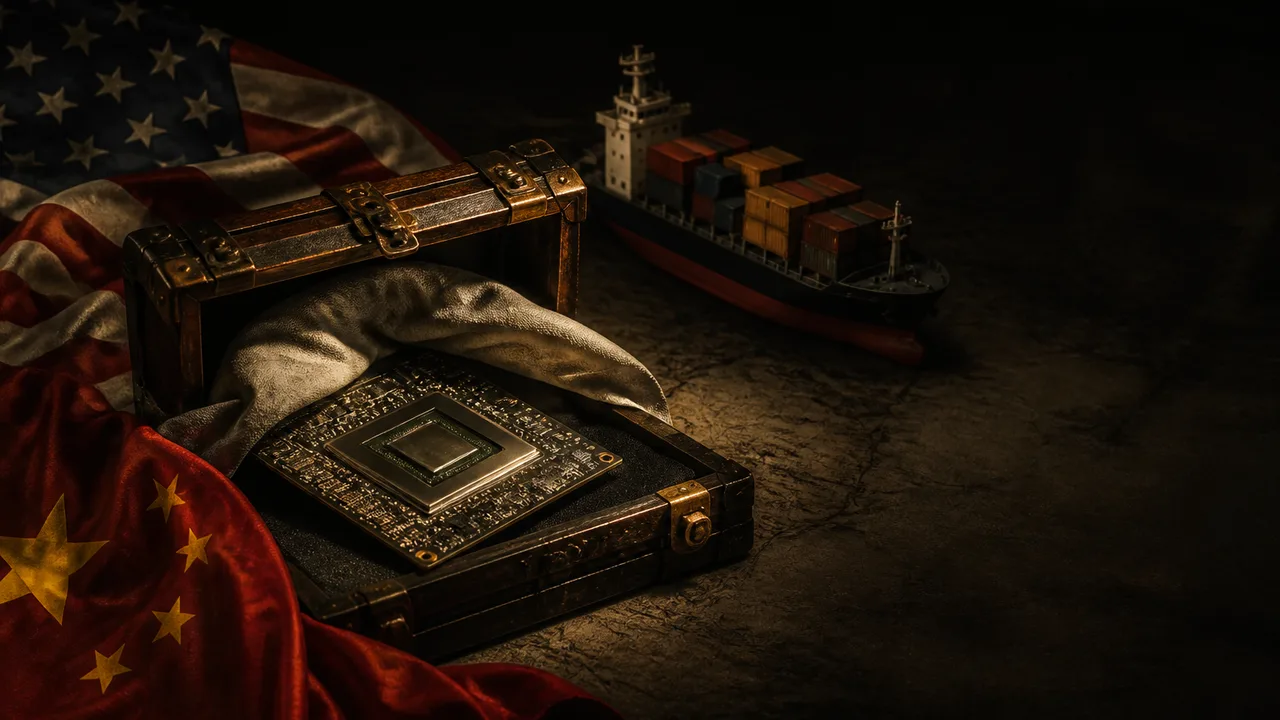
Photo: AI. Liora Goldstein
The export control is one of Washington's oldest tools — born in 1949, when the Truman administration decided that keeping advanced technology out of Soviet hands was as important as any military strategy. Seventy-five years later, the US is running the same play against a different rival, on a different technology, through a regulatory architecture that was not built for supply chains this complex or adversaries this resourceful.
The Financial Times' Eleanor Olcott spent four years documenting how that architecture is failing. Her investigation, presented in a new documentary, is granular where government talking points are vague: she found a paper trail of contracts, spoke with middlemen, and uncovered evidence of at least $1 billion in Nvidia GPUs being brought into China through illicit channels — with market participants suggesting the true figure runs considerably higher. The film is not a leak or a whistleblower story. Much of what Olcott documents is hiding in plain sight, advertised on Chinese social media platforms to anyone who types "Nvidia" into the search bar.
What the controls are supposed to do
In 2022, the Biden administration introduced sweeping restrictions on the sale of advanced AI chips to China. The logic was straightforward: computing power is the essential input for building frontier AI models, Nvidia holds somewhere between 80 and 90 percent of the AI chip market, and the most capable Nvidia chips — the H100s, H200s, and now the Blackwell series — are the infrastructure on which that power runs. Restrict the chips, and you restrict China's ability to develop AI at scale.
Chris Maguire, who has advised both the Biden and Trump administrations on China and emerging technologies, frames the stakes plainly in Olcott's film: "Computing power is the core input into AI. It is the reason that training and developing these models is the most expensive thing that humans are doing right now."
The commercial consequences have been real for Nvidia. Jensen Huang has stated that the company's AI GPU market share in China has collapsed from 95 percent to zero — a figure reported by Tom's Hardware — and that China now represents zero dollars in Nvidia's revenue forecast. That is not a small number to write off. It is also a measure of how seriously the US government took the policy.
What that measure does not capture is how porous the policy turned out to be in practice.
The market that filled the gap
Olcott's most striking reporting is not from any government hearing room. It is from Huaqiangbei in Shenzhen — a sprawling electronics market she describes as a labyrinth of retailers — and from the social media feeds of chip middlemen operating in public. On Xiaohongshu, a Chinese platform, sellers advertise H200s and B300s with the casual confidence of people who do not expect consequences. One seller Olcott found was claiming fresh stock of H200s routed through Hong Kong, destined for Shenzhen.
Shenzhen's role here is structural, not incidental. It is a port city adjacent to Hong Kong, which has functioned as a major transit point. It is also China's hardware hub — server builders, rack assemblers, chip resellers all operate there in density. If you need compute and you cannot access it through legitimate channels, Shenzhen is where you go to find someone who can build you a "custom solution."
The scale of organized smuggling is significant. In March of this year, the US Department of Justice brought charges against employees of Super Micro, a Taiwanese company and Nvidia partner, alleging that they smuggled $2.5 billion worth of Nvidia chips and servers into China using a front company to divert the goods. Super Micro was not named as a defendant and has denied any wrongdoing, as have the named defendants. But the case illustrates what Maguire described to Olcott as a spectrum running from "mom and pop smuggling operations to very large systematic criminal organizations." Nvidia produces somewhere between 5 and 10 million chips per year; organizations funneling tens of thousands of restricted chips represent a non-trivial fraction of that output finding its way to exactly the destinations the controls were designed to prevent.
The loopholes that are not loopholes
Smuggling is one problem. The regulatory gaps are another, and in some ways harder to fix because they are features of the written rules themselves, not violations of them.
Maguire identifies two that matter: first, there is currently no restriction preventing a Chinese company from remotely accessing compute power from a restricted Nvidia chip sitting in a data center in Malaysia or another third country. The chip never enters China. The access does. Second, a Chinese-owned entity or front company incorporated in a third country can purchase the same chips that are banned for direct sale to China. The export control follows the physical border, not the beneficial owner.
"Right now, the administration has not articulated a coherent strategy for controlling advanced compute and AI chips," Maguire says in the film. That is a damning assessment from someone who has sat inside both administrations trying to build that strategy.
The internal contradiction Beijing is managing
What makes Olcott's investigation more than a smuggling story is the political tension she surfaces inside China's own response. Chinese AI labs want Nvidia GPUs because they are the best tools for building competitive models. That is not ideology; it is engineering. But Chinese tech policy — and Chinese national security doctrine — is pushing toward domestic chip champions: Huawei's Ascend series, and others still developing.
These two objectives are not easily reconciled. Buying smuggled Nvidia chips wins the near-term race. Subsidizing domestic alternatives builds long-term independence. The Chinese Ministry of State Security has reportedly identified circumventing the US technology blockade as a top priority — suggesting that, for now, the near-term calculation is winning. But Maguire's framing is worth sitting with: "Export controls are meant to maintain US leadership by delaying their ability to achieve the same goals or levels of innovation." Delay, not prevention. Nobody interviewed in the film is arguing that the blockade holds forever.
What the Taiwan variable adds
The supply chain's geography makes all of this structurally messier. Virtually every advanced AI chip — designed by US companies — is fabricated at TSMC in Taiwan and packaged there or in third countries before moving into global distribution chains. Taiwan is simultaneously where the chips are made and the subject of a territorial dispute between Beijing and Washington. An export compliance program, as Olcott's experts note, needs to cover not just what happens in the US but what happens through every link in that chain — packagers, integrators, distributors, resellers. The surface area for diversion is enormous.
Taiwan's growing status as an AI hardware showcase — Olcott reports from Computex, the island's flagship chip conference, where she notes that the products on display are precisely the ones banned for export to China — underlines the irony: the manufacturing and the restriction are in the same place, which makes both more visible and more contested.
The enforcement gap is the story
There is a version of this story that reads as a straightforward account of Chinese bad actors circumventing good rules. Olcott's version is more uncomfortable than that. The controls are real, but they were designed without a coherent theory of enforcement across a global supply chain. The loopholes are documented and named. The black market is openly advertised. The March Super Micro case suggests that when enforcement does happen, it is catching incidents that were already massive.
That gap — between the ambition of the policy and the mechanisms available to execute it — is the same gap you find in most technology regulation. The rules move at legislative speed. The market moves faster. China's AI labs are not waiting for the US to close the third-country loophole. The sellers in Huaqiangbei are not worried about Tom's Hardware publishing Jensen Huang's market share figures.
The US is ahead in the AI race, by most credible accounts. The more unsettling question is whether the tools Washington is using to maintain that lead are calibrated for the actual problem — or whether they are, as Maguire suggests, a Cold War-era rule book being applied to a supply chain its authors could not have imagined.
More Like This

Karpathy's Self-Evolving AI Wiki Tests New Memory Model
Andrej Karpathy released an architectural blueprint for AI agents that maintain their own knowledge bases. Does it solve AI's memory problem or create new ones?
Design.md Files Expose a Gap in AI Regulation Standards
How a GitHub repository of design system files reveals the absence of standardization frameworks for AI-generated interfaces—and why that matters.

UN AI Summit: Big Room, Bigger Questions on Governance
193 countries met in Geneva to tackle AI governance. The warnings were credible. The robots were cool. The binding rules? Still not there.
OpenAI's Workspace Agents: The Governance Question No One Asked
OpenAI's new Workspace Agents automate team workflows—but the real product isn't the AI. It's the permission model enterprises can actually live with.

Kimi K2.6 Is Free on NVIDIA NIM—Read the Fine Print
Kimi K2.6 is now free via NVIDIA's NIM API. But who controls AI model distribution when NVIDIA becomes the default inference layer?
US AI Dominance Is Slipping. Workers Will Feel It First.
China is closing the AI gap with the US. The geopolitical story is getting plenty of coverage. The labor story beneath it isn't. Here's what's missing.
US and China Train Almost All the World's AI Models
US and Chinese companies train nearly every major AI model the world uses. Here's what that concentration means for global power, values, and sovereignty.

Promptware: When AI Agents Become Attack Vectors
Prompt injection attacks on AI agents follow a structured kill chain — and existing legal frameworks have almost nothing to say about who's liable when it works.