US and China Train Almost All the World's AI Models
US and Chinese companies train nearly every major AI model the world uses. Here's what that concentration means for global power, values, and sovereignty.

Written by AI. Zara Chen
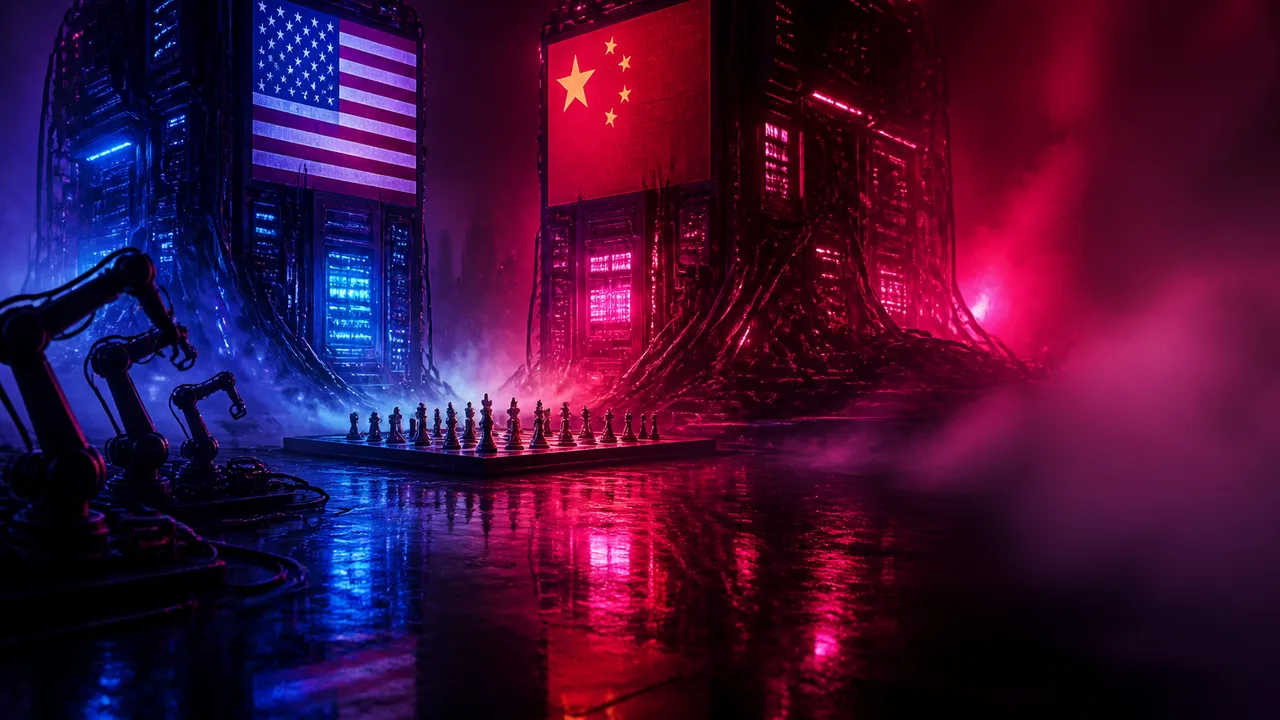
Every time I open a chat interface and type a question, I'm participating in a geopolitical arrangement I didn't agree to. Most people using AI tools right now are in the same position — end users of a technology whose foundational decisions were made in either California or Beijing. That's not a metaphor. It's increasingly the literal structure of global AI development.
Our World in Data put the numbers to it recently, and they're stark: virtually every model in the global top 50 by usage comes from a US or Chinese company. France gets a footnote with Mistral AI's NeMo. The rest of the world? Mostly consuming, not building. A technology that more people rely on every year is, so far, almost entirely shaped by two countries whose rivalry defines the current geopolitical moment. Cool! Fine! Nothing to see here!
The thing is, this isn't an accident of innovation. It's a consequence of infrastructure. Morgan Stanley lays out the structural reality clearly: US firms dominate in chip design and model development, but their dependence on Taiwan for manufacturing creates a strategic chokepoint that could disrupt supply chains if geopolitical tensions escalate. Meanwhile China has been building out domestic compute capacity and open-source influence at a pace that's easy to underestimate if you're not paying attention. The whole thing is one Taiwan Strait incident away from a supply chain crisis that would make the 2021 chip shortage look like a minor inconvenience.
INSEAD Knowledge frames this as a new world order unfolding in real time — the US-China AI race isn't just about who has the best chatbot, it's about who sets the defaults for how billions of people receive and process information. And that's where the values question gets genuinely uncomfortable.
Here's the thing about models: they're not neutral. They never were. The Centre for International Governance Innovation is direct about it — Chinese LLMs are trained within a tightly regulated political environment where certain topics and narratives are constrained by law and state ideology. Research directly comparing ChatGPT and DeepSeek has documented measurable differences in how the models handle politically sensitive subjects. That's not a surprise; it's a design outcome. But here's what's weirder: US models carry their own embedded assumptions too — about what counts as authoritative, what topics get hedged, whose epistemological frameworks get centered. The difference is that one set of constraints is legally mandated and the other is culturally invisible, which makes the American version easier to mistake for objectivity.
My generation grew up watching TikTok's algorithm decide what was culturally real. We lived through the Discord era, where platform moderation choices shaped entire communities. We've had ChatGPT as ambient infrastructure since before some of us finished school. The lesson we internalized — even if we didn't articulate it — is that platforms encode values. The feed is never just a feed. So when think-tank reports talk about "AI neutrality" as a goal, I want to know: neutral according to whom? Trained on whose internet?
DeepSeek's major public release in early 2025 (per Wikipedia) blew up Western assumptions about the cost of frontier model development and threw this question into sharp relief. Here was a genuinely competitive model from a Chinese lab, open-sourced, spreading across GitHub repositories globally. The Atlantic Council expects China to double down on exactly this open-source strategy through 2026 — pushing its models into the world's AI infrastructure not through sales or subscriptions but through adoption and dependency. It's a soft-power play running through a GitHub repository, and it's working.
This is the part where the US-China framing gets complicated, because open-source cuts against a simple narrative of closed national control. If Chinese labs are releasing weights publicly and encouraging global adoption, and US companies are increasingly locking models behind APIs and enterprise contracts, who's actually more closed? The Atlantic Council notes that several major US tech companies have also pursued open-source strategies — so this isn't a clean ideological divide. It's a competitive landscape where "open" is sometimes a market strategy and sometimes a genuine philosophical commitment, and distinguishing between the two requires paying close attention to what's actually released versus what's retained.
For everyone else — the vast majority of countries whose researchers and governments use models they had no hand in building — the picture Chatham House describes is genuinely difficult. US dominance as a gatekeeper for AI hardware limits how much AI sovereignty any middle power can actually achieve. States need access to frontier models to build downstream applications and services, which means they're dependent on either the US or Chinese ecosystems whether they like it or not. Chatham House is blunt: on current trajectories, the US and US companies will race ahead, and that dominance over hardware access will constrain everyone else's options.
The responses forming globally are interesting to watch. The India AI summit produced a declaration signed by 88 nations and organisations — a real signal that the geopolitical battleground has moved well beyond Washington and Beijing, with governments actively trying to shape AI governance frameworks before the concentration locks in completely. Whether declarations translate into actual development capacity is a different question, and the gap between signing something and training something is enormous.
The European approach — heavy on regulation, lighter on indigenous model development — is a bet that governance frameworks can shape how dominant models behave even if Europeans aren't building them. It's not obviously wrong. But it assumes the US and China will remain responsive to external regulatory pressure, which feels like a generous assumption given current trajectories. France's Mistral is the one real counterexample in the top-50 data, proof that frontier development outside the duopoly is possible — but Mistral's existence also shows how hard it is. One company, one country, one model in the rankings. That's the entire rest of the world's representation.
The labor dimensions of this concentration tend to get lost in the geopolitical framing, but they're real. When AI development concentrates in two countries, the economic returns from that development — the jobs, the tax base, the technical talent pipelines — concentrate there too. Every nation that builds its public services, its healthcare documentation, its educational tools on top of models it didn't train is also exporting economic value it can't easily recapture.
None of this means the duopoly is permanent. Technology concentration has broken before — sometimes by regulation, sometimes by a new entrant that changes the cost structure, sometimes by geopolitical disruption that forces alternatives. DeepSeek's early 2025 release was a reminder that "the US is ahead" and "this is locked in" are not the same sentence.
But right now, in 2026, the models that are shaping how most people on earth access AI-mediated information were built by companies operating under the laws and cultural assumptions of two specific nations that happen to be geopolitical rivals. If you think the values embedded in that infrastructure are incidental — that training data and fine-tuning choices and safety frameworks are just technical decisions with no politics attached — I have some extremely neutral algorithmic feeds to sell you.
More Like This
This Creator Got Shadowbanned on YouTube in 25 Days—On Purpose
A vidIQ creator deliberately shadowbanned their channel with AI-generated content to expose how YouTube's algorithm actually works. The results are wild.
Master Remote Access with Comet Pro KVM
Explore the Comet Pro KVM for seamless remote PC access: Wi-Fi 6, out-of-band management, and Tailscale security.

Alibaba's Qwen 3.7 Max and the Agentic AI Gap
Alibaba's Qwen 3.7 Max posts frontier-level benchmark scores at a fraction of the cost. What does that mean for AI regulation—and who's paying attention?
US AI Dominance Is Slipping. Workers Will Feel It First.
China is closing the AI gap with the US. The geopolitical story is getting plenty of coverage. The labor story beneath it isn't. Here's what's missing.
![Man in Laravel cap looking thoughtful beside phone displaying "Debounce for [301]" hashtag on pink background](https://static.buzzrag.com/articles/laravel-13-6-drops-debounceable-jobs-and-json-health-checks/thumb-5e646253.webp)
Laravel 13.6 Drops Debounceable Jobs and JSON Health Checks
Laravel 13.6 introduces debounceable jobs, JSON health check responses, and Cloudflare email support. Here's what developers need to know.
Heroku Is Really Dead This Time, and Here's What Happened
Heroku has entered full maintenance mode after mass layoffs and leadership exodus. How did Salesforce let a developer platform die at the finish line?

Google Nano Banana 2 Lite Makes AI Image Generation Cheap
Google's Nano Banana 2 Lite generates images in 4 seconds at $0.034 per 1,000—and that price point changes who gets to build with AI image tools.
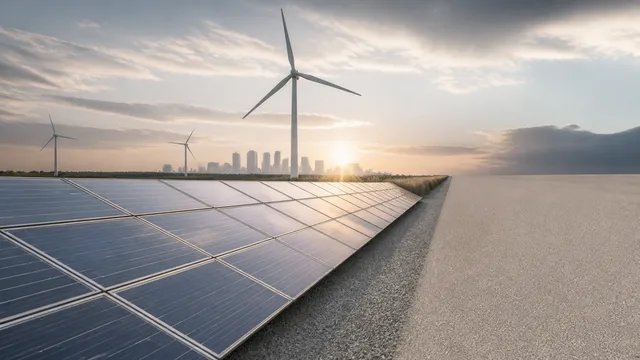
Renewables Hit 30% of US Electricity in Early 2026
EIA data shows renewables reached 30% of US electricity in early 2026, up from 27.8% a year ago. Here's what that number actually means—and what it doesn't.