US AI Dominance Is Slipping. Workers Will Feel It First.
China is closing the AI gap with the US. The geopolitical story is getting plenty of coverage. The labor story beneath it isn't. Here's what's missing.

Written by AI. Carmen Rodriguez
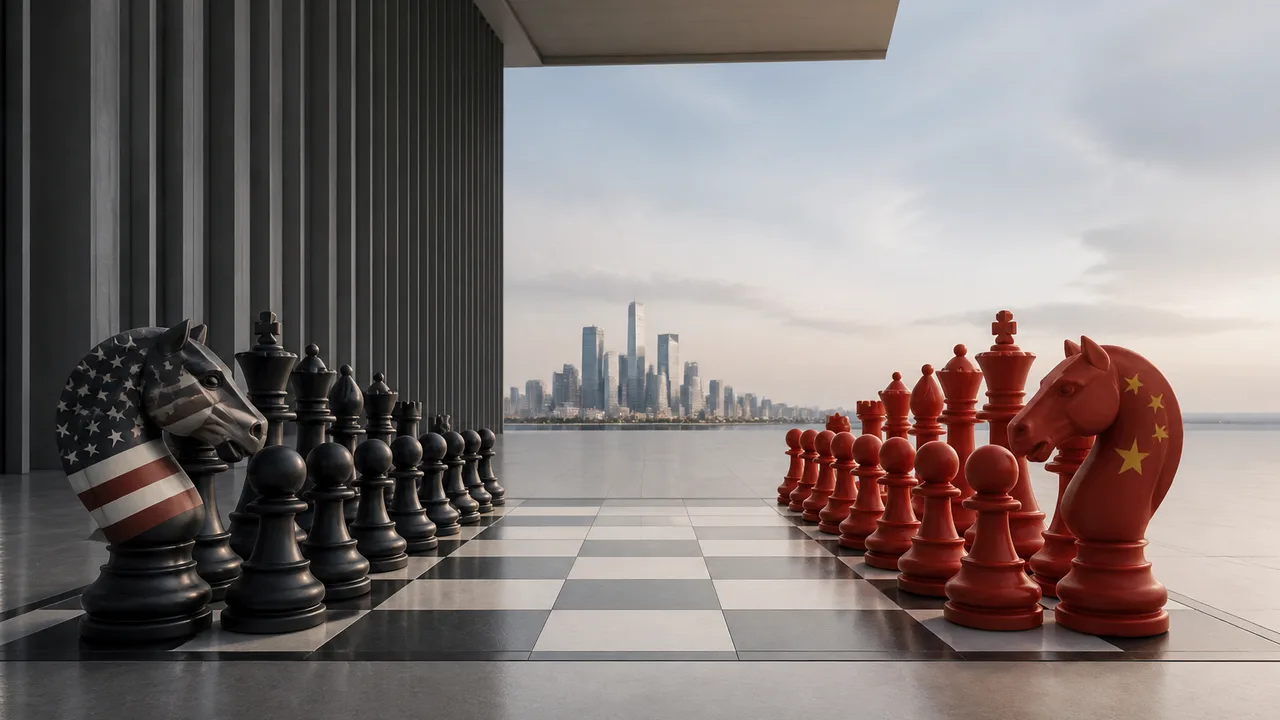
The conversation about the global AI race keeps happening at altitude — benchmark scores, compute clusters, export controls, national security doctrine. What it misses is the human infrastructure holding the whole thing up, and what happens to that infrastructure when geopolitical winds shift.
Start with what's actually changing. U.S.-based large language models continue to dominate global use, likely because of a first-mover advantage and superior model capabilities, according to a RAND Corporation analysis — but RAND is careful to note that dominance shouldn't be taken for granted. That qualifier is doing real work. Chinese models haven't surpassed OpenAI or Anthropic yet, but as Morning Brew reports, the gap is narrowing in ways that are starting to matter for how AI infrastructure gets deployed globally.
Meanwhile, the US government forced the Mythos AI model offline over unspecified concerns — a move that created a visible gap in the market at the exact moment international alternatives are gaining ground. Whether that was the right call on safety grounds is a separate question. The market consequence is straightforward: when American models get pulled, something fills the void.
What the scoreboard misses
The index.dev analysis frames the three-way competition usefully: the US leads in scale and capital, China leads in efficiency and rapid iteration, Europe leads in ethics and regulation. That's accurate as a snapshot. What it doesn't capture — and what most of this coverage doesn't capture — is that "AI infrastructure" isn't just servers and model weights. It's people. A lot of people, doing unglamorous work, in places that never appear in the benchmark announcements.
The annotators who label training data. The content moderators who review outputs that would otherwise traumatize an automated filter. The call center workers whose jobs get restructured every time a major client shifts its AI vendor. These workers exist at the exact intersection of the US-China competition, and they have no seat at any table where that competition gets discussed.
Take content moderation. The major US AI labs have relied heavily on outsourced moderation workforces, primarily in Kenya, the Philippines, and India — workers who review material that ranges from disturbing to genuinely traumatic, often through subcontracting layers that keep them off the lab's official headcount. This work is widely reported to pay far below what comparable roles command in the United States. The Rest of World analysis puts it plainly: to be competitive in AI, you need researchers, energy, chips, and data — and countries that have those things are offering them to the US not as a gift, but in exchange for something. That exchange logic applies to labor markets too. Cheap, abundant, deniable labor is part of the US AI stack. It just doesn't show up in the capability comparisons.
Maria, watching the vendor list change
Consider what the infrastructure competition looks like from the floor of a business process outsourcing firm in Cebu City. Maria — not her real name, but drawn from documented accounts of BPO workers in the Philippines who have spoken to labor researchers about their industry's AI exposure — has worked in tech support and data annotation for nearly a decade, moving between contracts as client companies rotate their outsourcing vendors. When a major US tech client switched its AI platform last year, her team's contract terms changed within ninety days: fewer hours, a new productivity metric, a different task queue. She didn't know which AI company had won the client's business. She knew her quota had gone up and her rate had stayed flat.
That's the texture of what the US-China AI divide means for the world, in practice. Not a geopolitical inflection point — a quota change. Not a strategic shift — a contract renegotiation she had no leverage in.
Workers in this sector have watched their conditions reshape with each outsourcing cycle, each new automation tool, each decision about what the client company handles with software versus people. The difference now is that the entity making those decisions might be headquartered in Beijing rather than San Francisco, and the labor protections — already thin — may look different again.
The export controls paradox
Here's where the policy story gets genuinely knotted. Morning Brew notes that some industry watchers argue the US is running a contradictory strategy: banning AI models on one hand while continuing to sell semiconductor chips to China on the other. That's not just a strategic incoherence — it's a subsidy for Chinese capability-building while restricting American model deployment. Whether that contradiction is intentional, bureaucratic, or the result of different agencies optimizing for different goals is unclear. The effect is legible: the US is making it harder to deploy American AI while making it easier to build Chinese AI.
Dr. Nimrita Koul's analysis on Medium maps the divergent scenarios — one where the US tightens compute controls and locks in its infrastructure advantage, another where China's efficiency gains and the US's domestic policy hesitations converge into a genuine leadership transition. Neither scenario is written yet. Both depend heavily on choices that are being made right now, in ways that will land on workers before they land on anyone else.
The Council on Foreign Relations is direct about the stakes: 2026 could decide the trajectory of AI development, with US-China competition intensifying as both sides race to capture economic and military advantages from AI systems that can design, code, and reason beyond human capability levels. This framing — which dominated Davos 2026 conversations — centers nation-states as the primary actors and treats the competition as a contest between two roughly symmetric players.
That's where I push back on the whole frame. The US and China are not symmetric. American AI companies operate with venture capital and stock market incentives that push toward rapid scaling and global deployment. Chinese AI development operates under state direction with different risk tolerances and different definitions of what the technology is for. When those two systems compete for the same global markets — including labor markets — the workers in the middle don't get to choose which governance model applies to their job. They get the terms that whoever won the contract decided to offer.
The governance gap nobody is pricing in
What makes this competition genuinely difficult to map is that the labor consequences aren't just about which country's AI wins. They're about what governance standards travel with the technology. US AI labs have faced criticism for their treatment of outsourced data workers — the conditions, the pay, the psychological exposure, the lack of collective bargaining. Those problems exist under US AI dominance. They don't automatically get better if Chinese models expand their global footprint; there's no particular reason to believe they do.
The question nobody in the benchmark conversation is asking: if the AI infrastructure race reshapes global labor markets — and it will — who decides the floor? Right now, the answer is nobody. Export control policy doesn't cover it. International AI governance frameworks don't reach it. The workers themselves have no mechanism to shape it.
That's not a rhetorical question. It's the actual policy gap that will determine whether the next decade of AI development extracts value from workers in the Global South or distributes some of it back to them. The countries that have researchers, energy, chips, and data are already negotiating their terms with the major powers. The workers providing the human layer of that infrastructure are not.
More Like This
Business Rules 2026: Impact on Labor and AI
Explore how emerging business rules and AI technology reshape labor dynamics and worker dignity by 2026.

Financial Crises Follow Patterns — But Not for Everyone
Kuran Francis maps four recurring patterns behind every major financial crisis. The framework is solid. What it leaves out is the story of who pays when the system breaks.

Wall Street Knew the Crash Was Coming. Saying So Got You Fired.
Jeremy Grantham's famous poll revealed 398 analysts knew the dot-com crash was guaranteed. A 2003 study shows why none of them said so publicly: accuracy cost careers.

Dubai's Crisis Has a Worker Problem No One's Covering
Dubai's economic model was built on migrant labor with almost no rights. Now, with airstrikes and a blockaded strait, those workers face the worst of the fallout.
AI Agents Are Now Hiring Humans for Real-World Tasks
New platforms let AI agents post jobs and hire humans, creating an inverted gig economy. What happens when automation needs manual labor?
Chinese AI Models Are Suddenly Catching Up—And Fast
GLM-5 claims to beat major US models on reliability while open-source agents hit near-human scores. The AI race just got a lot more complicated.

How Banks Price You Differently at Every Wealth Level
From a $35 overdraft fee to an $8M tax-free home purchase, banks apply the same logic at every tier — extracting the maximum you'll absorb.

Who Gets the Unhurried Conversation in the NBA Offseason
NBA front offices frame the offseason as strategy. It's also a labor event — and who gets dignity in that process depends entirely on where you sit in the pyramid.