Flock Cameras Track Far More Than License Plates
Flock Safety's AI-powered cameras are spreading fast across U.S. cities—and they're capturing far more than license plates. Here's what's at stake.

Written by AI. Zara Chen
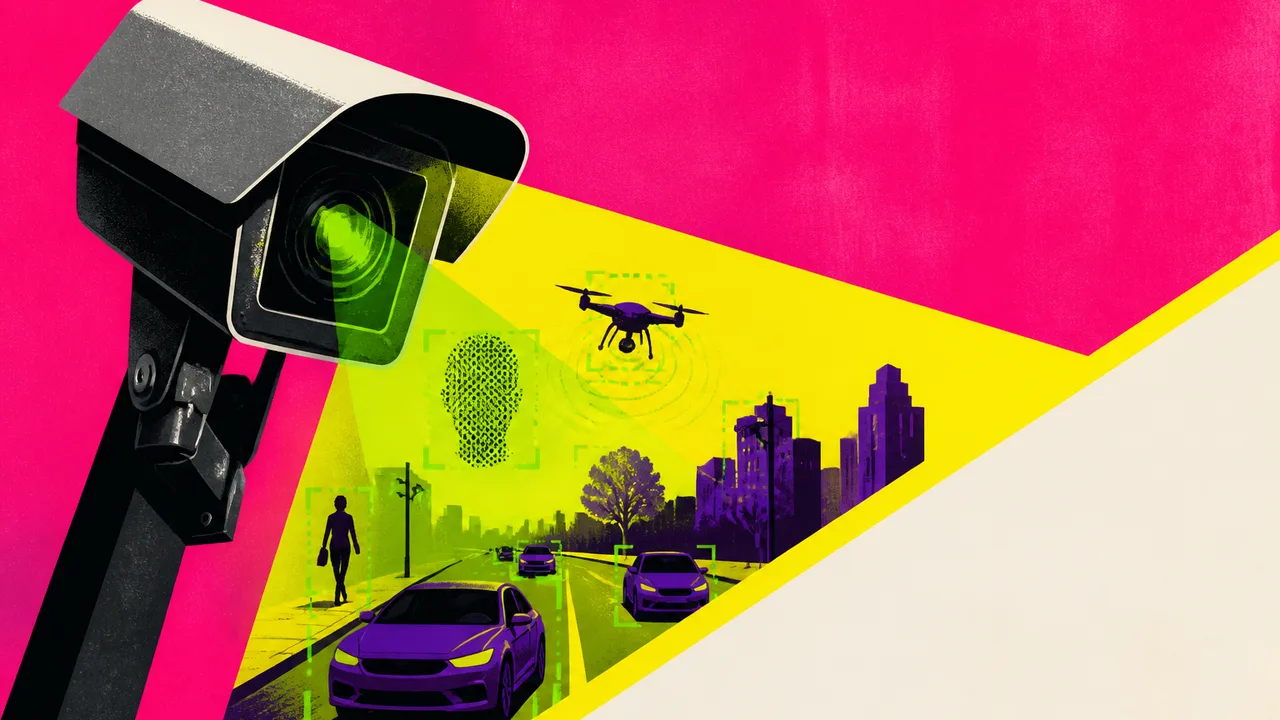
Picture this: you drive past a camera mounted on a pole near your neighborhood entrance. It reads your plate. Fine, maybe you even expected that. What you probably didn't expect is that the same camera also logged the color, make, and model of your car, noted the bumper sticker you've had since 2019, cataloged a scratch on your rear panel, and then fed all of that into an AI system accessible via natural language search to anyone with a login.
That's not a hypothetical. That's Flock.
The Camera That Became a Platform
Flock Safety started as a license plate reader company. That framing — "license plate reader" — did a lot of work to make the technology feel bounded and specific. Plates are already public-facing identifiers. Cops already write them down. What's the big deal?
The big deal is that the technology didn't stay there.
According to the ACLU's "Get The Flock Out" campaign, the system records and tracks every car that comes into view, and an AI algorithm catalogs the make, model, color, license plate number, bumper stickers, and even scratches on the vehicle. Engadget reports that thanks to the rise of AI, this new kind of surveillance camera has rapidly proliferated across the United States.
The cameras run a modified version of Android and wirelessly transmit footage to a database, where it's cataloged using AI and made searchable via natural language queries by anyone with system access, according to The Helper's coverage of the story. So it's not just that more data is being captured — it's that the data is structured for easy retrieval in ways that weren't possible even five years ago.
What Flock built isn't a camera. It's a searchable, AI-powered vehicle intelligence database that happens to require cameras to populate it.
Your Data, Their Upgrade
Here's where the business model and the surveillance scope start to blur together in uncomfortable ways.
The ACLU's roundup of Flock's expansion details plans for the company to plug its systems into commercial data brokers — meaning a camera scan of your car could connect to datasets that include your name, your address, your phone number, and your email. A license plate stops being a vehicle identifier and becomes an entry point into a commercial dossier on you, the person.
It's the same logic that made loyalty cards feel harmless until you realized every grocery trip was being profiled. The camera sees a car; the broker sees a customer; the system sees a pattern. The data points that seemed disconnected were always going to get linked — the only question was when the infrastructure to do it became cheap enough. Apparently, that's now.
And Flock isn't just sitting still with cameras. CNET reports that the company has expanded from cameras into drones, with that expansion bringing greater ability to track people — and doing so in ways that aren't always disclosed publicly. The piece notes that a March announcement about a police drone program from the city of Lancaster, California didn't mention Flock at all, even though Flock was the company behind it. That's not a minor detail. If a city can't be straightforward about who is operating its surveillance infrastructure, the oversight frameworks that are supposed to govern that infrastructure can't function.
The Governance Gap
The ACLU isn't just raising alarms — they're running a full campaign to push back, and they're asking for things that reveal exactly how thin the current guardrails are: warrant requirements before police can access data, public disclosure of where cameras are located, limits on data retention, and prohibitions on sharing data with immigration enforcement.
We are in 2024, and mass vehicular surveillance infrastructure is being deployed across American communities without a baseline requirement that law enforcement obtain a warrant to query it. That's not a gap in an otherwise functional system — that's an absence where the system should be. The frameworks governing door-to-door searches, phone taps, and financial record subpoenas all developed because courts and legislators eventually caught up to the technology. With Flock, the technology is lapping the governance in real time, neighborhood by neighborhood.
The community dimension matters here too. Flock contracts not just with cities and police departments but also with private neighborhoods and businesses — a model noted in Engadget's reporting — which means the surveillance grid doesn't require a public vote or even a city council meeting to expand. A homeowners association can add nodes to this network, and suddenly data about everyone driving through that neighborhood is feeding into the same AI-indexed system that police departments query.
Pushback Is Real, But So Is Momentum
Communities have organized against Flock deployments in meaningful ways. The Hacker News discussion around this story includes voices specifically urging people to take the energy from online outrage to city council meetings — which suggests at least some people understand that comment threads don't change surveillance policy, but showing up does. The ACLU's active campaign reflects genuine, organized opposition with documented wins across multiple states, even if the full scope of that pushback is still being tracked.
But the momentum question cuts both ways. Every city or neighborhood that adopts Flock expands the interoperability of the network. More nodes means more data, denser coverage, fewer blind spots. The system becomes more valuable to law enforcement as it grows, which creates an incentive loop that makes reversal harder over time.
That's the uncomfortable math that often goes unsaid in these debates: surveillance infrastructure isn't like a policy you can repeal cleanly. The cameras go up; the data gets generated and stored; the contracts have renewal clauses. Even if a city council votes to remove Flock cameras tomorrow, the question of what happens to the data already collected — and who still has access to it — doesn't resolve itself.
The Question Communities Actually Have to Answer
The strongest case for Flock sounds like this: crime is real, vehicles are public on public roads, and giving law enforcement better tools to identify and locate suspects has produced documented results in serious cases. The company makes these arguments, and they're not nothing. The technology does what it says it does.
The harder question — and the one that local governments are mostly avoiding — isn't whether the technology works. It's who gets to decide when, where, and under what conditions it's used; who has access to the data it generates; what happens to data about people who were never suspects; and whether any of those decisions were actually made by the public that's being surveilled.
Right now, in most places, the answers to those questions are: the company and its clients, the company and its clients, it's retained indefinitely, and not really.
Flock Safety built a product that the market wanted. That's a coherent outcome. The governance structures that are supposed to shape how that product operates in democratic communities have just... not kept up. And the cameras keep going up while the policy debates stay theoretical.
The technology waits for no one. The question is whether oversight will stay permanently one expansion behind.
More Like This
This Creator Got Shadowbanned on YouTube in 25 Days—On Purpose
A vidIQ creator deliberately shadowbanned their channel with AI-generated content to expose how YouTube's algorithm actually works. The results are wild.
Master Remote Access with Comet Pro KVM
Explore the Comet Pro KVM for seamless remote PC access: Wi-Fi 6, out-of-band management, and Tailscale security.
PocketCube Satellites: Earth Observation for $30K
Satellites small enough to hold in your hand can now image Earth at 6–12m resolution. But who controls the data—and who bears the cost of what orbits above us?
Claude's AI Video Stack and the Disclosure Gap
Claude can now orchestrate entire AI video workflows in minutes. The tech works. The legal framework governing disclosure doesn't exist yet—and that gap has real consequences.
Brad Carson: AI Surveillance Dossiers Are Already Legal
Former Congressman Brad Carson argues AI isn't unstoppable — and warns that using AI to compile surveillance dossiers on Americans is currently lawful.
![Man in Laravel cap looking thoughtful beside phone displaying "Debounce for [301]" hashtag on pink background](https://static.buzzrag.com/articles/laravel-13-6-drops-debounceable-jobs-and-json-health-checks/thumb-5e646253.webp)
Laravel 13.6 Drops Debounceable Jobs and JSON Health Checks
Laravel 13.6 introduces debounceable jobs, JSON health check responses, and Cloudflare email support. Here's what developers need to know.

A YouTuber Got a Sequence Into the OEIS With XOR Math
Gary Explains got an original integer sequence accepted into the OEIS by XOR-ing numbers in loops. Here's why that's genuinely fascinating—and what it connects to.

GNU Coreutils Now Run Natively on Windows
Microsoft has ported GNU Coreutils to Windows as native binaries. Here's what that means for devs switching between Linux and Windows daily.