2026 Medicine Nobel Honors Light-Controlled Brain Research
The 2026 medicine Nobel recognizes optogenetics, a way to test how neural circuits affect behavior. Its clinical promise, including restored sight, remains early.

Written by AI. Priya Sharma
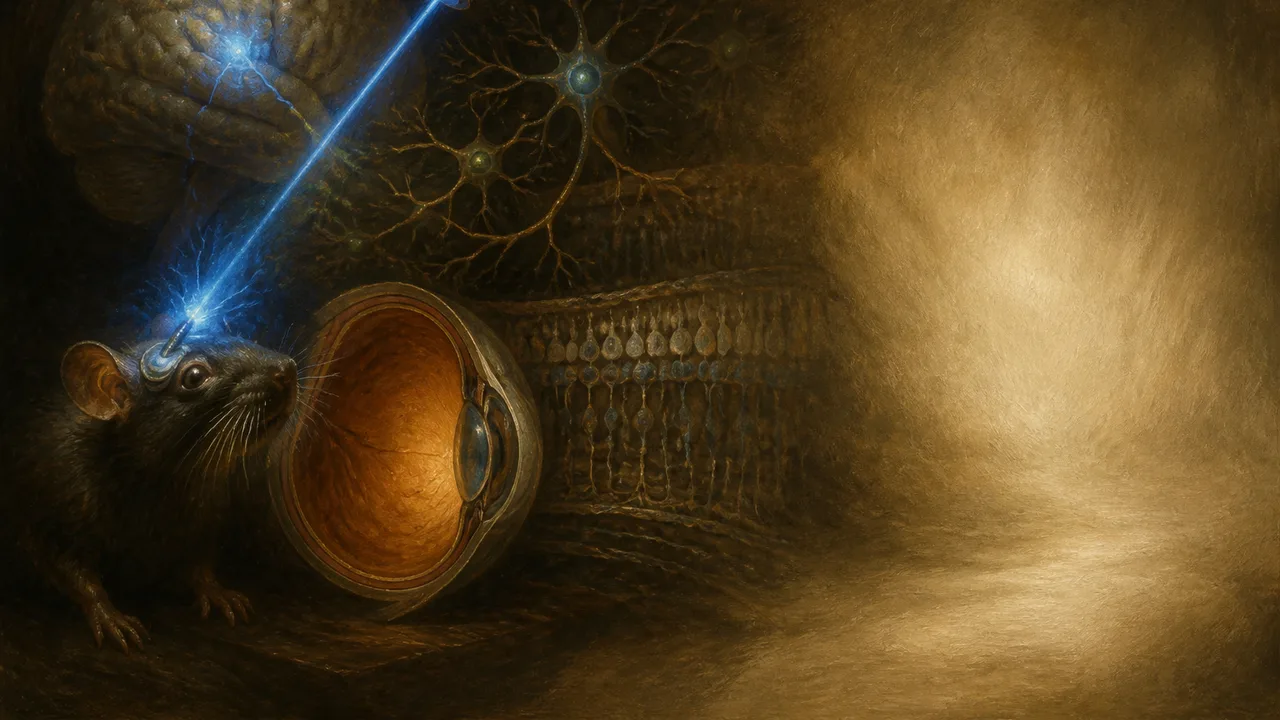
The 2026 Nobel Prize in Physiology or Medicine went to Karl Deisseroth, Peter Hegemann and Georg Nagel for discoveries that let researchers use light to control nerve cells. The Nobel Assembly awarded the prize on October 5 “for their discoveries concerning light-gated ion channels and optogenetics”. Behind that description is a change in what a brain experiment can ask. A researcher can make selected neurons responsive to light, activate them, and examine what follows. That gives scientists a way to test a circuit’s contribution to an effect, rather than relying only on where activity appears alongside it.
The route to that experiment began with Chlamydomonas, a single-celled alga that swims towards light. In the early 2000s, Hegemann and Nagel discovered channelrhodopsin, a protein in the alga’s surface that responds to blue light. Illumination opens a channel through the protein; charged ions flow into the cell and produce an electrical signal. A feature that helped explain how an alga responds to its surroundings also offered a way to make other cells light-sensitive.
Deisseroth introduced the gene for channelrhodopsin into nerve cells from rats and triggered a nerve signal with blue light, publishing that work in 2005. Two years later, the approach worked in the brains of living mice. The sequence matters: a light-sensitive protein identified in an alga became a means of activating a neuron, then a means of intervening in neural activity inside an animal. Each step answered a question the previous one left open. A response in cells alone could not show that the method would work in a living brain.
From a Map to an Intervention
The Nobel Assembly describes an earlier problem in twentieth-century neuroscience: researchers investigated which brain areas were associated with particular functions, but the methods in its account could not prove causal relationships. That is a useful comparison, provided it stays narrow. An association can identify a place to investigate. Changing activity in selected cells and observing a subsequent response asks whether that activity helps produce the response under the conditions of the experiment. The Assembly’s account of the earlier work is a broad historical sketch, not a claim that every pre-optogenetics experiment was merely observational.
In the living-mouse work, Deisseroth and colleagues introduced the gene into selected nerve cells and illuminated them through a thin optical fibre. They activated a group of neurons and elicited a distinct behavior, as Abdel El Manira of the Karolinska Institute described at the prize announcement. The method combines a biological choice, which cells carry the light-responsive protein, with a timed intervention, when light reaches them. Its advantage for a causal experiment follows from that combination: investigators can change an input and look for an effect, instead of treating simultaneous neural activity and behavior as an answer by themselves.
That account also defines the claim’s limits. Eliciting a behavior after activating a selected group of cells supports a causal role for that intervention in that animal and setting. It does not, on its own, tell us that those cells act alone, account for every occurrence of the behavior or explain an equivalent human experience. The group of neurons, the illumination and the observed behavior all need to be specified before a causal result can be interpreted. Precision in delivering light is valuable; precision in interpreting what it did is a separate task.
Optogenetics has since been used to investigate circuits associated with pain, thirst, food consumption, reward, attention and social behavior. The breadth of those questions helps explain the award: the laureates’ work supplied an experimental method that others could apply to different problems. But the list is a set of research subjects, not a list of conditions that optogenetics can treat. Studying a circuit relevant to a neurological or psychiatric disorder may clarify how it works. A treatment has to demonstrate benefit in people, with its own evidence about safety and effectiveness.
A Narrower Clinical Test
One early medical use illustrates both the continuity and the gap. In retinitis pigmentosa, people lose the eye’s rods and cones, the cells that normally detect light. Researchers have investigated putting a channelrhodopsin-like protein into remaining retinal cells so light can stimulate them and send signals along the visual pathway. The shared principle with the mouse experiments is making selected cells responsive to light. The immediate goal is different: to recover some visual function, rather than to probe a brain circuit’s role in behavior.
A patient with retinitis pigmentosa had some visual recovery while wearing special light-emitting glasses. The glasses supplied the light needed to activate the introduced protein. Physics World describes the result as partial recovery of visual function in a single patient; Per Svenningsson, chair of the Nobel Committee for Physiology or Medicine, said several clinical trials of the approach were ongoing. A patient’s improvement shows why the idea is being tested. It cannot establish how often the approach works, how much sight people might recover or whether any benefit lasts. Those are questions for clinical trials, whose ongoing status should not be mistaken for a positive result.
The retina also sets a boundary on the analogy with brain research. It offers an identifiable population of cells and a defined aim, vision, after damage to normal light-detecting cells. The mouse experiment tested whether activating selected neurons could elicit a behavior. Both depend on introducing light-responsive biology and delivering light, but success at one task does not establish success at the other. For someone reading a claim about an optogenetic treatment for a brain disorder, the useful questions are therefore concrete: Which cells would receive the protein? How would light reach them? What patient outcome has been measured? The prize recognizes a way to pose sharper biological questions; clinical trials must answer the medical ones.
More Like This
What the Brain's Two Progenitor Lineages Really Mean
A new study finds separate embryonic lineages for the front and back brain. Here is what it shows, why cell culture may benefit, and what remains open in evolution.
Brain-Computer Interfaces: Bridging Biology and Technology
Explore the potential of brain-computer interfaces to merge biology with tech, restoring lost functions and expanding human capabilities.

Cancer Treatment Using Light: Why PDT Isn't Everywhere Yet
PDT uses light to kill cancer cells with less toxicity than chemo. So why isn't it standard care? Stephen Bown's Royal Institution talk raises the question.
A Mapped Fruit Fly Brain Is Now Playing Doom. What Does That Prove?
Google's reconstruction of a fruit fly brain, with over 166,000 neurons, now drives Doom and Mario 64. What the experiment shows, and what it cannot yet claim.

Black Holes: Destroyers, Organizers, and Open Questions
Black holes destroy worlds and organize galaxies—but what does the science actually show? A look at Sagittarius A*, adaptive optics, and the limits of what we know.
The Quantum Twin Paradox and the Nature of Time
A new trapped-ion experiment may finally reveal whether time is a quantum property—bridging the long-standing gap between quantum mechanics and general relativity.