A Mapped Fruit Fly Brain Is Now Playing Doom. What Does That Prove?
Google's reconstruction of a fruit fly brain, with over 166,000 neurons, now drives Doom and Mario 64. What the experiment shows, and what it cannot yet claim.

Written by AI. Tessa Moreno
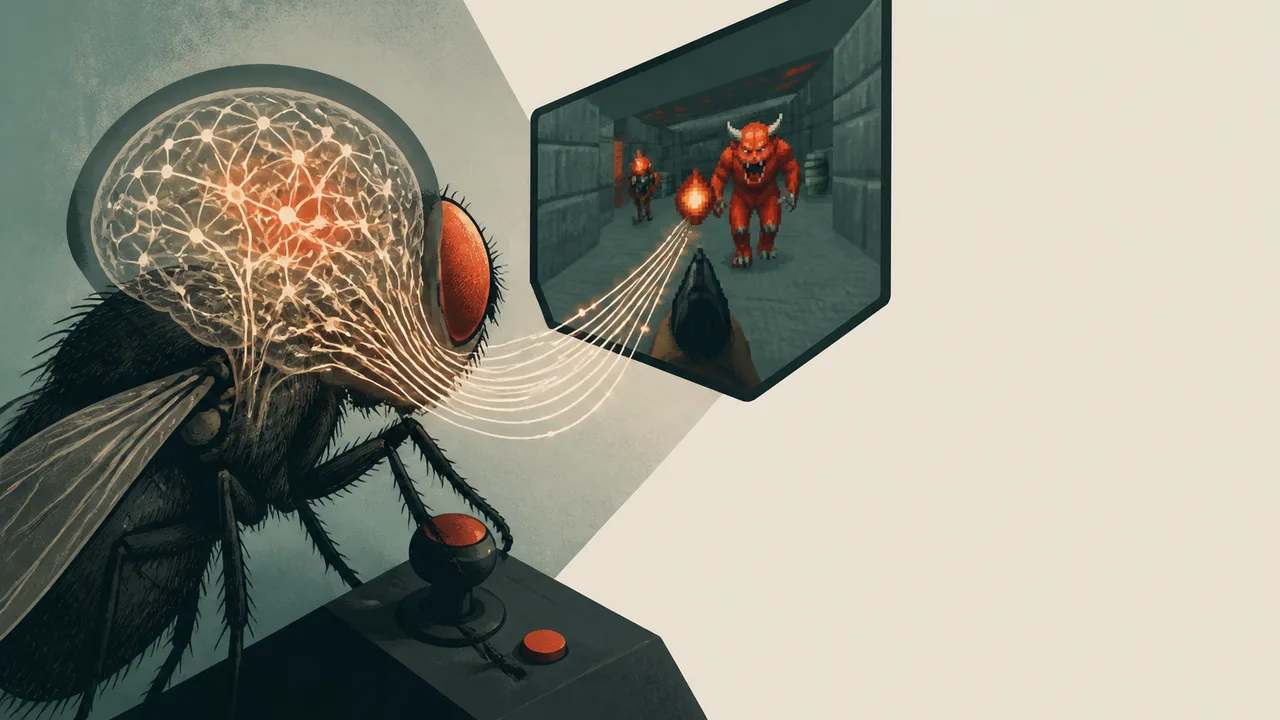
A digital reconstruction of an adult male fruit fly's brain, complete with its central nervous system and more than 166,000 neurons, is now being used to play Doom, Super Mario 64, and Beat Saber, according to Tom's Hardware. The setup works like this: visual frames from the game stimulate simulated sensory neurons, the resulting neural activity gets translated into controller inputs, and in-game damage supplies the feedback signal that drives learning.
If your first reaction is "surely the fly brain is the least qualified Doom player imaginable," you're in good company. But the experiment is more interesting than the headline, and more limited. Both things are true at once, and the gap between them is where the actual science lives.
How You Get from a Fly to Hell on Earth
The starting point is the connectomics work. Google and its research partners produced a detailed three-dimensional reconstruction of an adult male fruit fly's brain and entire central nervous system, a map of over 166,000 neurons and their connections, as reported by Tom's Hardware. This follows years of fruit fly connectomics milestones; the adult male full-brain map was itself a landmark because it captured not just the neurons but the wiring between them at synaptic resolution.
Then a software engineer took that biological model and wired it into a closed loop with a game environment. PC Gamer reports that the same setup runs Doom, Mario 64, and Beat Saber, and TheGamer adds Minecraft to the list of environments.
The game is not the point. The game is a convenient source of exactly what a learning system needs: a visual stream, a set of possible actions, and a cost function. Getting shot in Doom is unambiguous feedback. That makes the game a standardized test bench, the same way researchers use mazes for rats and, historically, Doom for anything with a display and an input layer. The genre earned this role honestly; id Software released the Doom source code in 1997, and researchers have been bolting agents onto it ever since.
The Arousal Detail Deserves Attention
The most scientifically specific claim in the coverage comes from Eurogamer, which quotes the project's description of how the fly model behaves: "The more aroused the fly is the harder it tries to shoot," according to Eurogamer. Insect neuroscientists have mapped arousal and motivation circuits in Drosophila for years, and if the simulated model's shooting intensity tracks the activity of those genuine biological arousal pathways, that's a claim about emergent behavior from the reconstructed circuit, which is far more interesting than a pixel-accuracy benchmark.
It's also a claim that needs the most scrutiny. Arousal in a real fly is measurable, heritable, and manipulable. Arousal in a simulation is whatever the model says it is. The researchers' framing is testable in principle: perturb the arousal circuit, observe the behavioral change, check whether the dose-response resembles the biology. If nobody runs that experiment, the quote remains a colorful observation.
What This Doesn't Show
The brief's most important caveat: no living insect has been trained to do anything. The reconstruction is a static anatomical map. A real fly brain is dynamic, chemical, and constantly rewiring; the map is a snapshot of structure, and structure alone doesn't determine function. The simulation runs on top of assumptions about how those neurons fire, how synapses weigh signals, and how plasticity works. Those assumptions, not the anatomy, may be doing most of the behavioral work.
This echoes a parallel effort: Eon Systems put a fruit fly connectome into a simulated body and got a virtual fly that walks with no training, raising similar questions about what the map itself contributes versus what the surrounding simulation supplies. Walking and shooting are very different behaviors, and both projects sit in the same methodological gray zone: impressive outputs that could, in principle, come from the model, the scaffolding, or some inseparable mix.
Gizmodo frames the story as spectacle, Google mapped a fly brain and now it plays Doom and Mario 64, according to Gizmodo, and the spectacle is doing distribution work that the underlying connectomics data has struggled to get for a decade. That's fine. Spectacle that routes attention toward real datasets is a net win. The problem starts when the spectacle gets mistaken for the finding.
The brief is careful on this point and so should we be: the experiment does not demonstrate human-like intelligence, does not mean a fly learned anything, and its value depends on three things that haven't been established yet: reproducibility, transparent methods, and evidence that responses arise from the reconstructed neural model rather than from hidden conventional controls. "Hidden conventional controls" is the polite term for the possibility that a standard neural network or hand-tuned game logic is doing the actual work, with the fly brain as elaborate window dressing.
What Would Change My Mind
For this to graduate from demo to science, several things need to appear in public:
- Ablation results. Damage specific neuron classes in the simulation and show the corresponding behavioral deficit. If silencing the visual system stops the fly from reacting to enemies, the model is load-bearing. If nothing you ablate changes behavior, the model is decorative.
- Method transparency. The full pipeline, from frame preprocessing to action decoding, published or released. Without it, nobody can rule out conventional control pathways.
- Biological validation. Compare the simulated arousal-driven shooting behavior against actual Drosophila arousal literature. If the dynamics diverge from known biology, the model is a toy with a fly costume.
- Independent replication. Someone else runs the same connectome with the same interface and gets comparable behavior. Connectomics has been burned before by results that didn't reproduce.
None of these are unreasonable asks. All of them are the difference between "engineers built a fun demo" and "a mapped biological circuit genuinely processes interactive sensory input," and the current coverage, across Slashdot, PC Gamer, Tom's Hardware, Eurogamer, Gizmodo, and TheGamer, documents the demo, not the science underneath it.
Why the Method Might Outlive the Headline
Even setting aside whether this particular fly shoots well, the setup points somewhere real. Connectomics has produced staggering data and struggled to produce matching insight; a full connectome is a parts list, and parts lists don't tell you how the machine runs. Interactive environments are one candidate bridge. Put the map in a closed loop, apply pressure, and watch which circuits change their activity when behavior has consequences. That's a question you can't answer from anatomy alone.
The constraint is also the value. A fly has roughly 166,000 neurons. A human has about 86 billion. If learning and behavior can't be understood at fly scale, where every connection is known, scaling up won't fix the confusion. The fly is the smallest system where the full problem, sensing, deciding, acting, learning, is present but tractable. Demos like this are the first crude attempts to turn that tractability into actual experiments.
The Doom framing will age. The question it poses won't: at what point does a sufficiently complete map of a nervous system, running in a closed loop, stop being a model of behavior and start being behavior? Nobody in this story has answered that. But they've built the cheapest laboratory anyone has ever had for trying.
More Like This
Unraveling the Golden Ratio's Mathematical Magic
Explore how the golden ratio's unique irrationality connects math, nature, and fractals.
Scientists Made a Virtual Fly Walk Using a Dead Fly's Brain
Eon Systems copied a fruit fly's brain into a computer and it just...walked. No training, no programming. What does this mean for AGI?

Private Satellites and AI Are Rewriting How We Watch Earth
Commercial satellite constellations and AI can track forests, ice and fires in near real time. The catch: who can audit the data, and who gets to see it.

Mapping the Brain's Electrical Grid to Treat Schizophrenia
Duke researcher Kafui Dzirasa is building an electrical map of the brain to find new treatments for schizophrenia and depression—beyond dopamine and serotonin.
Exploring Black Holes and Asteroids with StarTalk
Neil deGrasse Tyson delves into black holes, asteroids, and more in StarTalk's latest Cosmic Queries episode with Chuck Nice.

How the Brain Perceives and Distorts Time
Neuroscientist David Eagleman explains why time warps in emergencies, why childhood summers felt endless, and what all of it reveals about consciousness.

Why Creativity Strikes at Odd Times
Explore why your best ideas pop up during downtime and how to harness them.

Why Confident People Don't Overexplain
Exploring why confidence leads to less overexplaining and what we can learn from it.