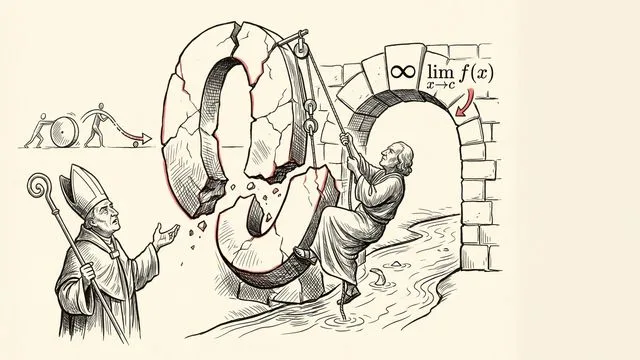
This cluster examines the rich history of calculus and mathematical innovation, tracing how some of the most fundamental tools in modern mathematics were developed and refined over centuries. The articles explore pivotal moments when mathematicians overcame conceptual barriers and formalized ideas that had long seemed intuitive or impossible. At the heart of this exploration is the story of how calculus emerged as a rigorous discipline, with figures like Isaac Newton playing crucial roles in both advancing the field and demonstrating its practical applications. These pieces reveal how mathematical breakthroughs often involve not just new formulas, but new ways of thinking about problems that previously seemed unsolvable.
One key theme across these articles is the relationship between everyday formulas and the deeper mathematical structures they represent. Many formulas that students memorize in school contain hidden mathematical principles—particularly the ideas of differentiation and integration that form the bedrock of calculus. This connection shows how calculus didn't emerge from nowhere but rather represents a formalization and extension of patterns mathematicians observed. Additionally, the cluster addresses one of mathematics' most notorious conceptual problems: division by zero. The resolution of this issue through rigorous mathematical frameworks represents a turning point in how mathematicians approached undefined operations and edge cases, leading to more robust and reliable mathematical systems.
Newton's work on calculating pi exemplifies how calculus became a tool for solving concrete problems. Rather than relying on geometric approximations or infinite series based on intuition, calculus provided systematic methods for computing values with remarkable precision. These articles collectively demonstrate that the history of mathematics is not merely about discovering isolated facts, but about developing increasingly sophisticated frameworks for understanding change, infinity, and the relationships between quantities. This historical perspective helps illuminate why calculus is structured the way it is and how it transformed mathematical practice across multiple disciplines.