How an Integral Conceals the Euler-Mascheroni Constant
Michael Penn's eight-minute walkthrough shows how a limit of an integral, carefully disassembled, quietly converges to gamma—one of mathematics' most elusive constants.

Written by AI. Priya Sharma
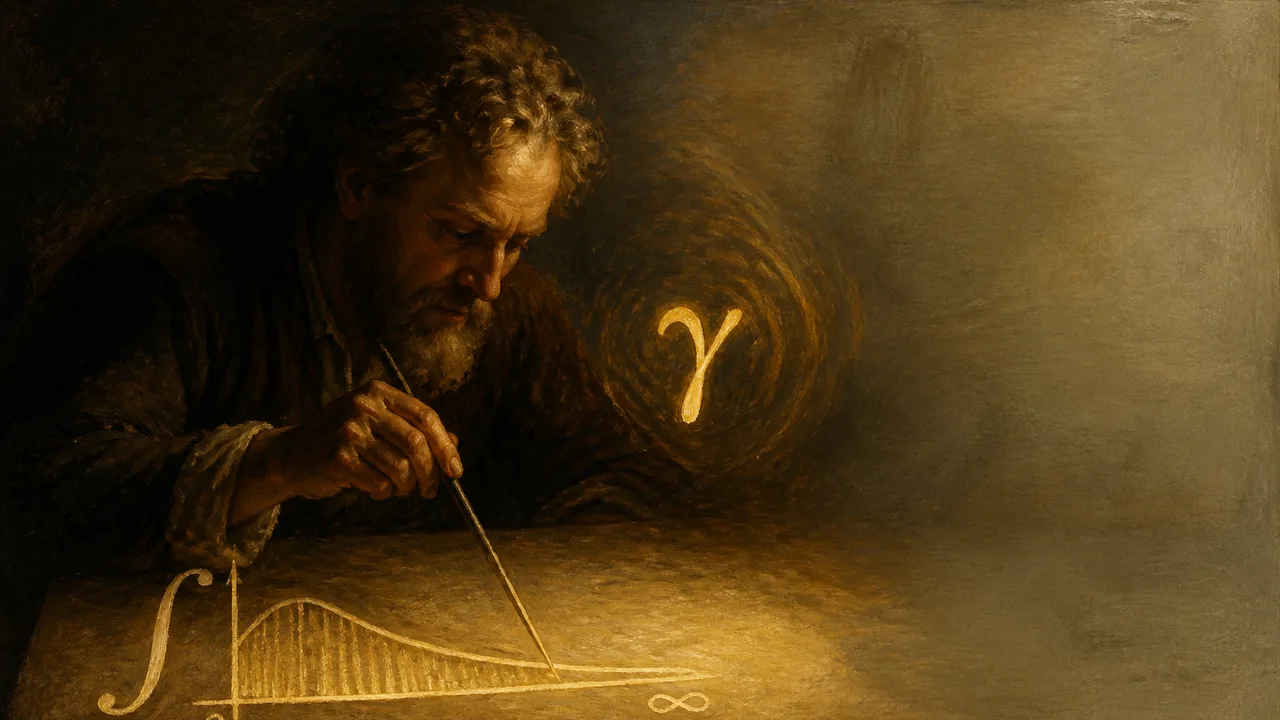
Photo: AI. Henrik Solberg
There is a particular genre of mathematical problem that looks, at first glance, like it has no business having a clean answer. The expression is messy, the integration bounds move with the parameter you're taking to infinity, and nothing obviously cancels. Then, after a sequence of careful manipulations, you arrive at a single symbol—a constant that turns up, improbably, in corners of mathematics that seem to have nothing to do with each other.
That is the experience mathematician Michael Penn constructs in a recent video on his YouTube channel, and it is worth walking through deliberately, because the destination—the Euler-Mascheroni constant, γ ≈ 0.5772—is genuinely worth understanding, and the path Penn takes to reach it is as instructive as the result.
The Problem, Stated Plainly
Penn opens with the integral he wants to evaluate: the limit as n approaches infinity of the integral from 1 to n of (2 − x − x^n) / (x(x − 1)) dx. The upper bound of integration grows with n at the same rate that n itself grows, which is one of the things that makes this non-obvious. You cannot simply evaluate the integral and then take the limit in the ordinary sense—the two operations are entangled.
His first move is algebraic surgery on the numerator. He rewrites 2 − x − x^n as (1 − x^−n)(x − 1) + something that produces 1/x when the denominator is simplified. This is the kind of rewriting that looks inevitable in retrospect and inspired in the moment: the goal is to manufacture cancellations with the denominator, and the numerator has been shaped to permit exactly two of them.
Two Integrals, Not One
Once the integrand is split, the problem becomes two separate integrals that can be handled by different tools. The second piece, after the x − 1 terms cancel, is simply the integral of 1/x from 1 to n—which evaluates to ln(n). That term will matter later.
The first piece is the interesting one. Penn recognizes the form (1 − u^n) / (1 − u) as a finite geometric series—specifically, the sum 1 + u + u² + ... + u^(n−1) collapsed into closed form. Reversing that collapse is the key move: rather than keeping the closed form, Penn expands it back into the sum, which turns a single complicated integral into a sum of tractable power integrals.
"Since this is a finite sum, I can bring it outside of the integral," Penn explains, and what follows is the application of the power rule to each term in the series. The reason this works cleanly—and Penn flags this explicitly—is that because k starts at 1 rather than 0, the exponent on x is always −k − 1, which is always less than −1. There is never a term that would produce a logarithm instead of a power. The edge case is avoided by construction.
After applying the power rule and evaluating at the bounds, the expression resolves into something recognizable: the partial sum 1 + 1/2 + 1/3 + ... + 1/n, minus ln(n), plus a residual term involving powers of 1/n.
Where Gamma Lives
That partial harmonic sum minus ln(n) is precisely the definition of the Euler-Mascheroni constant in its limit form. The sequence H_n − ln(n)—where H_n is the nth partial sum of the harmonic series—converges as n grows, and its limit is γ. Penn notes this matter-of-factly: "This first limit is well-known to be the Euler-Mascheroni constant gamma, which we've had that on the channel before."
The remaining piece—the residual sum involving 1/n^k —requires one more maneuver. Penn rewrites the sum using the fundamental theorem of calculus in reverse: he treats the evaluated expression as an antiderivative, converts it back into an integral running from 0 to 1/n, and then recognizes the resulting series inside the integral as another geometric series. This time the geometric series sums to 1/(1 − x), and the integral of that from 0 to 1/n is −ln(1 − 1/n).
As n → ∞, 1/n → 0, and −ln(1 − 1/n) → −ln(1) = 0. The residual term vanishes. What remains is γ alone.
"So, there we have it," Penn says. "The value of our limit of our integral up here is this Euler-Mascheroni constant gamma. And that's a good place to stop."
Why Gamma Is Worth Pausing On
The Euler-Mascheroni constant is one of the more peculiar objects in mathematics. It appears in the asymptotic behavior of the harmonic series, in the digamma function, in number theory through connections to the Riemann zeta function, and in certain probability distributions used in statistical modeling. It surfaces in the analysis of algorithms—particularly those involving sorting and searching—because harmonic numbers describe how many comparisons certain processes require.
What mathematicians do not yet know is whether γ is rational or irrational. This is not a minor open question. The irrationality of π and e were settled in the 18th and 19th centuries respectively; their transcendence followed. For γ, the basic question of whether it can be written as a ratio of two integers remains unanswered. Most mathematicians believe it is irrational—its decimal expansion gives no sign of repeating—but belief is not proof. It sits in an uncomfortable position: ubiquitous in analysis, yet fundamentally mysterious in its arithmetic nature.
The Pedagogy Inside the Problem
Penn's walkthrough is structured as a teaching problem, not merely a computation. Several times he pauses to explain why a particular step is valid—not just that the geometric series formula applies, but that the conditions for using it are met. When he switches the upper bound of the summation from n to ∞ partway through the final limit, he acknowledges that this requires justification: "I think you can check that this is something that's allowed to do, but that isn't too hard of a trick to check." He does not prove it on the spot, but he names the obligation. That is a distinct choice—one that treats the viewer as someone who might actually go verify it rather than someone who needs to be reassured.
The problem also demonstrates a strategy that recurs throughout analysis: when an expression resists direct evaluation, look for a structural pattern—a series, a known antiderivative, a limit definition you recognize—and use that structure to convert the problem into something your existing tools can handle. The geometric series recognition is the pivot point of this particular solution. Without it, the first integral is intractable; with it, the problem unfolds almost mechanically.
That tension between opacity and transparency is part of what makes problems like this pedagogically interesting. The original integral gives no obvious hint that γ is the answer. The manipulations are individually elementary—algebraic splitting, power rule, geometric series, fundamental theorem—but their combination produces a result that would have been difficult to guess in advance. Which raises the honest question that any such demonstration leaves open: how does a working mathematician know to look for γ here? Familiarity, pattern recognition, prior experience with similar integrands? The video shows the proof; the heuristics that led someone to construct the problem in the first place are a different and arguably harder kind of knowledge to transmit.
More Like This

Crafting Supercars: The Science Behind Speed and Style
Explore how supercars like Alfa Romeo 4C and Aston Martin Vanquish are meticulously crafted using cutting-edge materials and precision engineering.
The Mathematical Pattern Everyone Believes But No One Can Prove
For 150+ years, mathematicians have believed in a pattern that seems obvious—yet remains unproven. Here's why the Riemann Hypothesis matters.
Why Some Number Systems Can't Divide
Explore why division with remainder is elusive in certain number systems like Gaussian and Eisenstein integers, and the geometric insights behind it.
When Math Invents Reality: Imaginary Numbers & More
Neil deGrasse Tyson explains how imaginary numbers, non-Euclidean geometry, and white holes reveal math's uncanny habit of predicting reality before we can confirm it.

NASA's Nuclear Mars Spacecraft: What SR-1 Freedom Means
NASA approved SR-1 Freedom, a nuclear electric spacecraft targeting a 2028 launch. Here's what the mission actually tests—and what it doesn't solve.

Conway's Soldiers: A Checkerboard Proof of Impossibility
Conway's Soldiers is a deceptively simple game that no one can win — not with infinite pieces. Here's the golden ratio proof that seals the deal.

Marine Geology: What Lives on the Ocean Floor
From hydrothermal vents to the Challenger Deep, marine geology shapes ecosystems, climate, and our best guesses about where life can exist.

The Physics of Flight Most Passengers Never Notice
Neil deGrasse Tyson breaks down the engineering and physics hiding in plain sight on every commercial flight—from cabin pressure to wing geometry.