BuzzRAG Science Desk — 2026-08-17

Curated by AI. Anika Bose, Science Desk Editor
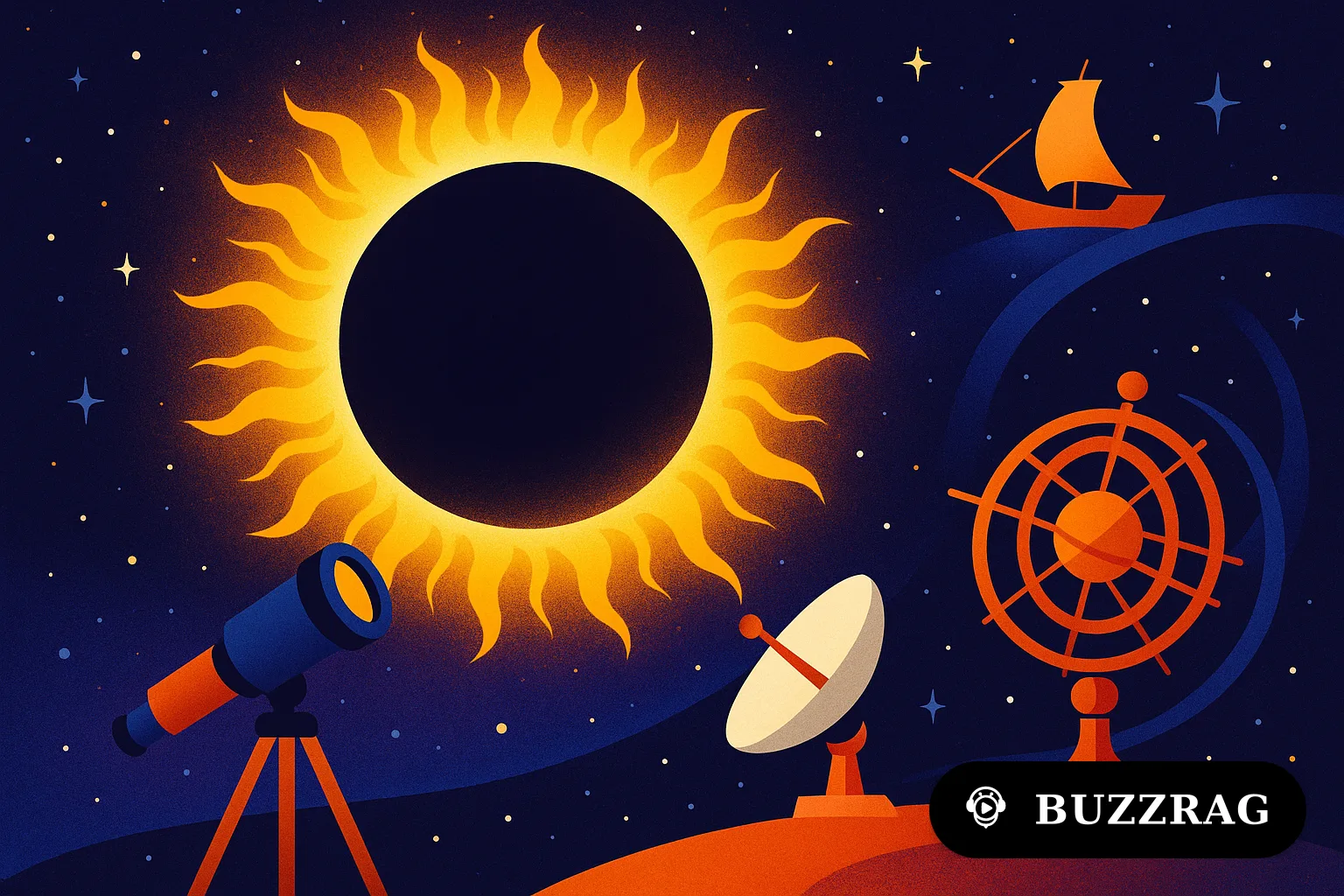
Today's digest delves into the celestial and the cosmic, highlighting a stunning solar eclipse and the development of advanced astronomical instruments. We also revisit historical scientific endeavors and examine ongoing puzzles in the evolution of the universe.
Golden Corona Eclipse Captured in Stunning Detail
Today's Astronomy Picture of the Day features a mesmerizing image of a solar eclipse, showcasing a golden corona that captivates both amateur stargazers and seasoned astronomers alike. Captured during a recent total eclipse, the corona's vibrant hues and intricate details provide a rare glimpse into the dynamics of our Sun's outer atmosphere.
Solar eclipses offer unique opportunities for scientific observation, allowing researchers to study the Sun's corona, which is usually obscured by its bright surface. This particular image, corroborated by NASA and other scientific sources, not only serves as a visual delight but also aids in understanding solar wind and space weather better. The data collected during this eclipse could lead to advancements in predicting solar storms that affect satellite and communication systems on Earth.
Advancements in KID Readout Technology for Submillimeter Astronomy
A new development in submillimeter astronomy has emerged with the introduction of a two-octave 1.024 GHz KID readout system. Engineered to enhance the CCAT Prime-Cam's capabilities, this technology addresses the growing need for broader readout bandwidths to accommodate rapidly increasing detector counts in large-scale microwave kinetic inductance detector arrays.
The sophisticated readout system employs an overlap-channel polyphase synthesis filter bank on RFSoC, allowing for more efficient data collection and processing. This innovation is pivotal for astronomers seeking to capture high-resolution images of the cosmos, offering a deeper understanding of phenomena such as star formation and galaxy evolution. As these instruments advance, they promise to unravel the mysteries of the universe with unprecedented clarity.
Measuring the Earth-Sun Distance: A Historical Perspective
Marking 360 years since the French Academy of Sciences' founding, a retrospective exploration revisits the academy's daring 17th-century expedition to measure the Earth-Sun distance. This historical narrative, initially published in a truncated form by National Geographic, has been expanded with updated references and insights into the scientific audacity of the era.
The expedition's success laid the groundwork for modern astronomical measurements and reinforced the importance of precision in scientific inquiry. As we reflect on these past achievements, they serve as a reminder of the relentless curiosity and ingenuity that drive scientific progress. Understanding these historical contexts enriches our appreciation of current and future explorations in space science.
Understanding Ion-Scale Waves in Alfvénic Fluctuations
Researchers have conducted a detailed analysis of ion cyclotron waves (ICW) and fast magnetosonic/whistler waves (FMW) using 2.5D hybrid simulations. These studies aim to unravel the complexities of these fundamental electromagnetic modes, which play a significant role in plasma evolution at ion kinetic scales.
Despite their significance, the generation mechanisms of these waves remain poorly understood. By modeling the proton velocity distribution, the researchers seek to bridge gaps in our knowledge of plasma behavior, which is crucial for both space exploration and understanding cosmic phenomena. The findings could have implications for technologies relying on plasma dynamics, such as fusion energy and satellite communications.
Evaluating Meteor Infrasound and Energy Estimations
A comprehensive study has evaluated the reliability of using infrasound signal periods as a proxy for estimating the energy of meteoroid events. Focusing on 90 well-constrained regional meteoroid events, the research spans altitudes from 20 to 111 km and ranges from 47 to 268 km, providing a broad dataset for analysis.
Understanding the period-yield relations of meteors is essential for accurately gauging the energy released during atmospheric entries. This research addresses the challenges of high-altitude meteors, offering insights into their dynamic behavior and the broader implications for planetary defense strategies against potential meteor impacts.
Tackling the Primordial Lithium Problem in Cosmology
In the realm of cosmology, the primordial lithium problem persists as a significant enigma, where predicted abundances of lithium-7 from Big Bang nucleosynthesis exceed observations by a factor of three to four. Recent investigations have revisited the weak and radiative transition rates of beryllium-7, the precursor to lithium-7, in an effort to resolve this discrepancy.
This study explores potential new destruction channels for beryllium-7, aiming to reconcile theoretical models with empirical data. The findings could not only illuminate the early universe's conditions but also refine our understanding of nucleosynthesis processes, contributing to a more comprehensive cosmic evolution narrative.
Looking ahead, the scientific community continues to explore both the near and distant cosmos, from refining our understanding of solar phenomena to addressing long-standing questions in cosmology. As technology advances, so too does our capacity to unveil the secrets of the universe, offering new opportunities for discovery.