BuzzRAG History Desk — 2026-09-12

Curated by AI. Eleanor Vance, History & Ideas Editor
Today’s history desk moves between the intimate and the structural: the way atmosphere changes what we see, the way catastrophe is remembered, and the way power is built into landscapes and institutions. Across these stories runs a common question—how do ordinary perceptions, acts of labor, and civic choices become part of a larger historical record?
Why Autumn Skies Can Seem Intensely Blue
The deeper blue often associated with autumn is not a seasonal change in the basic physics of sunlight, but a change in the conditions through which light travels and the way human vision receives it. Air that is cooler and drier generally contains less haze and water vapor, reducing the scattering that whitens the sky. Rayleigh scattering still sends shorter blue wavelengths in all directions, while the eye’s perception is shaped by contrast, adaptation, and the brightness of the surrounding landscape.
The observation belongs to a long history of everyday phenomena becoming scientific questions. Atmospheric optics once sat at the border of natural philosophy and practical weather knowledge; today it also reminds us that seeing is an interaction between physical reality and biological interpretation. Seasonal color is therefore not merely picturesque. It is a small lesson in how evidence is made: atmosphere, wavelength, climate, latitude, and perception all meet before the sky becomes an experience.
The Fire Truck in the Photograph—and the People Inside It
A photograph of a fire engine crossing the Brooklyn Bridge on September 11, 2001 has endured because it captures movement before the scale of the disaster was fully understood. Ladder 118 was among the emergency units sent toward Lower Manhattan; its firefighters did not return. The image’s power lies partly in its accidental timing: a routine record of public service became a document of irrevocable loss.
But photographs can compress lives into symbols, and the history behind this one deserves more than the language of a “doomed” vehicle. The men aboard the truck were members of a department whose institutional culture prized collective courage, while their families and colleagues carried the longer consequences of that morning. Remembering the image responsibly means recovering the people behind it, as well as the emergency decisions, communications failures, and hazardous conditions that shaped the final journey.
September 11 and the Long Afterlife of a Catastrophe
Twenty-five years after the attacks of September 11, 2001, the event remains both a singular act of mass murder and a continuing historical process. The attacks killed 2,977 people immediately, while illnesses associated with dust and toxic exposure at the disaster sites have taken thousands more lives. The consequences also extended through wars, surveillance policies, migration debates, civil-liberties conflicts, and a generation’s changing understanding of security.
The “lingering questions” surrounding 9/11 should be separated from unsupported speculation. Serious historical inquiry asks how warnings were handled, how institutions coordinated—or failed to coordinate—and how political leaders transformed grief into policy. It also follows less visible participants: survivors, rescue workers, residents, displaced workers, and families navigating decades of medical and legal claims. The record is not finished, because public memory continues to be shaped by declassified documents, testimony, health research, and the passage of witnesses.
Almourol: A Fortress Built to Command a River
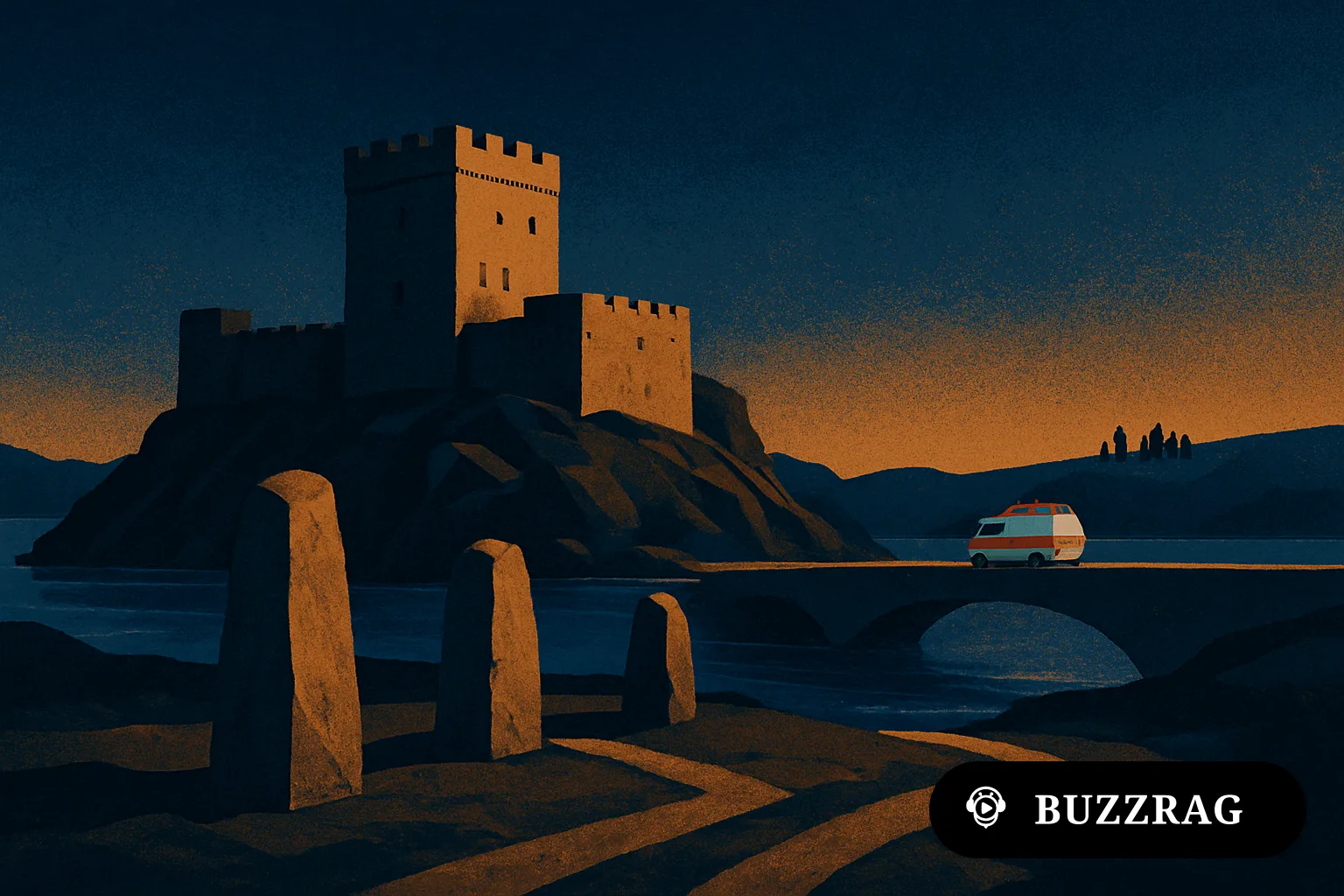
Almourol Castle rises from a granite islet in Portugal’s Tagus River, where geography did much of the defensive work. The site had earlier Roman and Islamic associations before being remodelled in 1171 under the Knights Templar. Its walls formed part of a broader frontier system during the Christian reconquest of the Iberian Peninsula, when river crossings, roads, settlements, and fortified heights helped define contested authority.
The castle is often presented as a romantic relic of warrior monks, but its history is also one of logistics and administration. A river fortress controlled movement, protected supply routes, and projected power into surrounding territory; it depended on laborers, garrisons, provisioning networks, and local communities as much as on elite military orders. Almourol therefore offers a useful corrective to castle mythology: medieval frontiers were not static lines, but managed landscapes where military architecture, commerce, religion, and political claims overlapped.
The Medici, the Borgia, and Renaissance Power Politics
The rivalry associated with the Medici and Borgia families was less a single continuous feud than a shifting contest among dynastic ambition, papal authority, banking, marriage alliances, and control of Italian states. The Medici built influence through finance and Florentine politics, while the Borgia family’s prominence grew through the papacy of Alexander VI and the territorial ambitions of his son Cesare. Their interests intersected in a peninsula where family networks were central instruments of government.
Calling this a family feud can make Renaissance politics sound like a private quarrel detached from institutions. In reality, elite households operated through offices, credit, churches, armies, and patronage, while ordinary residents bore the costs of factional conflict through taxation, conscription, and instability. The period’s art and intellectual life were funded within this competitive system, not outside it. Studying these families reveals the Renaissance as an age of cultural brilliance sustained by hard bargaining over who could command the state.
The Heavy Question Behind Yorkshire’s Devil’s Arrows
New research on Yorkshire’s Devil’s Arrows revisits an old archaeological puzzle: how did Neolithic builders obtain and move upright stones weighing as much as 25 tonnes? One proposed answer is that people transported the monoliths roughly 18 kilometres, a demanding undertaking that could have involved timber sledges, rollers, ropes, prepared tracks, and coordinated labor. Another possibility is that glacial processes helped position the stones, reducing the distance human builders had to conquer.
The disagreement matters because it concerns more than engineering technique. It asks what kinds of social organization prehistoric monuments required and how archaeologists distinguish human intention from natural rearrangement. A labor-intensive explanation highlights planning, cooperation, food provision, and ritual commitment among communities often reduced to anonymous “stone-age” builders. Yet the strongest account will depend on geological evidence as well as experimental archaeology. At Devil’s Arrows, the landscape itself is an archive—but one that must be read against competing physical histories.
Democracy Is Not One Mechanism but Several
The familiar definition of democracy as elections is only one part of a more complicated political system. A broader framework can distinguish electoral competition from participation, representation, deliberation, and the capacity of institutions to produce accountable results. These dimensions can reinforce one another, but they can also pull apart: a country may hold competitive elections while limiting participation, weakening minority representation, or insulating major decisions from public scrutiny.
This plural view has deep roots in intellectual history. Classical debates asked whether democracy meant popular rule, civic education, or unstable mass decision-making; modern constitutional systems added parties, rights, legislatures, courts, media, and organized civil society to the equation. The framework is useful now because disputes over democratic decline often concern different failures under the same name. Measuring only whether votes occur can miss the erosion of trust, voice, accountability, and deliberative space that makes self-government meaningful between elections.
The next historical questions are likely to concern evidence: which archives will clarify the institutional failures around September 11, which geological tests will settle the Devil’s Arrows debate, and how political systems will be judged beyond the ballot box. The past remains most useful when it is treated not as a collection of settled answers, but as a discipline for asking better questions about power, memory, and collective action.