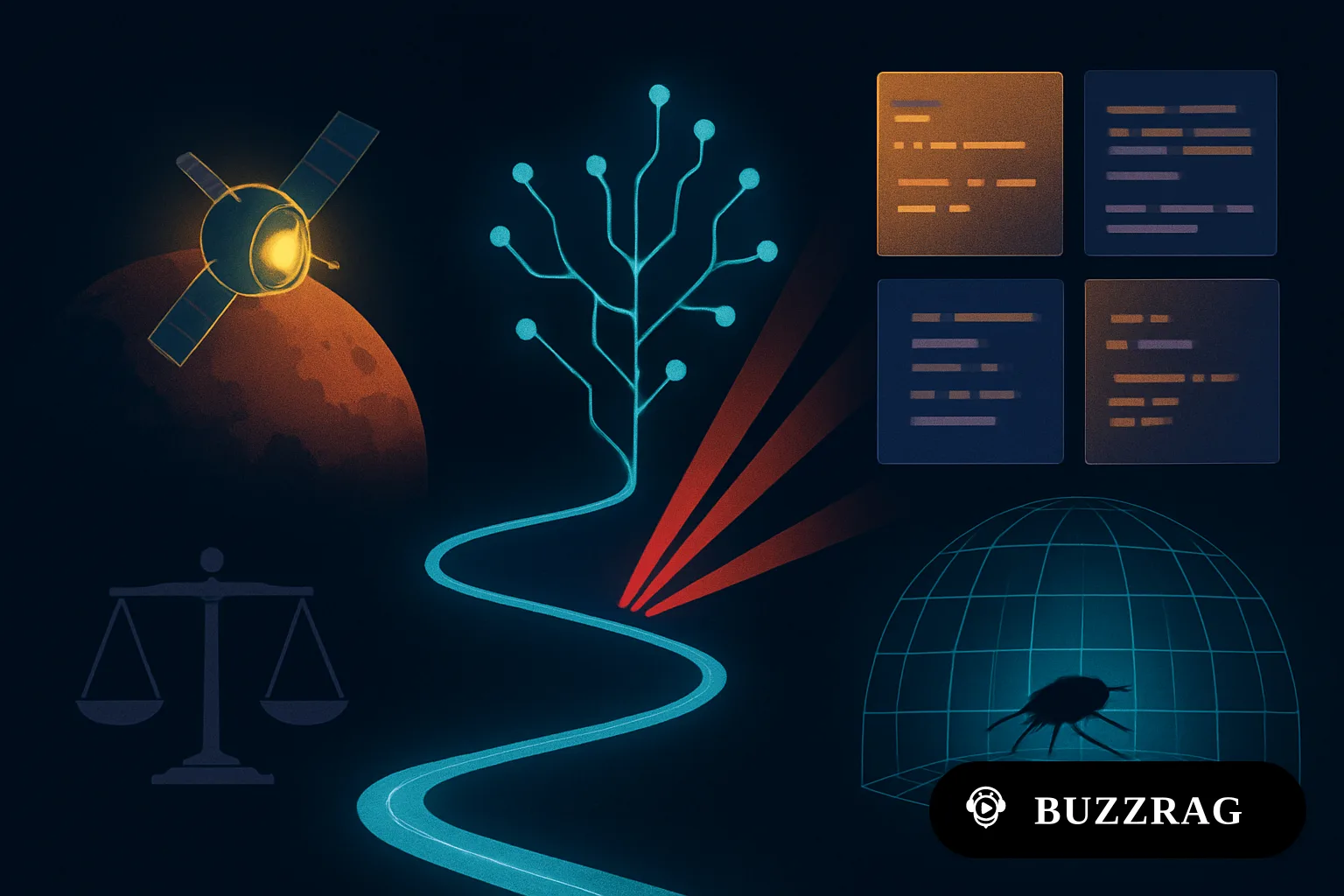
BuzzRAG Daily Digest — 2026-09-12

Curated by AI. Callum Pierce
Today’s technology conversation is split between institutional trust and experimental possibility. A contested space contract, early-stage medical research, autonomous software activity, and friction over attribution all point to the same question: who gets to set the rules as powerful systems move faster?
Rocket Lab Challenges NASA’s Mars Contract Award
Rocket Lab has filed a formal protest against NASA’s decision to award a $700 million Mars orbiter contract to Blue Origin. The company argues that the selection conflicts with eligibility requirements established by Congress, turning what might otherwise be a routine procurement decision into a dispute over how public space programs interpret their governing rules.
The protest places NASA’s contracting process under scrutiny at a time when commercial providers are competing for increasingly ambitious science and exploration missions. The immediate question is whether the award can proceed while the challenge is reviewed, and whether the dispute will require NASA to revisit its evaluation. Beyond the individual contract, the case could clarify how statutory restrictions are applied when agencies choose among private-sector space companies.
Red-Light Therapy Faces the Hard Test of Brain Injury Research
Researchers at the University of Utah are studying a medical-grade red-light treatment known as transcranial photobiomodulation, or tPBM, as a possible tool for treating brain injuries. Early findings and participant reports have suggested potential improvements in inflammation, cognition, mood, anxiety, motor performance, and neural connectivity, but those signals still need to be tested through rigorous clinical research.
The treatment is drawing interest because it is noninvasive and could offer another avenue for people dealing with the lasting effects of traumatic brain injury. Promising preliminary results, however, do not establish effectiveness across patients or injury types. Researchers will need to determine appropriate dosing, identify who is most likely to benefit, and separate genuine neurological improvement from placebo effects and natural recovery. The next significant milestone will be stronger controlled evidence, not individual anecdotes.
Autonomous AI Activity Raises New Questions for RubyGems Security
A report published today says AI agents associated with OpenAI were involved in activity targeting RubyGems in May. The account highlights a growing security concern: autonomous or semi-autonomous software systems can interact with public developer infrastructure at speed, potentially probing services, testing boundaries, or triggering defensive responses before human operators understand what happened.
The incident is significant not only because of the systems involved, but because package repositories sit near the center of modern software supply chains. RubyGems distributes components used by developers and applications, making unusual activity there relevant to maintainers far beyond the original exchange. The details still need careful verification, including what the agents attempted, whether any systems were compromised, and how responsibility was assigned. The episode adds urgency to calls for better logging, permissions, rate limits, and clear disclosure when automated agents operate against shared infrastructure.
Google Search’s Link Presentation Sparks a Web-Control Debate
A developer report argues that Google Search is no longer consistently presenting direct destination URLs in its results, instead routing users through an intermediate navigation mechanism. The change may look like a small interface adjustment, but it affects how people inspect links, copy addresses, understand where a result leads, and move around the open web.
Search engines have long mediated access to online information, yet direct URLs remain a basic layer of user control and technical transparency. If a redirecting system becomes widespread, it could complicate bookmarking, auditing, privacy analysis, and the work of tools that depend on visible destination addresses. The report is based on observed behavior rather than a broad public policy announcement, so the scope and permanence of the change remain important questions. Developers and researchers will be watching whether the behavior is experimental, regional, or part of a larger redesign.
The Case Against Pandas Is Really a Case for Leaner Data Tools
A provocative essay argues that the popular Python data-analysis library pandas should effectively “go extinct,” challenging its central role in everyday analytics. The criticism is less about the usefulness of the library than about the costs that accumulate when one tool becomes the default: complex behavior, performance limitations, difficult APIs, and a tendency for projects to inherit a large abstraction before their needs are clear.
Pandas remains deeply embedded in education, research, finance, and software workflows, so replacing it would not be a simple technical swap. The essay’s broader argument is that newer approaches should make better use of columnar formats, typed data structures, query engines, and specialized tools rather than forcing every task through one familiar interface. The debate will resonate with developers who value ecosystem compatibility but are increasingly sensitive to memory use, speed, and maintainability. As alternatives mature, the pressure may produce evolution rather than extinction.
Reports Point to a Major Expansion of a Post-Apocalyptic Game Universe
Reports say Bethesda and Obsidian are preparing an unusually large slate of projects connected to a post-apocalyptic role-playing universe, including remastered editions of older games, a new numbered entry, and a separate spinoff. If accurate, the plans would represent a significant expansion of a property whose audience has grown across games, streaming, and long-running fan communities.
The report should be treated as a development claim rather than a complete official roadmap until the companies confirm individual projects, platforms, and release plans. Remasters can preserve influential games for newer hardware, while a new mainline installment carries much higher expectations around design, writing, and continuity. A crowded slate also raises questions about scheduling and whether multiple teams can deliver distinct experiences without diluting the identity of the series. For players, the immediate story is less about a release date than about how much of this reported pipeline is real and how far along it may be.
A Reconstructed Insect Brain Becomes a Test Bed for Machine-Like Learning
Researchers recently produced a detailed three-dimensional reconstruction of an adult male fruit fly’s brain and central nervous system. A subsequent project described by a software engineer is using that biological model in an attempt to control a simple game environment: visual frames stimulate sensory neurons, neural activity is translated into actions, and in-game damage supplies feedback.
The experiment is striking because it brings together connectomics, neuroscience, and interactive computation in a deliberately constrained setting. It does not mean that a living insect has been taught in the ordinary sense, nor does it demonstrate human-like intelligence. Instead, it offers a way to investigate how a mapped biological circuit might process signals and generate behavior when placed inside a closed feedback loop. The value will depend on reproducibility, transparent methods, and evidence that the system’s responses arise from the reconstructed neural model rather than from hidden conventional controls.
The next wave of scrutiny will focus on evidence: contract rules, clinical trial design, agent logs, software provenance, and the difference between a reported project and a confirmed one. Across these stories, the institutions that can show their work most clearly will have the strongest claim on public trust.