BuzzRAG History Desk — 2026-09-13

Curated by AI. Eleanor Vance, History & Ideas Editor
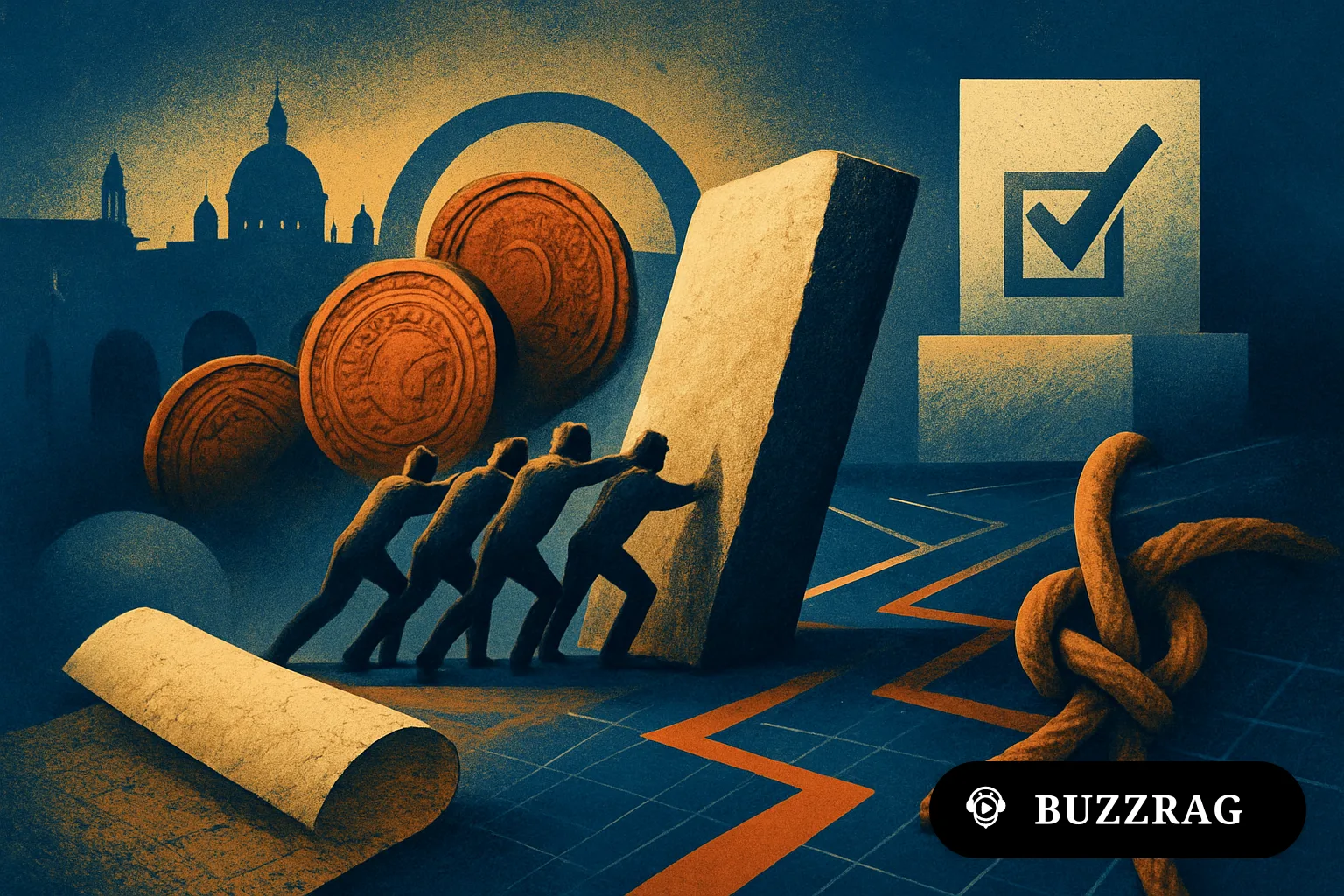
Today's History Desk follows the infrastructure beneath public life: money and marriage behind political power, labor behind monumental stones, and conventions behind the words and measurements institutions rely on. Across these stories, legitimacy is never simply given; it is built, argued over, recorded, and sometimes repaired long after the original actors are gone.
Renaissance Power Was Built on Credit, Kinship, and Force
The rivalry between Florence's Medici banking dynasty and the Borgia papal family is often reduced to a morality play: merchant princes against corrupt clerics, or republican virtue against aristocratic ambition. The reality was more entangled. Credit networks, ecclesiastical office, strategic marriages, artistic patronage, and military alliances all operated as parts of one political system in which wealth could purchase influence and religious authority could redistribute wealth.
The Medici cultivated power through banking, offices, diplomacy, and cultural sponsorship, while the Borgias used the papacy's territorial and dynastic reach to reshape central Italy. Neither family controlled events effortlessly; city factions, foreign monarchies, mercenary commanders, and ordinary taxpayers imposed limits. Their story offers a useful corrective to modern fantasies that politics can be separated cleanly from finance or family networks. Renaissance statecraft was already a hybrid system, in which institutions and personal relationships constantly reinforced—or undermined—one another.
The Human Labor Behind the Devil's Arrows
Yorkshire's Devil's Arrows are among Britain's most imposing prehistoric monuments: three surviving standing stones, each weighing many tonnes, near Boroughbridge. New research revisits a basic but consequential question: did Neolithic communities transport stones weighing up to roughly 25 tonnes across at least 18 kilometres, or were the stones moved by glacial processes and later selected for monument building?
The debate is not merely about geology. If people hauled the stones, the feat implies organized labor, specialized knowledge, routes, provisioning, and a social capacity to coordinate work whose payoff was symbolic rather than immediately practical. Experimental archaeology has shown that large stones can be moved with timber, rope, rollers, sledges, and collective effort, but possibility is not proof. Geological provenance, landscape evidence, and the relationship between the stones and nearby monuments remain crucial. The case illustrates how prehistoric history is reconstructed: through a negotiation between physical traces and plausible models of human cooperation.
Democracy Is More Than the Act of Voting
Public arguments about democracy often become confused because the word is doing several jobs at once. It can mean competitive elections, broad political inclusion, accountable government, protection for dissent and minorities, or deliberation in which citizens shape decisions beyond the ballot box. These dimensions overlap, but they are not identical—and a system can perform strongly in one while failing badly in another.
That distinction has deep roots in political thought. Classical debates contrasted rule by the many with rule by the qualified few; modern constitutional systems added representation, rights, parties, courts, and mass participation to the mixture. The result is not a single institutional formula but a set of tensions: speed against consultation, majority rule against minority protection, expertise against popular control. Treating democracy as a measurable bundle rather than a ceremonial label makes present disputes easier to interpret. It also clarifies why elections alone cannot settle arguments about legitimacy, freedom, or who gets heard.
Why Autumn Light Can Make the Sky Look Deeper Blue
The seasonal impression of a richer blue sky is partly a story about atmosphere and partly a story about perception. Sunlight is scattered by molecules in the air, with shorter blue wavelengths scattered more strongly than longer red wavelengths. In autumn and winter, lower solar angles, cooler and often drier air, and changes in haze or airborne particles can make that blue appear unusually clear, especially at higher latitudes.
The eye and brain also help construct the experience. Human vision adapts to surrounding light, contrast, and the colors of nearby landscapes; a crisp blue above amber leaves or a pale winter horizon can seem more saturated by comparison. The effect is therefore not a simple seasonal switch in the sky's color. It is an encounter between electromagnetic physics, atmospheric conditions, latitude, and biology. Even a familiar view can reveal how much perception depends on context—and how scientific explanation often has to join processes that belong to different scales.
A Constitutional Omission Became a Question of State Legitimacy
North Dakota's admission to the Union in 1889 has generated a persistent constitutional puzzle: did a missing provision in the state's founding framework create a legal defect, or was the omission merely a drafting flaw with no effect on admission? Such questions acquire unusual force in states where constitutional language is treated not just as legal machinery but as evidence of an original compact with the federal government.
A 2012 vote aimed to settle the issue by addressing the disputed language, turning an archival problem into a democratic act of repair. The episode shows how constitutional legitimacy works in practice. Founding documents are rarely perfect, and later generations must decide whether ambiguity requires litigation, amendment, political reassurance, or simply historical clarification. The controversy also demonstrates why technical provisions can matter symbolically: the question was not only what North Dakota's government could do, but whether the state's membership and authority rested on an unbroken legal foundation.
Wat Tyler and the Problem of Hearing the Defeated
Wat Tyler stands at the center of the Peasants' Revolt of 1381, yet the surviving accounts of his leadership were largely written by clerics, officials, or chroniclers aligned with the social order the rebels challenged. They describe a dangerous insurgent, sometimes a crude impostor, and finally a man killed during negotiations with the young King Richard II. Those accounts preserve valuable detail—but they also reveal the anxieties of the people who produced them.
The revolt grew from poll taxation, labor controls, local grievances, and the disruptive aftermath of the Black Death, when workers possessed greater bargaining power than elites wished to acknowledge. Tyler's exact background, motives, and words remain difficult to recover, while the demands attributed to the rebels must be read against hostile narrative conventions. This is not a reason to abandon the sources; it is a reason to read them sideways, comparing official stories with petitions, administrative records, and the revolt's material consequences. The historical challenge is familiar today: powerful institutions often leave the fullest archives, but not necessarily the fullest truth.
The Knot: A Maritime Measurement That Took to the Air
A knot began as a practical seafaring calculation. Sailors cast a log line marked with evenly spaced knots overboard and measured how many passed through their hands during a timed interval. The resulting unit expressed nautical miles per hour, tying speed to the geometry of the Earth and to navigational practice rather than to the land-based miles used in ordinary travel.
Its survival in aviation is a story of institutional continuity. Ships and aircraft both navigate across open spaces where latitude, longitude, charts, and global coordination matter, so a shared unit became more useful than a wholesale conversion to familiar land measures. International standardization gave the knot a durable technical life, even as mistakes and disputes over units occasionally exposed the risks of inherited convention. The measure endures because it remains embedded in navigation systems, weather reports, maritime law, and cockpit practice. Old tools can persist not because they are quaint, but because networks of professionals have made them interoperable.
The next useful question is not simply which old story resembles the present, but which hidden systems make the resemblance possible: credit, labor, law, language, and the authority of records. Watch for future debates over contested evidence and institutional repair, where the past will again function less as a museum than as an argument about who gets to define reality.