Xbox Series S Puts Game Access and Developer Work at Odds
Katsuhiro Harada's Xbox Series S criticism raises a hard question: how can Xbox keep cheaper access while asking studios to support two performance targets at once?

Written by AI. Derek "D-Block" Washington
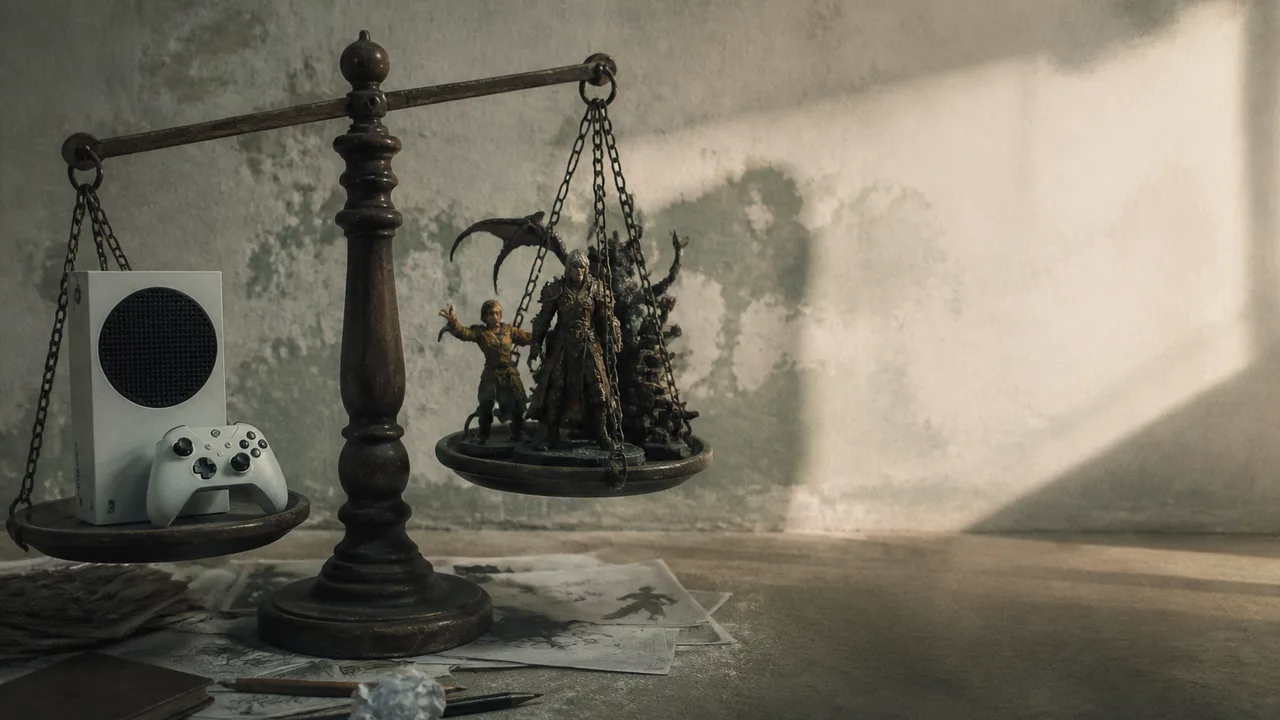
Katsuhiro Harada told a console-developer panel in South Korea that he wished hardware like the Xbox Series S wouldn't be released. The former Tekken director was speaking with an Xbox representative in attendance. His complaint had a target: limited memory and lower performance in a machine that Microsoft sells as part of the same console family as the more powerful Series X. CD Projekt Red associate game director Paweł Sasko, seated on the panel, offered a different account of what that constraint can produce. The two were talking about the same work, but assigning different value to it.
Harada's remarks, translated into English by Inven Global, included a telling detail: players ask developers why textures look worse on Series S. He sees the studio handling a compromise that begins with Microsoft's hardware choice, then facing the complaints when that compromise appears on-screen. Sasko said the console forces cleaner optimization and argued that its lower price can put games in more players' hands. That makes this a question for anyone buying into an Xbox generation, as well as anyone building for it: who gets the benefit of a cheaper entry point, and who does the work to keep games running there?
The Promise that Came with the Cheaper Xbox
When the Series X and Series S launched in 2020, Microsoft positioned the S as the cheaper way to play games released for the X, at lower resolution. Xbox's release requirements made that pitch consequential for studios: a game targeting this console family had to support both machines. IGN describes the current rule as requiring launches on both or neither, with main features matching across versions. For a player considering the less expensive console, shared releases are a stronger proposition than a low sticker price alone. For a developer, the lower-performing version becomes part of the release plan even if the team would rather concentrate on the X.
That history explains the force behind Harada's complaint. If the S were simply another platform a studio could choose to skip, its limits would present a different business decision. Under the shared-release requirement, they become a design and scheduling problem for a game the studio wants to bring to Xbox. A lower texture resolution may be an acceptable compromise; a feature that proves difficult to run on the S can put the release plan under pressure. Those outcomes differ by game, so Harada's frustration shouldn't be treated as a measured cost for every studio.
Baldur's Gate 3 arrived on Xbox months later than on other platforms, with Microsoft's engineers helping on split-screen co-op for Series S. It is a concrete example of the compatibility work behind the shared-release pitch, though the reported delay alone cannot tell us how much time to assign to that one feature. The episode also gives players a reason to care about platform policy: a promise intended to protect owners of the cheaper console can complicate the route by which a game reaches Xbox owners at all.
Switch 2 Changes the Question Developers Ask
Harada compared the Series S with Nintendo's Switch 2. In his telling, developers approaching Switch 2 can regard it as a distinct device for Nintendo players; Series S feels like another pass at the Xbox game after the strongest Series X version is done. His comparison concerns the expectation attached to a platform. A team porting to a separate console can decide what that version should look like. A team shipping across the Xbox Series family must work within Microsoft's shared-release promise. Neither observation proves that Switch 2 ports take less effort, and Harada offered no cross-platform workload figures at the panel.
Sasko's answer complicates the picture further. He said work for weaker hardware can improve performance elsewhere, and pointed to Cyberpunk 2077 optimization for Switch 2 that benefited other platforms. That is a plausible payoff for doing difficult engineering work: an improvement made to fit one device can be useful beyond it. The example also has a limit. A performance gain on other versions doesn't tell us whether it repays the staff time, testing and release pressure required for every game. Studios facing different engines, budgets and features could come out of the same hardware constraint with different results.
For players, the two arguments meet at an awkward place. A cheaper console offers access only if developers can deliver the games people want on it. Shared-release rules try to secure that access. They also make the S a development obligation for teams seeking an Xbox release. Loosening the rule could ease that obligation, but it could leave S owners watching some new games pass them by. Keeping it gives those owners a firmer expectation while leaving studios to solve the harder compatibility cases. Neither choice makes the work vanish; each changes where its cost appears.
Sales Tell Two Stories, Depending on the Question
Harada said there were more Series S users than Series X users in markets such as the United States, arguing that developers cannot treat the S version as an afterthought. The console's sales history shows why the cheaper machine deserves attention, while putting a limit on that particular claim. Kotaku cites a Series S share of nearly 75 percent of Series-console sales in 2022, followed by Series X outselling S in the United States by 2024. Those are sales measures from different points and scopes, not a current count of people actively playing on either machine. They cannot settle Harada's present-tense claim about users.
They do expose a trap in arguments about abandoning the lower-cost model. Early Series S sales suggest that excluding it could have meant excluding a substantial portion of Xbox buyers. A later shift toward Series X sales makes any fixed assumption about the audience risky. And even a precise count of consoles sold would leave another question unanswered: how many people could buy an Xbox only because the cheaper option existed? Sasko's access argument rests on that possibility, but a sales split by itself cannot measure it.
Harada joked that praise for the S might encourage Microsoft to make a similar cheaper machine for its next Xbox. There is no need to settle that hypothetical to see the decision ahead. If Xbox offers another lower-cost option, its price will tell players only half the story. The release rules will tell studios what they must build, and buyers what they can expect to play.
More Like This
U.S. Console Sales Slide as PS5 and Xbox Buyers Wait
U.S. console sales through August lag 2025, with PS5 down 25%. High prices and aging hardware complicate the outlook for holiday shoppers and game publishers.
Gears of War: E-Day Reportedly Passes 400,000 Sales
Gears of War: E-Day reportedly passed 400,000 sales after launching on Game Pass. Earlier estimates and player counts complicate the picture for Xbox.
Xbox and Netflix's Failed Deal Puts Exclusivity on Trial
Xbox and Netflix's reported seven-year licensing talks fell apart. Their $500 million and $800 million figures raise a bigger question about adaptation rights.
Gears of War: E-Day Tests the Math Behind Xbox Game Pass
Early E-Day estimates put paid copies, Game Pass players and upgrades on different scales. Xbox's Call of Duty change shows why no single count settles the debate.
How to Pick the Right Art Style for Your Indie Game
Imphenzia's framework for choosing an indie game art style covers 15+ options and four must-pass tests. Here's what it gets right — and what it leaves open.
Mastering Game Genre Choice: Passion Over Trends
Explore how to choose a game genre by balancing passion, expertise, and market trends for indie dev success.
CraftyMasterman Built a Working RGB TV in Minecraft
CraftyMasterman used Minecraft's new cushion blocks and copper bulbs to engineer a working RGB TV display with pure redstone. Here's how it works.

Crazy Taxi World Tour: Arcade Classic Meets Open World
Sega's Crazy Taxi World Tour blends arcade chaos with open-world design. Here's what the previews show — and what history says about Sega franchise revivals.