Why Scary Movies Make Your Heart Race When You're Safe
Scary movies can trigger a racing heart even when viewers know they are safe. Learn how suspense activates a threat response and when to seek medical advice.

Written by AI. Vanessa Torres
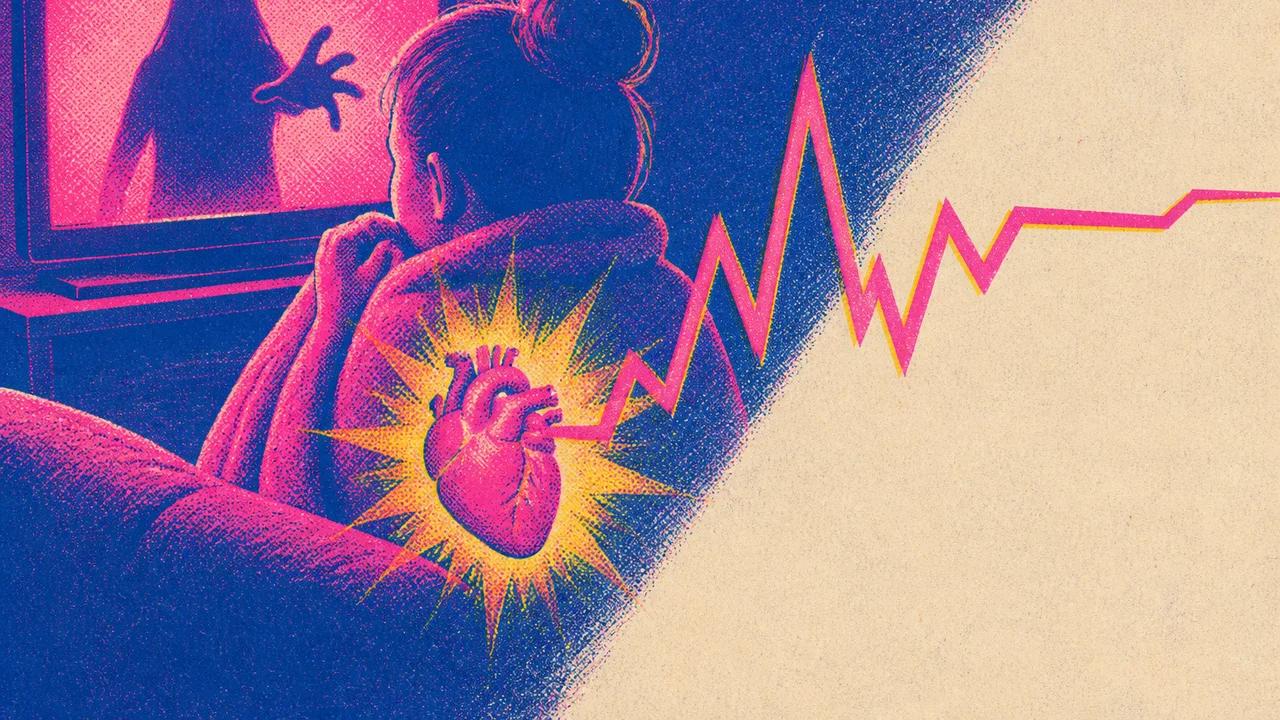
A frightening movie scene can leave viewers with a pounding heart and widened eyes even when they know they are safe, Mayo Clinic explains. The threat is on a screen. The pulse belongs to the person watching.
That mismatch can feel strange. You chose the movie, you know the people in danger are characters, and you can stop watching whenever you want. Yet as the scene builds, your body may respond to its cues before you have time to remind yourself of any of that. Knowing you are safe and feeling briefly alarmed can happen at once.
The practical question is what a racing heart tells you. During a frightening scene, it may reflect a rapid response to perceived danger and uncertainty. By itself, it cannot tell you how frightened you are, whether you enjoyed the movie or whether you have a medical problem.
Your Body Can React Before You Finish Thinking
A threat response has a different job from deliberate reasoning. Reasoning can place a scene in context: actors, a script, a screen in your living room. A rapid response can register the apparent danger first. Your body does not need to settle the question of whether the danger is fictional before arousal begins.
Think about the seconds before a character opens a door. The movie has made you expect that something might happen, but you do not know what or when. You may watch the doorway more closely and feel your heart pick up. The uncertainty is doing work alongside the threat cue. Once the scene resolves, the tension may fade, and for most viewers the physical sensation fades with it.
This explains why telling yourself, “It’s only a movie,” may leave your pulse unchanged for a moment. That thought gives you accurate information about your surroundings. It does not necessarily interrupt a response already underway. A startled reaction says your body responded to the scene; it says nothing conclusive about whether you mistook the fiction for an event in the room.
The same sequence also helps explain why a scary scene can feel intense without any danger to the viewer. The screen supplies the cues, while the viewer supplies the attention. A movie can keep a possible threat unresolved for longer than an everyday surprise lasts. You know the filmmakers will eventually show you what is behind the door. Waiting for them to do it is part of the experience.
Suspense Gives the Response Time to Build
A sudden scare and a long stretch of suspense can both produce a rush, but they give viewers different things to respond to. A sudden change asks for an immediate reaction. Suspense asks you to keep tracking a possible threat. A hallway that stays empty for several seconds may hold your attention precisely because you expect it to stop being empty.
That does not mean a film can make every viewer react on command. The movie controls when it reveals information; it does not control what each person brings to the scene. One viewer may lean forward, another may look away, and a third may feel little more than curiosity. All three can understand what the filmmakers are trying to do.
The racing heart is also a poor review score. Someone who loves horror may feel a strong physical rush and enjoy it. Someone who dislikes horror may feel one and wish they had chosen something else. A person who barely reacts may still be engaged with the story. Heart rate alone cannot sort enjoyment, distress and attention into separate boxes.
For readers who have ever wondered whether they are “bad at” scary movies because they react strongly, that is an unnecessarily harsh interpretation of an ordinary physical response. Likewise, feeling calm does not prove you are braver than the person beside you. People differ in how intensely they respond, and the visible behavior of the person next to you will not give you a reliable measure of their pulse or experience.
The Setting Changes What You Make of the Feeling
Watching a frightening scene is an unusual arrangement: you can expect to feel unsettled while still choosing to stay. That choice can change how you interpret a pounding heart. If you wanted a scare, the rush may be part of what you came for. If you thought you were settling in for something mild, the same sensation may be unwelcome.
Control matters at the everyday level, too. You can pause, lower the volume, leave the room or choose another film. None of those choices requires you to justify how strongly you reacted. The useful question is whether you want to continue, rather than whether your response meets someone else’s standard for handling a movie.
There is a limit to what the familiar scary-movie explanation can do. A fast pulse during a tense scene has a clear possible trigger, especially when it eases as the tension passes. A symptom that appears outside that setting, persists or raises a medical concern calls for clinical advice rather than an assumption that the movie explains it. The sensation alone is not a diagnosis.
That leaves room for two sensible reactions to the same scene. You can trust your judgment that you are safe and acknowledge that your body is responding. Or you can decide the feeling is unpleasant and switch the movie off.
More Like This
Your Phone Is Training You. So Is Your Job.
Monami Banerjee's TEDx talk on tech and the subconscious mind hits differently when you're a professional whose job requires being permanently interruptible.
How to Find Lost Items Using Smarter Search Methods
Visual search experts, detectives, and cognitive science all point the same direction: finding lost items is about method, not effort. Here's what actually works.
Procrastination Is a Survival Mechanism, Not a Flaw
Researcher Itamar Shatz argues procrastination has evolutionary roots. Here's what the science says and which strategies actually help.
Microplastics: The Unseen Invaders in Our Lives
Explore the hidden world of microplastics in our daily lives and what you can do to minimize exposure.

Windows 11 Snipping Tool Features Worth Using
The Windows 11 Snipping Tool does far more than basic screenshots. Here's what it actually does—and why it might replace tools you're paying for.
How to Start Journaling: A Practical Beginner's Guide
Journaling can sharpen mental clarity and ease stress—but only if you actually start. Here's what the research and real journalers say works for beginners.