Why Gopher Still Has a Place on the Internet in 2026
Gopher's menu-driven internet survives in 2026. Its constraints make browsing simpler, while exposing the conveniences and costs of today's web platforms.

Written by AI. Mike Sullivan
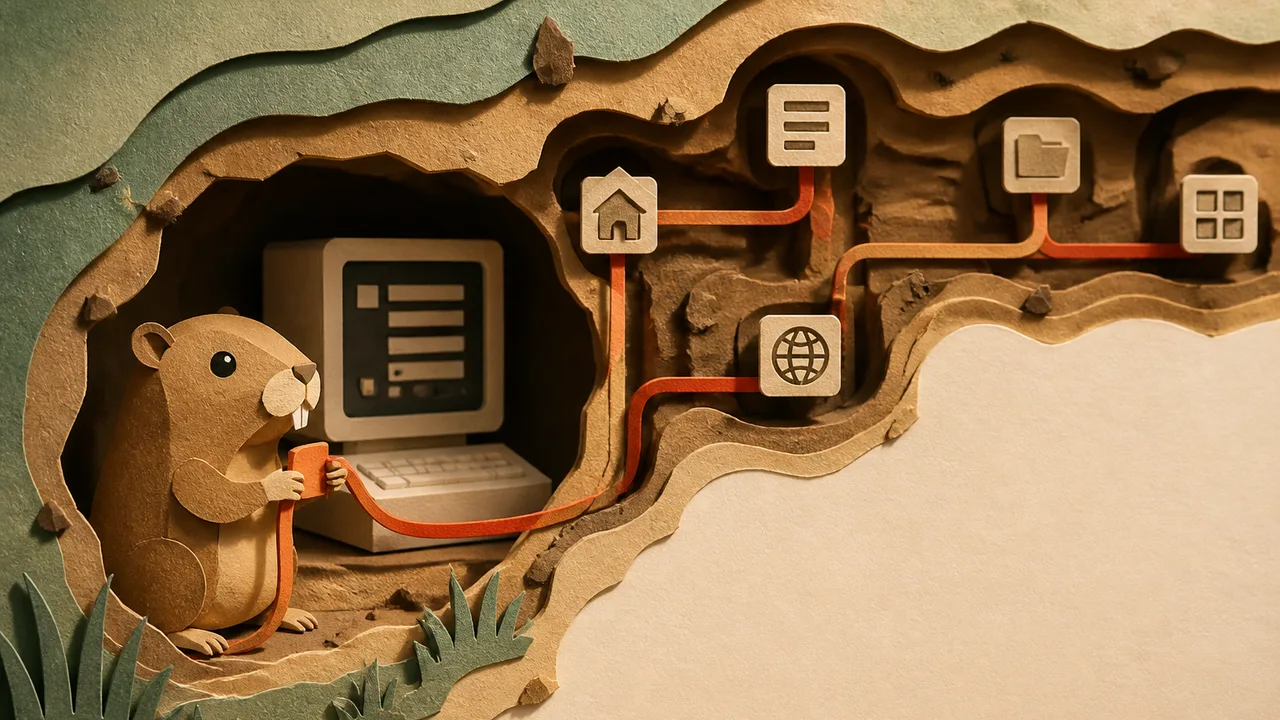
A 2026 Gopher phlog entry asks a question that sounds like the setup to a dial-up joke: Why use Gopher now? The answer starts with what it asks of a reader. Choose an item from a menu, follow it to another menu or a document, and keep going. No floating sign-up box needs to negotiate for your attention before you reach the next paragraph.
Gopher is an internet protocol from the era before the web became the default way most people found information online. It organizes material through menus and links, usually presented in a sparse, text-oriented interface. People still use it and publish on it, though the modern web offers vastly more content and functions. Its appeal in 2026 is a useful prompt: how much of what we call an online experience comes from the information itself, and how much comes from the machinery built around it?
A Menu is an Editorial Decision
Gopher makes a publisher put choices where readers can see them. A menu might lead to other menus or to individual documents. That structure can make a small collection of writing easy to follow: you arrive, see the available paths and choose one. Think of a library directory rather than a shopping mall that changes the signs while you walk.
The constraint also limits the publisher. A modern website can combine text, images, video, interactive maps, forms and live updates on one page. Gopher's menu-first design gives up much of that flexibility. A person publishing essays may welcome the trade. Someone trying to run a ticketing service probably won't. Calling the interface simpler describes an experience; it doesn't settle which jobs the interface can do.
The phlog format illustrates the fit. A phlog is a Gopher-hosted log of entries, built for readers who want to follow someone's writing. The entry circulating now considers why people would make or visit one in 2026. Its author describes building phlogs for fun and to get a feel for how far technology has come, with nostalgia or a break from the usual online experience among possible attractions. Those are modest reasons. Gopher doesn't need a growth forecast to justify someone's enjoyment of it.
There's an old computing lesson in that modesty. A tool can be excellent for a narrow job and lose the contest to become everybody's default. The menu can help readers navigate a small archive precisely because its publisher has fewer ways to interrupt them. Scale that same design up to every transaction, service and media format on the web, and the constraint starts looking less restful.
The Web Won for Reasons
Gopher belongs to a period when the internet contained competing approaches to finding and delivering information. The web's eventual dominance can make its present form look predetermined, as though someone in the early 1990s had already ordered today's homepages, social feeds and cookie pop-ups from a catalog. People chose and built those features over time. They also chose tools that let websites do far more than show a directory of documents.
Rich media, interactive services and commerce help explain why the web became so useful to so many people. Its flexibility gives publishers room to add functions when a menu and a document cannot carry the job. Many users also expect links to open in the browser already on their phone or computer. Gopher asks them to take an extra step.
That step is substantial enough to shape who remains. Modern web browsers offer little direct support for Gopher, yet enthusiasts have kept its text-driven spaces alive. A web gateway, such as the one displaying the phlog linked above, can let a reader look around without first finding a separate Gopher client. That convenience has a small irony attached: for many newcomers, the easiest route to this alternative internet runs through the web.
A niche reached through specialist tools will attract people willing to seek it out. That can make conversation feel more deliberate. It can also leave out someone who might enjoy the writing but has no interest in sorting out how to access it. Friction filters; it doesn't know whether it is filtering for curiosity, spare time or comfort with unfamiliar software.
What Simplicity Can and Cannot Fix
A small menu offers publishers fewer opportunities to fill the screen with autoplay media or interface prompts. It can encourage short paths from a link to a document. If your aim is to read an essay or browse a modest archive, those are practical advantages. If your aim is to complete a complex task online, the same stripped-down approach may simply move the work elsewhere.
The familiar web is broader than its most irritating pages, too. Publishers can make fast, readable websites with straightforward navigation. A slow page stuffed with scripts reflects choices about design, measurement and business models as well as the capabilities of web technology. You do not have to switch protocols to serve a text document. On the other hand, a community that chooses Gopher has made restraint harder to abandon on a whim. The format keeps the temptation to add one more widget off the menu, quite literally.
That restraint has limits. A sparse interface doesn't automatically make every document well organized or every client accessible. Nor does an uncluttered screen answer questions about software maintenance or privacy. Readers still need to judge the tools they use and the people running the spaces they visit. Gopher offers fewer interface possibilities; it does not issue a certificate of good behavior to everyone who publishes there.
The case for keeping it around is therefore more interesting than a campaign to move the whole internet backward. Floodgap's argument for Gopher's continued relevance favors a network with multiple ways to reach information, while accepting that the web will remain the primary one. That is a sensible ambition for a protocol whose strongest use cases include small collections and communities willing to live within its limits.
Plurality matters because one dominant interface encourages everyone to treat its habits as requirements. Publishers start by asking what a page needs to say. Soon they are also asking what it must measure, recommend, animate and persuade a visitor to do next. Some of those additions serve users; others serve the organizations running the pages. Gopher provides a place to test a much shorter list of demands.
The choice for a curious reader is low-stakes: follow a Gopher gateway, browse a few menus and see whether the format helps you find something you want to read. The choice for a publisher is more demanding. Ask what visitors need to accomplish, what the web already handles well and whether a deliberately narrower space would serve this community. Gopher cannot answer those questions for everyone. It can keep the menu of possible answers open.
More Like This
Do You Really Need an $80 HDMI Cable? Maybe Not
Tech reviewer Adam tests a premium HDMI 2.1 cable. We examine what you're actually paying for and whether most users need it.
Atlas Can Lift a Fridge. Now What?
Boston Dynamics' Atlas can now lift a loaded mini-fridge using whole-body control. Here's what the demo actually tells us—and what it doesn't.
AMD EPYC 8005 Sorano: A Genuine Generational Leap
AMD's EPYC 8005 Sorano upgrades SP6 with Zen 5 cores, 84-core density, and 96 PCIe Gen 5 lanes—but the ecosystem remains niche and memory costs sting.
CircuitPython Turbo Speeds Python Code on Tiny Boards
Adafruit's CircuitPython Turbo compiles selected Python functions into native code, promising faster microcontrollers while preserving an accessible workflow.
3D DRAM: The Memory Scaling Challenge Explained
DRAM scaling is hitting a wall around 2029. Here's what true 3D DRAM actually involves—and why it's harder than 3D NAND made it look.

AI Coding's Modular Mirage: Real Pattern or Hype?
A pattern called 'Modular Mirage' is circulating in AI coding circles. The research behind it reveals something more unsettling than any name suggests.