What the Mediterranean Diet Actually Does to Your Body
The Mediterranean diet has decades of research behind it—but not for weight loss. Here's what the evidence actually says about how it works and why.

Written by AI. Kira Yoshida
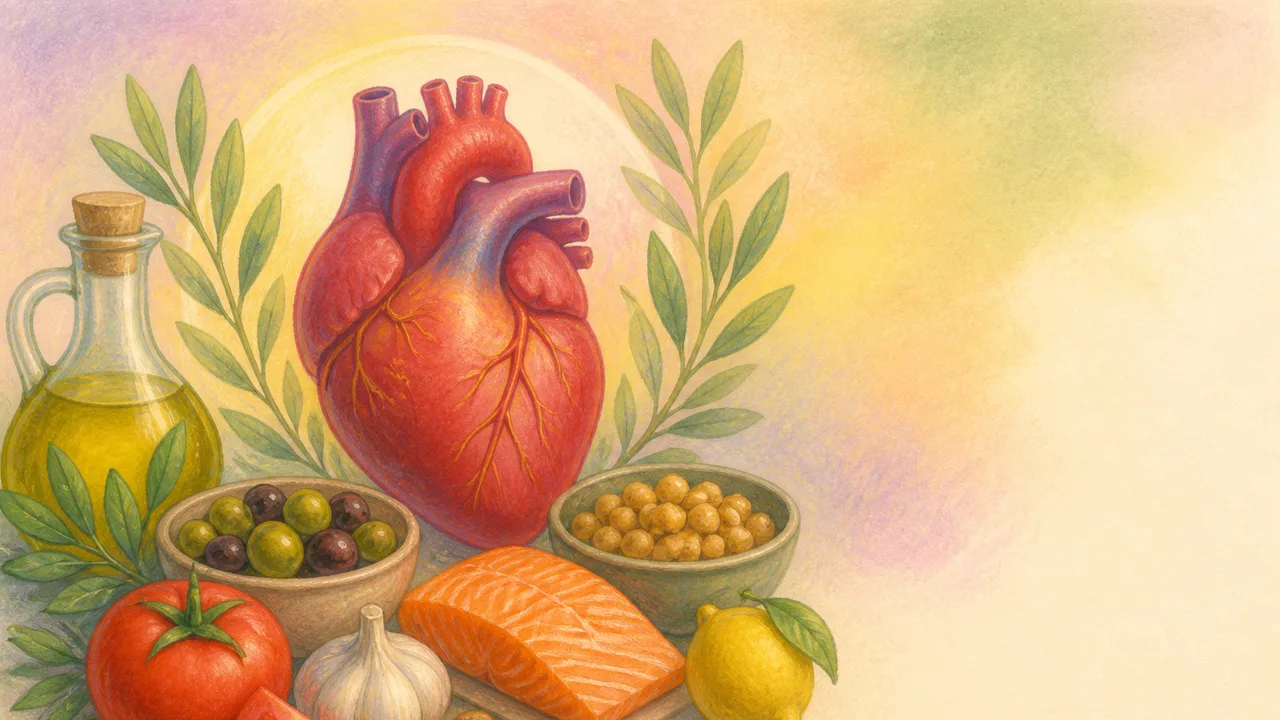
Photo: AI. Aiyana Stone
Every few years the diet industry repackages the same three ideas—eat less, move more, buy this book—and sends them back out into the world with a new name and a celebrity endorsement. It's a machine that runs on the anxiety that your body is a problem to be solved, and it has been running since at least 1864, when an early fad diet was already singing the praises of low-carb eating.
The Mediterranean diet is strange in this context, because it is not a product. Nobody invented it to sell you something. It's just how people in parts of southern Europe, North Africa, and Western Asia have eaten for generations—lots of vegetables, fruit, legumes, whole grains, fish, olive oil used generously, red meat used sparingly. Ancel Keys' Seven Countries Study, which began tracking eating patterns and cardiovascular outcomes in the late 1950s, helped formalize the world's attention on this way of eating, rooting the concept in what people in places like Crete and southern Greece were actually eating around that era.
What's unusual is that decades of research have borne out what Keys was observing. This doesn't happen that often in nutrition science, a field littered with findings that don't replicate and headlines that age poorly. The Mediterranean diet keeps showing up in the data.
The Honest Difficulty of Studying a Diet
Before we get into what the research shows, it's worth sitting with how hard this research is to do well. Tom Lum, hosting a recent SciShow episode on the Mediterranean diet, puts it plainly: "Getting tens of thousands of people to change their entire diets for decades for a scientific study is a huge ask."
He's right. The gold standard in medical research is a randomized controlled trial—you take a large group, split them randomly, one group gets the intervention, one doesn't, and you measure outcomes. For a dietary pattern, that kind of trial over the timeframes needed to observe things like cancer or heart disease is basically impossible. People don't comply, they move, they die of other things, and you can't ethically tell someone to eat badly for thirty years to serve as your control group.
So researchers do two things instead, and use them together. First, shorter randomized controlled trials that track what are called surrogate markers—measurable things like LDL cholesterol or blood pressure that are known to predict the outcomes you really care about. Second, prospective cohort studies, where researchers follow large groups of people over time, track how they eat, and see who develops what. Neither approach alone is airtight, but the combination gives you something more persuasive than either would on its own.
Mediterranean diet researchers also don't sort people into "follows the diet" or "doesn't." They use scoring systems that rate adherence across multiple components—vegetable intake, fruit and nut consumption, meat consumption, alcohol use—which lets them capture the gradient of how closely someone's eating resembles the pattern. When the gradient correlates with outcomes, that's meaningful signal.
What the Evidence Actually Shows
The research literature on the Mediterranean diet is extensive, and across multiple health domains, the picture is consistent enough to take seriously.
The strongest evidence clusters around cardiovascular disease. Cohort studies consistently associate higher Mediterranean diet adherence with lower risk of coronary heart disease, reduced stroke risk, and fewer cardiovascular deaths. Intervention studies back this up mechanistically: the diet lowers blood pressure, improves blood lipid profiles, and reduces markers of inflammation. Diabetes follows a similar pattern—cohort studies show lower risk of developing type 2 diabetes, and intervention studies show better blood sugar control in people who already have it. Metabolic syndrome, which sits at the intersection of cardiovascular risk and diabetes risk, also shows compelling evidence of reduced incidence and improved remission.
For people who train and think about their bodies in terms of performance and recovery—not just disease prevention—that inflammation piece is worth pausing on. Chronic low-grade inflammation is a significant drag on recovery, on adaptation to training, and on long-term tissue health. The Mediterranean diet's apparent effect on inflammatory markers isn't just a disease-prevention story. It might also be a "feel better and recover faster" story, even if the research hasn't been designed with athletes specifically in mind.
The evidence for cognitive function—lower risk of Alzheimer's disease and age-related cognitive decline—is highly suggestive across multiple observational studies, with no major studies pointing in the other direction. Cancer is similar: lower overall cancer incidence and mortality, with particularly notable evidence for breast cancer risk reduction.
The Weight Loss Thing
Here's where it gets culturally interesting. In the wellness industry, "diet" almost always means weight loss. The Mediterranean diet is one of the few eating patterns that researchers recommend primarily for everything else—and the evidence for weight loss specifically is, at best, suggestive.
A calorie-unrestricted Mediterranean diet doesn't appear to produce meaningful weight loss. As Lum summarizes the research: "reducing calories is still more important than the specific nutrients you get on the Med diet." What the evidence does suggest is that when people are restricting calories, eating in a Mediterranean pattern may produce better results than a generic calorie restriction. So it's not that the food is magic—it's that the food profile may interact favorably with a calorie deficit in ways that generic reduction doesn't.
This is also why some doctors don't lead with the Mediterranean diet for patients whose primary concern is weight. The evidence simply doesn't support it as a weight-loss tool on its own. What it does support, comprehensively, is a lower risk of dying from the things most likely to kill you.
That's a different pitch than the wellness industry makes. The wellness industry sells transformation—usually visible, usually fast. The Mediterranean diet offers something more boring and more valuable: decades of reduced systemic damage.
The Telomere Thing (No, Seriously)
I want to linger on this for a second because it is genuinely one of the wilder findings in this space. The Mediterranean diet is associated with longer telomeres.
Telomeres are the protective caps at the end of chromosomes. They shorten with age, with chronic stress, and with inflammation. When researchers talk about "cellular aging," telomere length is often the proxy they reach for. Shorter telomeres are associated with cell damage and accelerated biological aging; longer ones suggest slower age-related decline.
The fact that an eating pattern shows up in telomere data is not nothing. It means the diet may be doing something at the cellular level that goes beyond reducing any single risk factor. The mechanism isn't established—researchers are still working out whether the Mediterranean diet dampens pro-inflammatory signals, amplifies anti-inflammatory ones, makes cells more resistant to oxidative stress, or shifts how the immune system communicates. Maybe all of the above. But whatever is happening appears to be system-wide, not just localized to one organ or disease pathway.
This is the finding that should be landing harder in mainstream coverage than it does. Instead, we keep getting the olive oil piece.
The Part the Wellness Industry Won't Tell You
Here is something the Mediterranean diet does that almost no trendy eating plan does: it's better for the environment. Because it's largely plant-based, it uses less water and generates lower greenhouse gas emissions than most Western dietary patterns. In traditional Mediterranean food systems, the meat consumed typically comes from animals grazing among existing tree crops—a different environmental calculation than industrial grain-fed livestock.
This matters for how we think about what "healthy eating" means. The wellness industry has been very good at selling individual optimization—the right supplement, the right macro split, the right biohack for your body. It has been considerably less interested in the question of whether the food system that serves your optimized body is livable at a planetary scale. The Mediterranean diet, simply by being plant-forward and culturally rooted rather than commercially manufactured, sidesteps a lot of that.
It's not a moral argument for the diet. It's just an interesting thing to notice about what "sustainable" means when we're not using it as a marketing adjective.
What This Is, and What It Isn't
The Mediterranean diet is not a weight-loss program. It's not a detox or a reset or a cleanse. It's a way of eating with a substantial body of research behind it suggesting it reduces the risk of cardiovascular disease, diabetes, metabolic syndrome, cognitive decline, and several cancers—and that it may slow biological aging at the cellular level.
The research is not perfect. Nutritional epidemiology has real limitations, and the mechanisms behind many of these effects are still being mapped. But across multiple study designs, multiple populations, and multiple health outcomes, the pattern holds. That's more than most dietary advice can claim.
The diet industry has been running on your insecurity since 1864. The Mediterranean diet has been running on olive oil and vegetables for much longer than that, and the data keeps showing up to defend it.
More Like This

Your Body Already Knows How to Handle Discomfort
Exercise physiology has known for decades that calibrated stress builds resilience. So why does the wellness industry keep selling you comfort instead?

Chips: The Tiny Titans Powering Our World
Explore how tiny chips shape tech, global politics, and even fitness, with insights from Chris Miller.

How Sports Actually Bring People Together
Sports are celebrated as a universal unifier—but how does that actually work, and when does it fall short? We map the real science and the real limits.
Fasting and Connective Tissue: What the Science Shows
A 2024 Nature Metabolism study tracked 3,000+ proteins during a 7-day fast. The findings on collagen remodeling and muscle preservation are harder to dismiss than you'd expect.

5 Life Regrets That Are Actually Real (With Caveats)
The Art of Improvement's viral regret video gets a lot right — but the gap between what you *should* do and what you *can* do is where self-improvement content always falls apart.

Vitamin D, Sleep, and Your Gut: A Neurologist's Case
Neurologist Dr. Stasha Gominak argues poor sleep is a biochemical deficiency, not a behavior problem—and that vitamin D and gut health are at the center of it.

Eckhart Tolle Says Know Less. Your Body Already Does.
Eckhart Tolle's case for 'not knowing' as spiritual awakening has real overlap with movement science—and a $139/year subscription attached to it.

Why Proving 1+1=2 Took Mathematicians 362 Pages
Whitehead and Russell spent 362 pages proving 1+1=2. Their story is about what happens when you actually audit the axioms everyone told you were obvious.