Why Proving 1+1=2 Took Mathematicians 362 Pages
Whitehead and Russell spent 362 pages proving 1+1=2. Their story is about what happens when you actually audit the axioms everyone told you were obvious.

Written by AI. Kira Yoshida
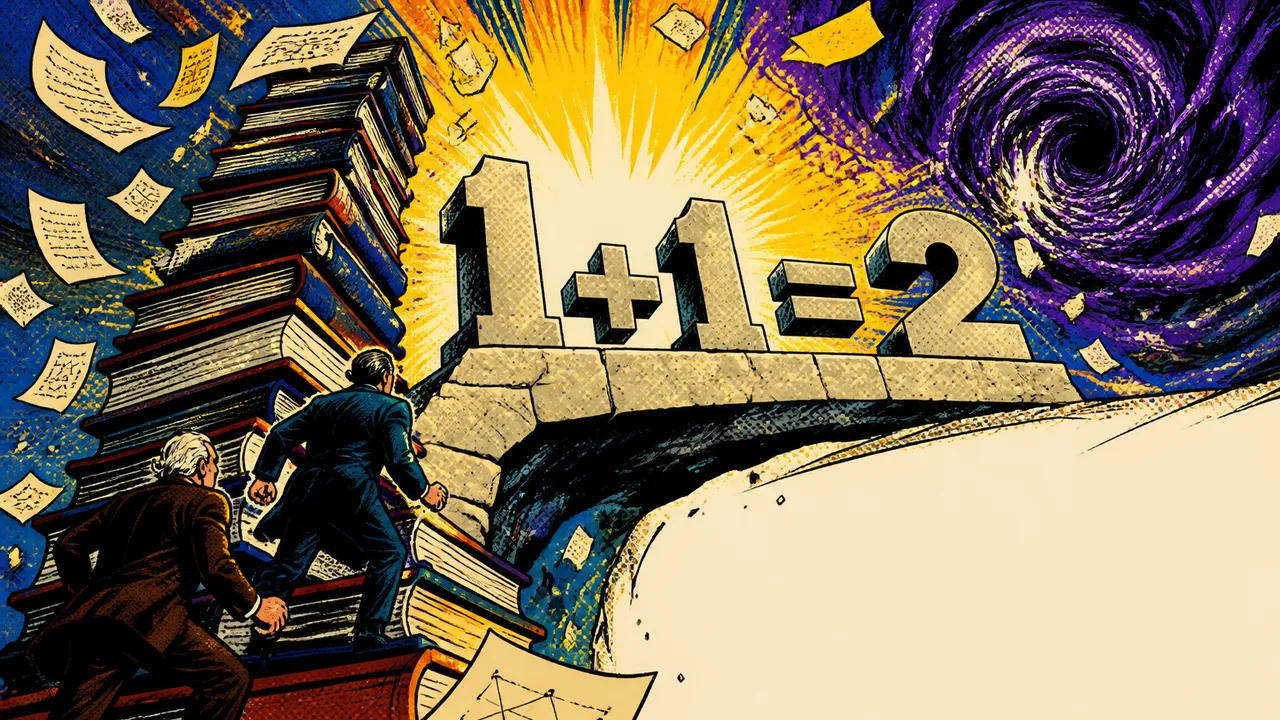
Photo: AI. Marco Velez
My job is basically "show me the study." Someone tells me high-rep training is inferior for muscle growth, I want the citation. Someone tells me women shouldn't lift heavy because hormones, I want the mechanism. Someone tells me you can spot-reduce fat with enough targeted crunches—I want them to explain that to adipose tissue directly, because it doesn't work that way.
The thing I've learned doing this work is that most fitness "facts" aren't facts at all. They're axioms—starting assumptions that got laundered into certainty somewhere between a 1980s aerobics instructor and your high school gym teacher. Cardio burns fat. Muscle weighs more than fat. No pain, no gain. These aren't theorems. Nobody derived them from first principles. They're things that got repeated until they felt obvious, and once something feels obvious, nobody checks.
Turns out mathematicians had the exact same problem, and it broke two of them in the early 1900s.
The thing about "obvious"
A recent DIBEOS video asks a question that sounds like a joke: why did it take over 300 pages to prove that 1+1=2? The answer is genuinely strange, and it maps onto something I think about constantly—what it actually costs to take nothing on faith.
Alfred Whitehead and Bertrand Russell set out to do something almost deranged in its ambition: reconstruct all of mathematics from pure logic. No hand-waving. No "this is obvious." Every single claim earned from the ground up. The project became Principia Mathematica, three volumes of notation so dense that DIBEOS helpfully links a Stanford guide just to help you read the symbols.
It was only by page 362 that they could formally prove 1+1=2.
That number lands differently depending on your relationship with "obvious." If you grew up in a system that handed you facts without derivations—and if you later discovered that a meaningful portion of those facts were wrong, or incomplete, or serving someone else's interests—page 362 starts to feel less absurd and more like the correct amount of work.
I grew up being told that a low-fat diet was healthy, that sitting out gym class if you were bigger was probably for the best, that certain bodies were just "naturally" this way or that, and that exercise was primarily for losing weight. Every one of those was an axiom masquerading as settled science. Nobody showed me the derivation. They just told me it was obvious.
Whitehead and Russell were not willing to be told anything was obvious.
Why they started: the floor was already cracked
Before the Principia, Russell had been working in set theory—the branch of mathematics that deals with collections of objects—when he walked into a problem that shouldn't have been possible. He asked: can a set contain itself?
Think about a set of all things that are not members of themselves. Is that set a member of itself? If it is, it isn't. If it isn't, it is. The logic collapses into contradiction. This is Russell's paradox, and it meant that naive set theory—mathematics' assumed-to-be-solid foundation—was producing contradictions at its base.
This wasn't a crisis that threatened to bring down all of mathematics overnight; mathematicians kept doing mathematics. But it was a serious crack in the specific foundational project that Russell and others had been building, and Russell found it impossible to simply note the problem and move on. As DIBEOS puts it: "If something as basic as set theory could produce contradictions, then maybe the foundations of mathematics were not as solid as people thought."
So he and Whitehead decided to rebuild. Not patch—rebuild.
What axioms actually are (and what they aren't)
Here's where the movement-science lens gets useful, because I spend a lot of time explaining a version of this same structure to readers.
In exercise physiology, we work with a hierarchy: mechanisms we understand pretty well at the cellular level (muscle protein synthesis, glycogen depletion, the sliding filament theory of muscle contraction), principles derived from those mechanisms, and then practical applications derived from the principles. The hierarchy matters. When someone sells you a supplement "clinically proven" to burn fat, the question is always: where in that hierarchy does the evidence actually live? Is this a replicated mechanism, or is it vibes with a lab coat?
Mathematics has an analogous structure. The video explains it clearly: axioms are the foundation—things mathematicians accept as starting rules without proof, because they're as self-evidently minimal as possible. From axioms, you derive theorems. From theorems, more theorems. The whole edifice is downstream of those original commitments.
One example is the successor axiom from Peano's arithmetic: every number has a next number. After zero comes one, after one comes two. As DIBEOS notes, "this sounds really obvious, but in a formal system, even things that are as basic as the next number has to be treated as a formal rule."
That's the discipline. You don't get to say "obviously." You have to say "here is the rule, here is what follows from it." The proof of 1+1=2 takes 362 pages because Whitehead and Russell refused to skip steps that everyone else had been skipping since arithmetic was invented.
What the proof actually says
The actual logical content of the proof is more interesting than "1 and 1 is 2, obviously." DIBEOS breaks it down:
To prove 1+1=2, you first have to stop treating numbers as symbols and think of them as sizes of collections. The number one isn't a squiggle—it's the property shared by every collection that contains exactly one thing. Then you take two non-overlapping collections, each of size one. Combine them. You get a collection of size two. That's the proof.
There's a trap built in: if the two collections overlap, their union isn't necessarily size two. Addition only works this way when the collections are disjoint—completely separate. The disjointness requirement isn't a minor technical caveat; it's doing foundational work. Without it, you've assumed something you haven't earned.
DIBEOS is also careful to note that a lot of popular explanations of this proof—including some on YouTube—get the method wrong. They use the Peano axiom approach with successor functions, which is a valid way to prove 1+1=2, but it's not what Whitehead and Russell actually did. The Principia proof works through classes and cardinal numbers, a more primitive and more painstaking route. "It approaches the problem in a completely different way."
The distinction matters if you care about not laundering one kind of rigor for another. Both proofs are correct; they're not the same proof.
Why they stopped—and what Gödel did to the dream
Whitehead and Russell got through three volumes. There was supposed to be a fourth, on geometry. It was never written. Partly because the project was, by any reasonable measure, exhausting. But also because in 1931, Kurt Gödel proved something that retroactively reframed the entire enterprise.
Gödel's incompleteness theorems established that no formal system powerful enough to describe arithmetic can prove all the truths of arithmetic. There will always be true statements the system cannot reach. The dream of a complete logical foundation—everything derivable, nothing assumed—is mathematically impossible.
DIBEOS frames this as the end of the foundational dream: "Gödel proved that no formal system, no matter how strong it is, could prove all the truths of arithmetic. It's impossible."
I want to sit with what that actually means, because I think readers who've spent time in wellness culture already know this feeling from a different direction. Every system that promised total completeness—every diet that claimed to explain everything about your body, every program that said just follow this and you'll get results, guaranteed—eventually runs into the thing it can't account for. The body that doesn't respond the way the model predicts. The study that contradicts the protocol. The axiom that was never as solid as it looked.
Gödel didn't destroy mathematics. Whitehead and Russell's Principia successfully reconstructed substantial core mathematics from logical first principles—that's a genuine, remarkable achievement, not a partial failure. What Gödel ended was the specific dream of total formal completeness. Which is a different thing. Mathematics didn't collapse; a particular kind of ambition did.
There's something almost relieving about that, if you've made peace with the fact that no system closes all the way. The honest ones tell you where the edges are. The dishonest ones pretend the edges don't exist.
Whitehead and Russell at least made it to page 362 before they had to write down "1+1=2." They knew exactly what they'd assumed to get there, and they could show you every step. That's rarer than it sounds—in mathematics or anywhere else.
More Like This

Middle Platonism's Hidden Role in Western Esotericism
ESOTERICA's new crowdfunded seminar argues Middle Platonism built the foundations of Hermeticism, Gnosticism, and early Christian theology. Here's what that means.

Unveiling Rome's Gladiator Underworld
Explore the hidden world beneath ancient Rome's arenas, unveiling gladiator training, underground tunnels, and cultural practices.
When Math Invents Reality: Imaginary Numbers & More
Neil deGrasse Tyson explains how imaginary numbers, non-Euclidean geometry, and white holes reveal math's uncanny habit of predicting reality before we can confirm it.

Harvey Friedman: Math's Foundations Are Shaking
Harvey Friedman spent 60 years proving that ordinary math can't be trusted. His work in reverse mathematics may be the most unsettling idea in modern logic.

Conway's Soldiers: A Checkerboard Proof of Impossibility
Conway's Soldiers is a deceptively simple game that no one can win — not with infinite pieces. Here's the golden ratio proof that seals the deal.

The Science and Stories Behind Earth's Fiercest Winds
Explore the science of deadly winds, from hurricanes to tornadoes, and the people dedicated to understanding and surviving them.
How Your Circadian Rhythm Controls Morning Wakefulness
Your body already knows how to wake up naturally. Here's what sleep science says about training your circadian rhythm to stop dreading mornings.
Grounded Confidence Is a Body State, Not a Mindset
A viral Charisma on Command video gets the framework right but misses the physiology. Grounded confidence isn't a technique — it starts in your nervous system.