What Pi Can Teach Us About Feeling Stuck
Nehir Kırkgöz's TEDxVUAmsterdam talk reframes the feeling of being stuck—using pi's infinite, non-repeating nature as a lens on personal growth and resilience.

Written by AI. Samir Patel
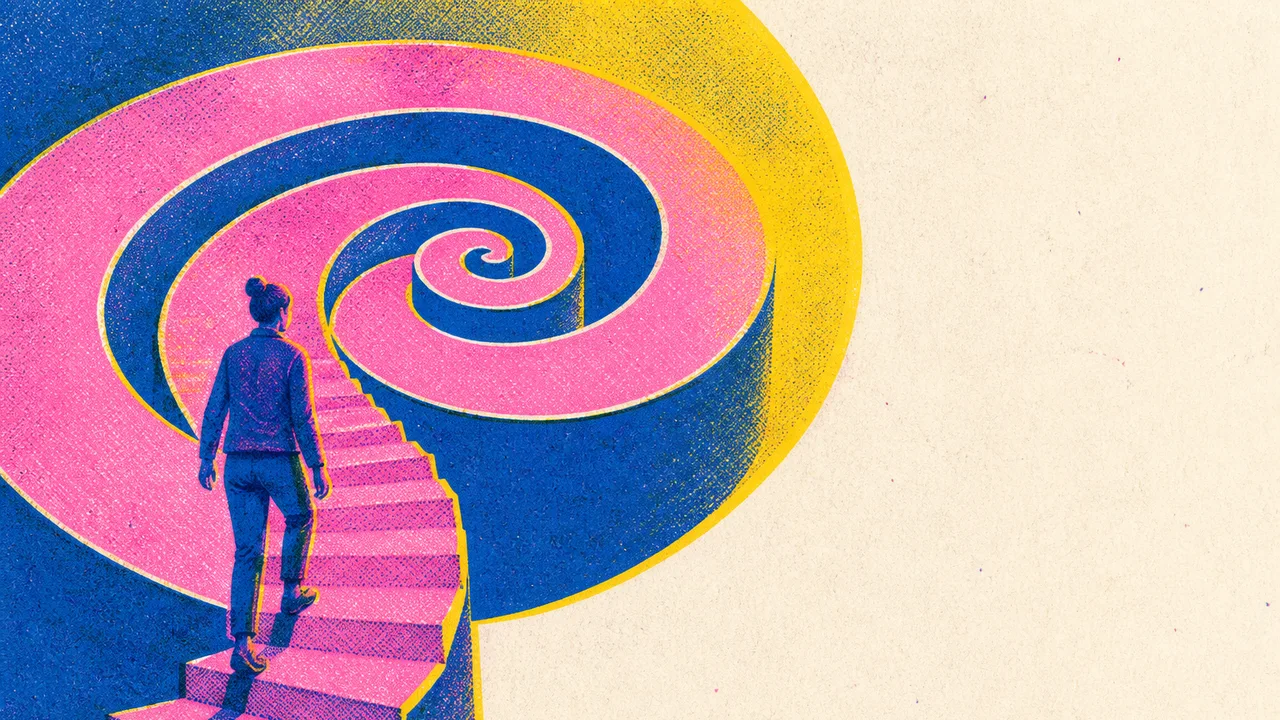
Photo: AI. Jorah Maktoum
There's a particular kind of suffering in feeling stuck. Not the clean pain of failure — that at least has a shape you can hold — but the low-grade, quietly disorienting experience of working hard and arriving, again, at a place that looks exactly like where you started. You've done the work. You've tried. And yet here you are: same problem, same doubt, same quiet panic in your chest.
Nehir Kırkgöz, a second-year Computer Science Honours student at Vrije Universiteit Amsterdam, named that experience out loud at TEDxVUAmsterdam — and then offered mathematics as an unexpected frame for understanding it differently.
Her argument, built around the number pi, is more structurally interesting than the average growth-mindset talk. It doesn't promise you'll stop feeling stuck. It suggests that the feeling itself might be misread data.
The Digit That Doesn't End
Kırkgöz opens by recounting a seventh-grade pi digit memorization contest — a detail that, on its face, is charming and probably relatable to anyone who's ever found themselves inexplicably drawn to a numerical rabbit hole. What's interesting is what she says she actually took from it.
Not the competition. Not the winning. The realization:
"No matter how many digits I memorized, there was always another one. Pi never ends. It never repeats. It just keeps going. And that's the beauty of it."
That observation becomes the spine of the whole talk. Pi is defined by a circle — the most closed, most repetitive, most finite-looking shape in geometry. And yet the number it produces is infinite and non-repeating. It contains no closed loop, no final answer, no point at which you can say: done.
That contradiction is where Kırkgöz plants her flag.
When Curiosity Becomes Fear
Years after that pi contest, she describes a shift that will feel familiar to a lot of people who once found a subject easy and then, gradually, didn't. Math stopped being a place of exploration and became a place of judgment. Tests were no longer puzzles to solve but occasions for being measured.
"When fear replaces curiosity, learning stops feeling like growth. It starts feeling like risk."
This is a sentence worth slowing down on, because it captures something real about how performance pressure changes the relationship between a person and a subject. You're no longer asking what can I discover here? — you're asking what am I risking by being wrong? Those are genuinely different cognitive orientations, and they produce different outcomes.
What's worth noting here — and what Kırkgöz earns by grounding this in her own experience rather than citing data — is that this shift doesn't announce itself. It's "quiet," as she puts it. You don't decide to become afraid of math. You just... wake up one day and it has happened.
The Spiral Problem
The conceptual centerpiece of the talk is the move from circle to spiral. Kırkgöz describes what it felt like to return to the same frustrations over and over — trying, failing, starting over — and experience that not as progress but as a loop. She uses the word "loop" deliberately. A loop feels like motion. You're doing something. But you're not getting anywhere. That's the trap of it.
Then comes the reframe:
"What looks like a circle might not be a circle at all. It might be a spiral. Something that loops, but moves forward at the same time."
This is not a new idea — Jerome Bruner formalized something adjacent to it in his 1960 book The Process of Education, where he introduced what educators now call the "spiral curriculum": the idea that learners revisit the same core concepts at increasing levels of complexity over time, each pass building on what came before. The structural-learning.com analysis of Bruner's model describes it as a deliberate pedagogical design, not a flaw in the system.
What Kırkgöz does is apply that same logic to the felt experience of struggle — not just to curriculum design. She's not talking about what teachers should do. She's talking about how to read your own life when it seems to be running on a loop.
The insight is that returning to a familiar difficulty doesn't mean you've made no progress. It means you're encountering the same terrain from a higher elevation. You bring, as she puts it, "a little more awareness, a little more resilience, a little more understanding" each time. The terrain looks the same; the person walking it has changed.
There's a genuine open question here worth sitting with: Is this always true? The talk presents the spiral model as universally applicable — any moment that feels like stagnation is actually upward motion you can't yet see. That's a meaningful reframe. It's also possible to be genuinely stuck, and to be gaslighting yourself with the spiral metaphor. Kırkgöz doesn't address that edge case, which is probably fine for a nine-minute TEDx talk and less fine as a life philosophy applied without discernment.
Progress Without a Finish Line
The mathematical hook works because pi is genuinely, provably, infinite and non-repeating — and that's strange. It's derived from a closed shape and produces an open number. Kırkgöz uses that strangeness to make a point about identity:
"There is no final version of you. There is no point in life where you figured everything out. There is no point where growth stops."
This lands differently depending on where you are when you hear it. For someone in the middle of a difficult stretch, it can feel like permission — not to be finished, not to have arrived, not to present a complete self. For someone who is exhausted and just wants a break from growth, it might land as relentless. The talk doesn't acknowledge the second possibility.
That's not a fatal flaw. It's a tonal choice. Kırkgöz is a student at a university giving a talk at a student pitch night, drawing from her own experience with academic anxiety. The audience is likely people who are also mid-process, mid-becoming, mid-uncertainty. The permission to still be in motion probably lands exactly as intended.
What the Metaphor Actually Does
Metaphors in self-help often fail because they're decorative — they make a familiar argument prettier without changing its architecture. The pi metaphor works somewhat better than most because it draws on a mathematical property that is genuinely counterintuitive. Most people's intuition about circles is that they're closed. Pi breaks that intuition. That intellectual surprise is doing real work; it shakes loose a prior assumption and installs a different one.
Whether the feeling of being stuck is always a spiral rather than a circle is, frankly, an empirical question about individual lives that no metaphor can settle. What Kırkgöz is offering is a perceptual tool: a way to re-examine a feeling before accepting its face-value meaning.
That's modest, actually. It's not a cure. It's a question she closes with:
"Am I really stuck? Or am I just at the next turn of the spiral?"
There's wisdom in the uncertainty of that. She's not telling the audience they're definitely spiraling forward. She's asking them to consider the possibility. That small gap between assertion and invitation is where the talk earns something the genre often doesn't.
Whether the answer, in any given case, is yes, you're spiraling or no, you genuinely need to change something — that's the question only the person asking it can answer.
More Like This
Eckhart Tolle Says Know Less. Your Body Already Does.
Eckhart Tolle's case for 'not knowing' as spiritual awakening has real overlap with movement science—and a $139/year subscription attached to it.

When Teens Look Fine but Feel Invisible
Deniz Erdemir's TEDx talk on adolescent belonging reveals how social exclusion registers as physical pain—and what adults keep missing.
Parenting and Smartphones: A Balanced Approach
Exploring how parents can navigate smartphone use, focusing on development and communication.
The Emotional Resonance of Sound: Teresina's Journey
Explore how Teresina Kerubo uses sound to navigate love and grief, finding peace through recorded memories.
How to Make It Safer for People to Tell You Hard Truths
Chris Wheatley's TEDx talk reframes feedback as the receiver's responsibility—and offers a practical approach to making honest conversations actually happen.
When to Push Through and When to Pivot Your Career
Alex Hormozi's framework for knowing when to quit vs. persist—and why the lessons you draw from failure matter more than the failure itself.
Discipline Is About Removing Options, Not Building Willpower
Mark Manson argues discipline has nothing to do with willpower—it's about eliminating choices. Here's what the research says, and what the theory leaves out.

Neurotic vs. Psychotic: What the Terms Really Mean
Alain de Botton's School of Life video reframes "neurotic" and "psychotic" as degrees of self-awareness—not insults. Here's what the distinction actually reveals.