Water at Near-Freezing Turns Glassy, Not Icy, Study Finds
A Nature Communications study from ANSTO reveals water confined at nanoscale doesn't freeze but turns glassy. The implications span cryopreservation, climate science, and more.

Written by AI. Nadia Marchetti
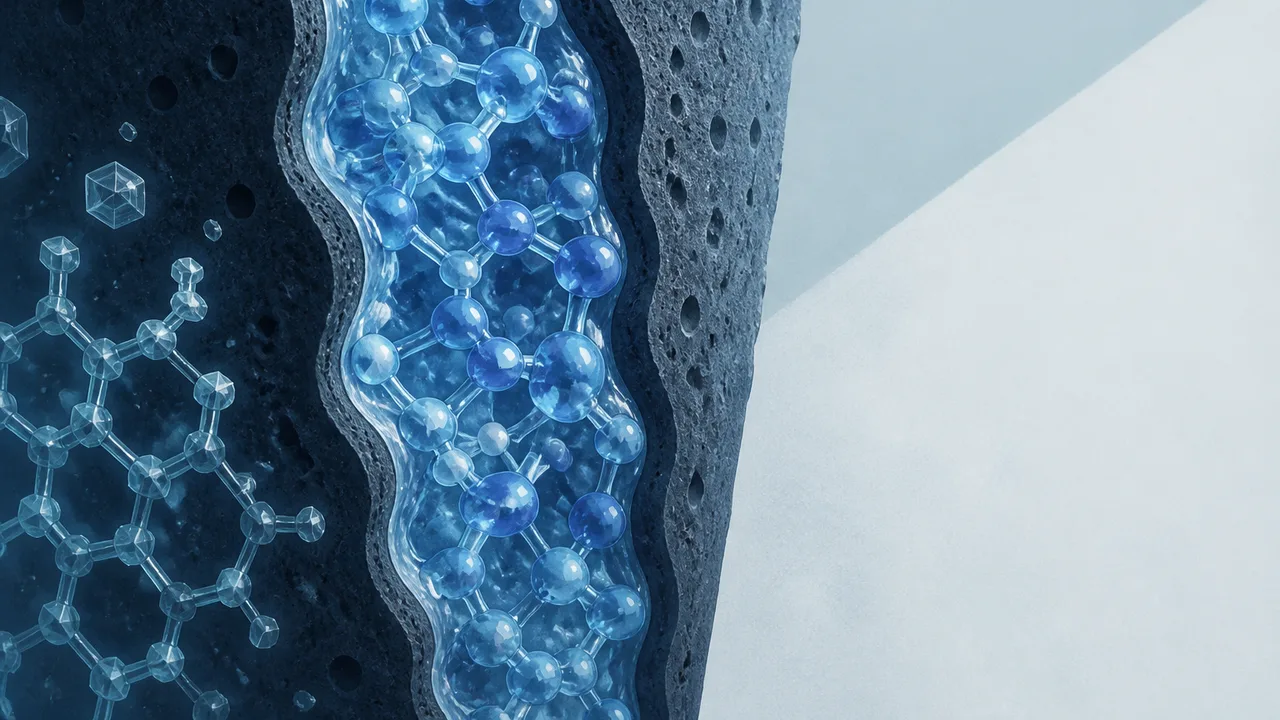
ANSTO, Australia's national nuclear science and technology facility, is better known for reactor-based research than for upending a substance as mundane as water. So when a study from its researchers landed in Nature Communications, describing how water at near-freezing temperatures can bypass ice formation entirely and settle into a glass-like state, it was worth following the claim all the way down.
According to phys.org, the key condition is confinement at the nanoscale. When water molecules are squeezed into spaces just a few nanometers wide, the geometry that normally organizes them into crystalline ice breaks down. Instead of locking into the familiar hexagonal lattice, the molecules get stuck mid-transition, forming what scientists call an amorphous or glassy state: disordered like a liquid, rigid like a solid.
This isn't entirely new territory. Researchers have known for decades that water is stranger than its reputation suggests. It's one of the few substances that expands when it freezes. Its boiling and melting points are anomalously high for a molecule of its size. And amorphous ice has been observed in laboratory settings and theorized to exist in interstellar space since at least the 1980s. What the ANSTO work appears to add is a clearer picture of the conditions, specifically soft nanoscale confinement, under which this glass transition happens instead of crystallization. That specificity matters, because it converts a curiosity into a variable scientists can potentially control.
What "glassy" actually means here
Glass, in the materials science sense, is an amorphous solid: atoms or molecules locked in place without the long-range order of a crystal. Window glass is the familiar example, silicon dioxide cooled fast enough that its molecules never found the orderly arrangement of quartz. Water, cooled slowly in bulk, always finds that arrangement. Ice is a crystal. But push the cooling fast enough, or constrain the geometry enough, and the crystallization can be kinetically blocked.
In the ANSTO study, the confinement itself does the blocking. Nanoscale pores, channels, or surfaces create boundary conditions that disrupt the cooperative hydrogen-bond rearrangements water needs to nucleate ice. The result is a glassy phase that can persist at temperatures where bulk water would long since have frozen solid.
For the physics to work this way, the confinement has to be small. We're talking about spaces on the order of a few nanometers, roughly ten to fifty water molecule widths. At that scale, the ratio of surface-to-bulk water flips: most molecules are near an interface, not free to form the bulk hydrogen-bond network that drives crystallization. The surface wins.
Why cryopreservation researchers are paying attention
Freezing kills cells. More precisely, ice crystals kill cells. When biological tissue freezes, water inside and between cells nucleates into sharp crystalline structures that puncture membranes, disrupt organelles, and shred the architecture that makes a cell a cell. This is the central problem of cryopreservation: how do you get tissue to very low temperatures without destroying it in the process?
Current approaches rely on cryoprotectants, chemicals like glycerol or dimethyl sulfoxide that depress the freezing point and slow ice nucleation. They work, to a degree. Red blood cells survive cryopreservation reasonably well. Sperm and embryos survive it. Complex organs, including hearts, livers, and kidneys, largely do not, at least not with current techniques. The ice problem hasn't been solved; it's been managed at small scales and remains catastrophic at large ones.
Biological cells are themselves nanoscale confinement environments: water inside mitochondria, in the narrow channels of the endoplasmic reticulum, threading through protein scaffolds. A better model of how water behaves in those spaces under cold stress could inform new preservation strategies, potentially replacing or supplementing chemical cryoprotectants with structural or physical approaches.
The phys.org report notes that improved organ preservation for transplantation and extended food product viability are both cited as potential downstream applications. Neither is imminent, and it would be worth treating those framings with some patience: the gap between a material-science finding and a clinical transplant protocol is wide and expensive. But the direction of relevance is clear.
The climate angle is less obvious but not trivial
Climate science enters this story through a less intuitive door. Water in the atmosphere, in soil, and in permafrost doesn't always behave like water in a beaker. Nanoscale pores in aerosol particles, clay minerals, and frozen ground confine water in exactly the regime the ANSTO research describes. How that confined water freezes, or doesn't, affects cloud formation, soil frost dynamics, and the stability of Arctic and Antarctic ground ice.
Cloud glaciation, the process by which supercooled water droplets in clouds convert to ice crystals, is one of the larger sources of uncertainty in climate models. Water droplets can remain liquid at temperatures as low as minus 38 degrees Celsius under the right conditions. The mechanisms governing when and how ice nucleates in those droplets involve surface chemistry and confinement effects that are still being worked out. A more precise understanding of how nanoscale geometry blocks or enables crystallization feeds directly into that uncertainty.
Permafrost is a second area of interest. As Arctic temperatures rise, permafrost thaws. The rate and pattern of that thaw depend partly on how water in the micro-pores of frozen soil transitions between phases. If some fraction of that water is in a glassy or amorphous state rather than crystalline ice, its thermal behavior and its response to warming differ from standard ice. Getting those numbers right matters for carbon cycle projections.
The limits of what we know from this study
The phys.org attribution is clear that the research was conducted at ANSTO's facilities and published in Nature Communications, but the source brief I'm working from doesn't include the full paper, specific author names, or the precise experimental parameters used. I'm not going to fill those gaps with inference. What the available sourcing supports is the core finding: nanoscale confinement suppresses ice formation in favor of a glassy transition, and that this has recognized relevance to cryopreservation and climate science.
What remains open, based on available information, is how transferable these findings are across different confinement geometries and materials, what the minimum confinement scale is before bulk ice behavior reasserts itself, and whether the glassy state is stable enough under biological or environmental conditions to be practically useful rather than just physically interesting.
Those are the questions the next few years of follow-on research will need to address. Nature Communications papers in materials science often function as proofs of concept: here is a phenomenon, here are the conditions under which it occurs, here is why it matters. The harder engineering and biological work comes after.
Water keeps surprising people
Water has more known anomalies than almost any other common substance: density maximum at 4 degrees Celsius, negative thermal expansion near freezing, anomalously high surface tension, the list runs long. Scientists have been cataloguing these anomalies and debating their molecular origins for well over a century. The ANSTO finding fits into that ongoing project rather than resolving it.
What's useful about framing it this way is that it sets appropriate expectations. This is not a discovery that rewrites everything we know about water. It's a precise, well-placed finding that sharpens one corner of a very complex picture. Water confined at the nanoscale doesn't freeze the way bulk water does, and now researchers have a cleaner experimental window into why.
For the cryopreservation field, that window could eventually mean the difference between organs that survive cold storage and ones that don't. For climate modeling, it could close a gap that's been producing uncertainty in projections for decades. For water science as a discipline, it's another reminder that the most familiar molecule on Earth still has structural surprises left.
The question that follows naturally from this research is whether the glassy state can be reliably induced in biological systems, not just in controlled nanopore materials in a laboratory. If the answer turns out to be yes, the organ transplant waiting list will look different.
More Like This
We've Been Teaching Heisenberg's Uncertainty Principle Wrong
The story we tell about Heisenberg's Uncertainty Principle is misleading. Professor Aephraim Steinberg explains what the textbooks got wrong—and what's right.
Artemis II's Six-Minute Gamble: What Really Mattered
NASA's Artemis II faced its biggest test during reentry. But the mission's real significance might be what happened at a crater called Carroll.

The Next Generation of Windows Is Already Here
From squid-inspired liquid panes to transparent wood, new window technologies promise dramatic energy savings—but how close are they to your wall?

Exciton Condensation Precursors Detected in Quantum Materials
Ultrafast core-level spectroscopy has detected the earliest signals of exciton condensation in quantum materials — a find that reshapes how physicists read phase transitions.
The Physics of Beads on a Liquid String
How the Rayleigh-Plateau instability shapes saliva, spider webs, and Bose-Einstein condensates through the same elegant fluid physics.
Two Small Worlds With Atmospheres They Shouldn't Have
A Kuiper Belt rock and a distant rocky exoplanet both carry atmospheres that shouldn't exist. What these discoveries reveal about planetary science.
Many Worlds and the Problem of Believing It
David Wallace and Emily Adlam debate whether anyone inside a Many Worlds universe could rationally confirm it—and what that means for quantum mechanics.

A Physicist Calls UFO Disclosure a Distraction
Physicist Brian Keating tore through the latest government UFO release and found nothing. His argument: the timing alone makes it suspect.