Volunteers Join Search for Milky Way's Hidden Black Holes
Volunteers are scanning NASA telescope data for possible Milky Way black holes. How can human pattern-spotting help, and what would confirm a discovery?

Written by AI. Mei Zhang
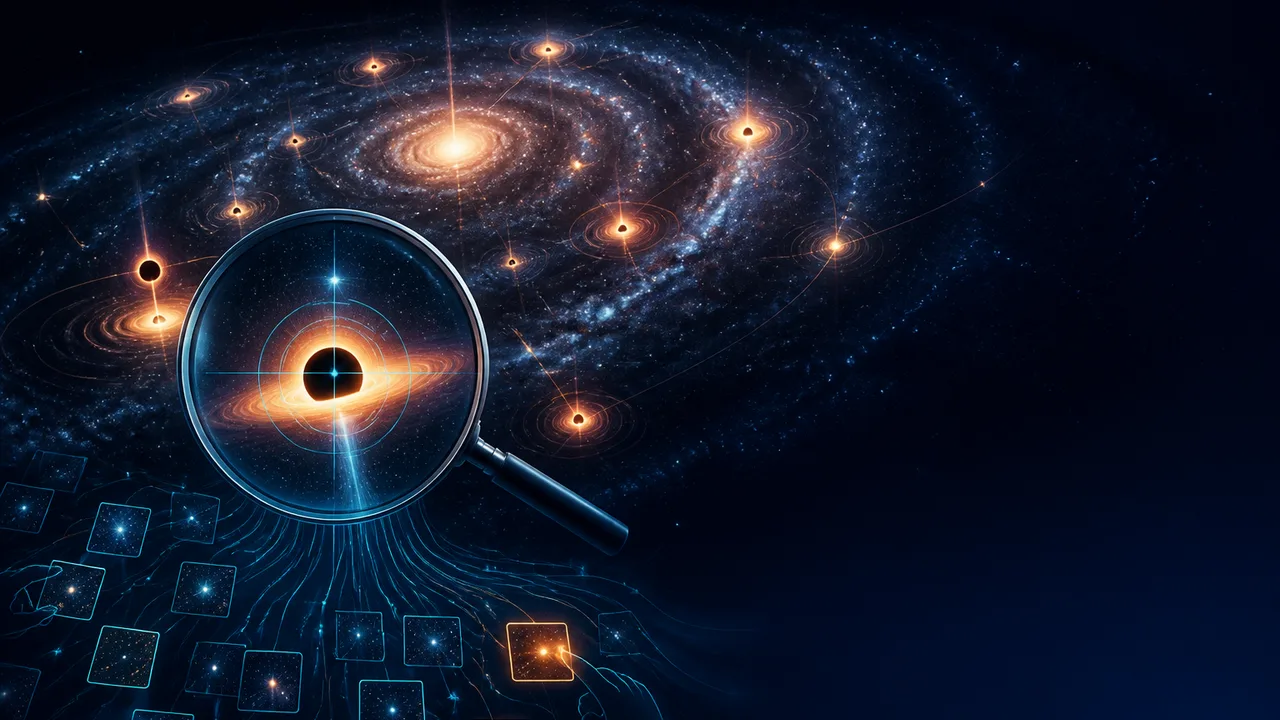
NASA telescope data has a new set of readers: volunteers hunting for signs of black holes in the Milky Way. A citizen-science project is asking the public to inspect observations and flag candidates astronomers may have missed. The assignment sounds like cosmic Where’s Waldo, except Waldo emits no light of his own and the background is full of lookalikes.
The volunteers’ job is to help narrow a search. Researchers still have to examine promising signals and check whether another explanation fits. That handoff, from a person noticing something odd to astronomers testing what it is, makes this project more interesting than a simple invitation to click through pictures.
How Do You Spot Something You Can't See?
A black hole’s defining boundary, the event horizon, lets light enter but prevents it from escaping. Astronomers therefore look for effects around a black hole rather than a photograph of the object itself. Matter falling toward one can grow hot and radiate before crossing that boundary. A nearby star’s motion can also reveal the gravitational pull of an unseen companion.
Think of a missing ingredient in a recipe. You might never see the cinnamon going in, but you can taste its effect in the finished cake. Astronomy has a harder version of that problem: other ingredients can produce similar clues, and the kitchen is enormous.
Those two routes, radiation and gravitational motion, also help explain why some black holes remain elusive. A black hole with little nearby material has less opportunity to announce itself through glowing gas. One without a useful nearby companion may offer no obvious orbital clue. The galaxy’s “missing” black holes are missing from current catalogues; the word describes a detection problem, not a confirmed gap in the galaxy itself.
That also puts a limit on what any search can accomplish. A method that relies on a visible effect will favor black holes that produce that effect. Finding more candidates would improve astronomers’ picture of the objects they can detect, while leaving the hardest-to-see population a further challenge.
What a Volunteer Can Add
Telescope observations accumulate faster than researchers can give every possible oddity individual attention. Recruiting volunteers to search for undiscovered black holes adds human pattern-spotting at an early stage: people can flag unusual signals so scientists know where to look harder.
A useful mental model is a very large tray of mixed beans. Volunteers help sort out the ones that look unusual. They do not establish what each bean is made of by sight. In telescope data, an interesting-looking signal earns scrutiny; it does not earn a place in a black-hole catalogue on appearance alone.
Human attention can be useful precisely because a search begins with uncertainty. If astronomers already had a perfect rule for identifying every black hole in the observations, they could apply that rule and be done. Instead, the project asks people to notice patterns worth testing. That leaves room for missed signals and mistaken flags, both ordinary costs of looking for rare objects amid a great deal of data.
The strongest case for citizen science here is practical. It gives researchers a way to direct scarce follow-up attention toward a smaller set of candidates. Volunteers do not need to settle the physics of each signal for their contribution to help. The value comes from improving the shortlist that reaches the next stage.
There is a harder question behind that appealing division of labor: which signals can a volunteer recognize from the observations they are shown? A faint black hole with little surrounding activity may never produce a conspicuous pattern for anyone to flag. More eyes can help search a large dataset; they cannot make an absent clue appear. The design of the search, including what data people examine and what counts as unusual, shapes what it can find.
From Interesting Signal to Black Hole
A candidate starts a sequence of questions. Does the signal hold up when researchers examine the underlying observations? Could a different astronomical object or an issue with the data account for it? What further evidence would distinguish those possibilities?
The answers depend on the clue. Radiation from hot material near an unseen object calls for a different investigation from an apparent gravitational effect on a nearby star. Astronomers infer a black hole by testing explanations against observations, not by applying the label to every dark or surprising patch. Volunteer classifications can guide that work, while independent checks determine whether a proposed discovery survives.
This is where the word “candidate” earns its keep. It allows people to share a promising observation without making every volunteer flag carry the weight of a discovery claim. That precision protects two things at once: public excitement and scientific credibility. Readers can be excited that an unfamiliar pattern reached the shortlist, then ask what measurements would establish its cause.
Nor would one confirmed find settle how many black holes the Milky Way contains. A catalogue grows one well-supported entry at a time, but the objects it contains reflect the methods used to find them. A search that does especially well with conspicuous signals may reveal a great deal about those systems and relatively little about black holes that have almost nothing nearby to light up.
Who Gets to Help Map the Galaxy?
Opening a data search to volunteers changes who can take part in astronomy. Someone outside a research institution can contribute attention to observations that researchers want searched. That is an invitation into the process, with an important boundary: noticing a candidate and verifying its nature require different kinds of evidence.
The invitation also raises practical questions about participation. Can people understand what they are being asked to mark and why? Can they see what happens after a signal gets flagged? Will they learn which candidates survived scrutiny? Clear answers would make the exercise more informative for volunteers and make the resulting claims easier for everyone to interpret.
Those questions are about the science as much as public engagement. If a project asks many people to inspect difficult observations, clear instructions help them make useful classifications. If it explains how candidates are checked, the public can see why an intriguing signal sometimes ends in a new finding and sometimes ends in a better understanding of a false lead. Either outcome can sharpen the search.
The Milky Way’s black holes will keep their secrets unevenly. Some may betray themselves through bright material or a companion’s motion; others may give observers little to work with. Volunteers can help astronomers find the promising clues already sitting in telescope data. The next challenge is to learn which of those clues belong to black holes, and which black holes have left no clue we yet know how to spot.
More Like This
Unraveling the Golden Ratio's Mathematical Magic
Explore how the golden ratio's unique irrationality connects math, nature, and fractals.
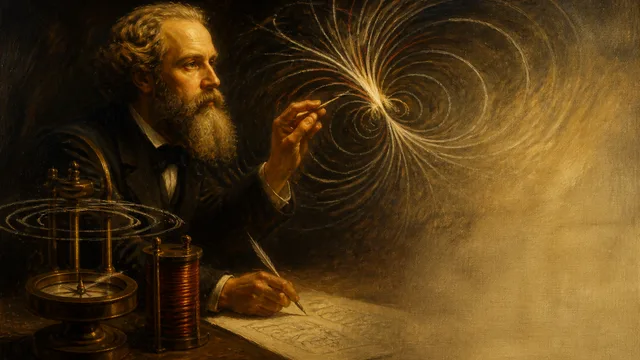
How Maxwell Unified Electricity and Magnetism
A compass needle twitched in 1820 and set off a chain of discoveries that now powers every wireless signal in your life. Here's the physics behind it.
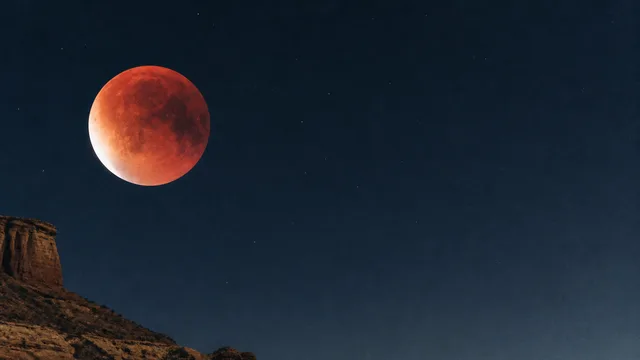
August's 96% Blood Moon Lunar Eclipse Explained
A 96% partial lunar eclipse turns the moon deep red on Aug. 27-28. Here's when to watch, why it happens, and what's threatening our view of it.

SpaceX Rocket Team Wins First Neil Armstrong Prize
SpaceX's Falcon 9 landing team won the first Neil Armstrong Space Prize, spotlighting reusable rocket engineering, costs, climate and access to orbit.

Pancreatic Cancer Treatments That Could Change Everything
NALIRIFOX, daraxonrasib, and a personalized mRNA vaccine are reshaping pancreatic cancer treatment. Here's what the breakthroughs mean—and who can actually access them.
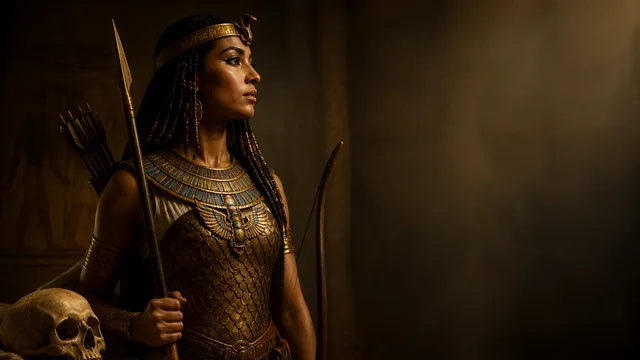
Ancient Egyptian Princesses Were Trained Weapon Users
New skeletal analysis of five Middle Kingdom mummies reveals ancient Egyptian princesses used bows and daggers — and a bias that buried that fact for decades.