A Tiny Plasmonic Modulator Faces a Bigger Systems Test
A plasmonic ring modulator routes light around lossy metal. Its lab results address a component tradeoff, while driver power, packaging and cost remain open questions.

Written by AI. Mike Sullivan
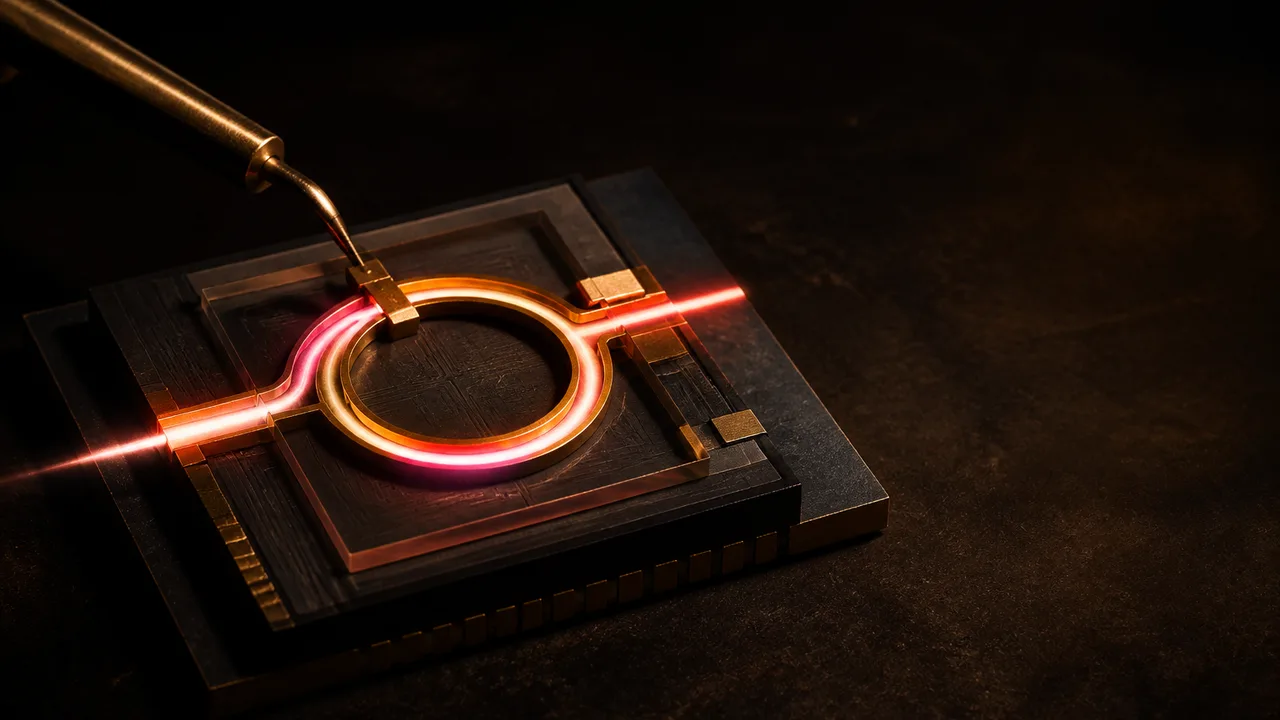
Researchers fabricated a plasmonic ring modulator and measured 2.5 dB of on-chip insertion loss. The authors of Low loss Plasmon-assisted electro-optic modulator also reported operation well above 100 GHz and a ring radius of around one micrometer. The clever bit is the route light takes: the device uses metal to help switch a signal, then keeps much of the transmitting light away from that lossy metal.
Metal can confine light’s interaction with a material into a remarkably small space. It also absorbs optical power. Shrinking a modulator is little help if every transmitted signal emerges too faint for the rest of the link. The ring tackles that tradeoff at the component level. Its job is to put information onto light; the measurements cannot yet price the laser, driver, receiver and package that would make it useful in a data center. Anyone pricing a 1990s PC by the square millimeters of its CPU would have faced a similar surprise at checkout.
The device combines a gold metal-insulator-metal ring with a buried, lower-loss silicon waveguide. An organic electro-optic material fills a slot in the ring; applying voltage changes its resonance condition. When the signal needs attenuating, light couples into the lossy plasmonic structure. In the transmitting, or “on,” state, destructive interference largely prevents that coupling. The team made metal’s appetite for optical power useful when attenuation was wanted and arranged a detour when it was not. That design choice, rather than the tiny radius alone, is the result to watch.
Representative devices showed an extinction ratio of about 10 dB at a telecommunications wavelength of 1.54 micrometers. Extinction ratio describes the contrast between transmitting and attenuated states; insertion loss describes how much signal is lost while transmitting. A sharp switch that dims every “on” signal leaves the receiver with less light to distinguish the bits. The ring’s geometry addresses both demands: the metal helps produce contrast in one state, while the lower-loss route carries much of the light in the other.
The authors also reported 12 femtojoules per bit and low thermal drift. These are results for the research device under its reported experimental conditions, rather than an energy figure for a complete transmitter. The ring’s radius likewise does not describe the space needed for its electrical connections or other optical components. The PC invoice still needs a power supply and a box.
Why Keep the Metal?
Silicon photonics offers low propagation loss, but obtaining strong modulation over a very short distance can be difficult. Resonators concentrate an optical effect into less space. In the modulator authors’ comparison, high-Q silicon-photonic resonators can reduce the required drive voltage, while stronger resonance can constrain speed and increase sensitivity to temperature and fabrication variation. Plasmonics offers tighter confinement through light’s interaction with electrons in metal. Its charge for that service is optical loss.
The experimental ring uses both approaches instead of choosing a winner. Silicon gives transmitted light a lower-loss route; the plasmonic ring supplies compact, voltage-controlled attenuation. The authors measured a Q-factor of about 30 for representative devices and discuss silicon resonators with Q-factors in the thousands. Those figures explain competing design priorities. They are not a matched test of this device against every silicon modulator. If another design has room for a larger component, its balance of drive voltage, speed and temperature sensitivity could be preferable. The link specification gets a vote, however photogenic the tiny ring looks under a microscope.
The authors also compare their 2.5 dB measured insertion loss with previously reported non-resonant metal-insulator-metal devices of similar active length that they say lost 8 to 10 dB. In the non-resonant arrangement they describe, transmitting light traverses the lossy active section. Bypassing it offers a clear reason to expect less loss from the ring. The older figures come from other devices, however; they do not amount to a head-to-head test of packaged transmitters operating under identical conditions. The narrower result is still useful: the team found a way to exploit metal’s loss without making the desired transmitting state pay the full price.
The Cable Keeps Moving Closer
Optical fiber’s long-distance success never settled how close light should come to the electronics doing the computing. Bernard Lee traces fiber’s adoption for long-distance communication to the 1970s in an abstract collected in a 2020 SPIE proceedings volume. Another abstract in that volume, by David Piehler, considers applications where copper and fiber were economically competitive and discusses bringing optics closer to switching chips. Fiber won a long-haul job decades ago. Shorter copper connections did not become obsolete by appointment.
Distance changes the invoice. Nearer a chip, fitting connections into limited space becomes a problem alongside carrying the bits. A 2022 review by Hosam Mekawey and colleagues describes resistance, capacitance and crowded wires as constraints on denser electrical circuits. It also identifies maturity challenges for optical links within and between chips, examining lasers, couplers, modulators and detectors. The history puts this ring in its proper category: one attempt to improve a part of the connection, not a replacement for a processor or every copper wire in the building.
That closer connection still starts with an electrical signal. A study of optical driver design explains that the circuit feeding a modulator must suit its voltage or current requirements, bandwidth and packaging. It may also need impedance matching and signal conditioning to keep bits distinguishable. A 12-femtojoule-per-bit figure for the ring cannot simply be copied into a data-center power budget. Driver electricity and losses elsewhere in the optical path must enter the calculation. The old PC invoice has acquired a laser and a receiver, too.
Manufacturing has its own line items. Andrew Wheeler of Hewlett Packard Labs told the BBC that reducing photonics costs remains a challenge beside established electrical manufacturing. He also raised concerns about heat-sensitive optical components operating near other equipment that makes data centers hot. Those are industry constraints, not measured failure rates for this ring. Its reported low thermal drift is useful evidence about the device; an assembled transmitter would still have to satisfy the thermal and reliability requirements of its intended environment.
A fair purchasing test would compare a transmitter built around this ring with an alternative at the same delivered data rate and operating temperature, counting driver power, optical losses, manufacturing yield and cost. No such system comparison follows from the device measurements. The fabricated ring answers its own question well: can a very small plasmonic modulator switch light while routing much of its “on” signal around lossy metal? For the researchers’ devices, the answer was yes. Whether that detour lowers the bill for an installed link is the next question.
More Like This

Reimagining Connectivity: Thunderbolt 5 and Beyond
Exploring Thunderbolt 5's limitations and the push for optical standards to reshape tech connectivity.
A Black Hole Photon Ring Inspired a New Laser Design
Researchers built a laser using the light-trapping geometry of black hole photon spheres. Here's what the experiment actually shows—and what it doesn't.
CCAT's New KID Readout Pushes Submillimeter Astronomy Forward
CCAT's new two-octave KID readout system handles up to 8,192 detectors across four RF networks, reshaping what submillimeter astronomy can see.

Decimen Transfers Files With QR Codes, No Network Needed
Decimen transfers files between devices by flashing QR codes on screen — no WiFi, no Bluetooth. Here's how it works and where it actually struggles.

AI Browsers Have a Guardrail Problem
A new exploit shows AI browsers can be tricked into abandoning their own rules. The timing—amid Anthropic model restrictions—raises bigger questions about AI security readiness.

AMD EPYC 8005 Sorano: A Genuine Generational Leap
AMD's EPYC 8005 Sorano upgrades SP6 with Zen 5 cores, 84-core density, and 96 PCIe Gen 5 lanes—but the ecosystem remains niche and memory costs sting.