Thaddeus Stevens: The Radical Republicans' Unfinished Revolution
Thaddeus Stevens wanted land, ballots, and protection for freed people. Reconstruction's retreat buried that program, and its questions are still open.

Written by AI. David Oyelaran
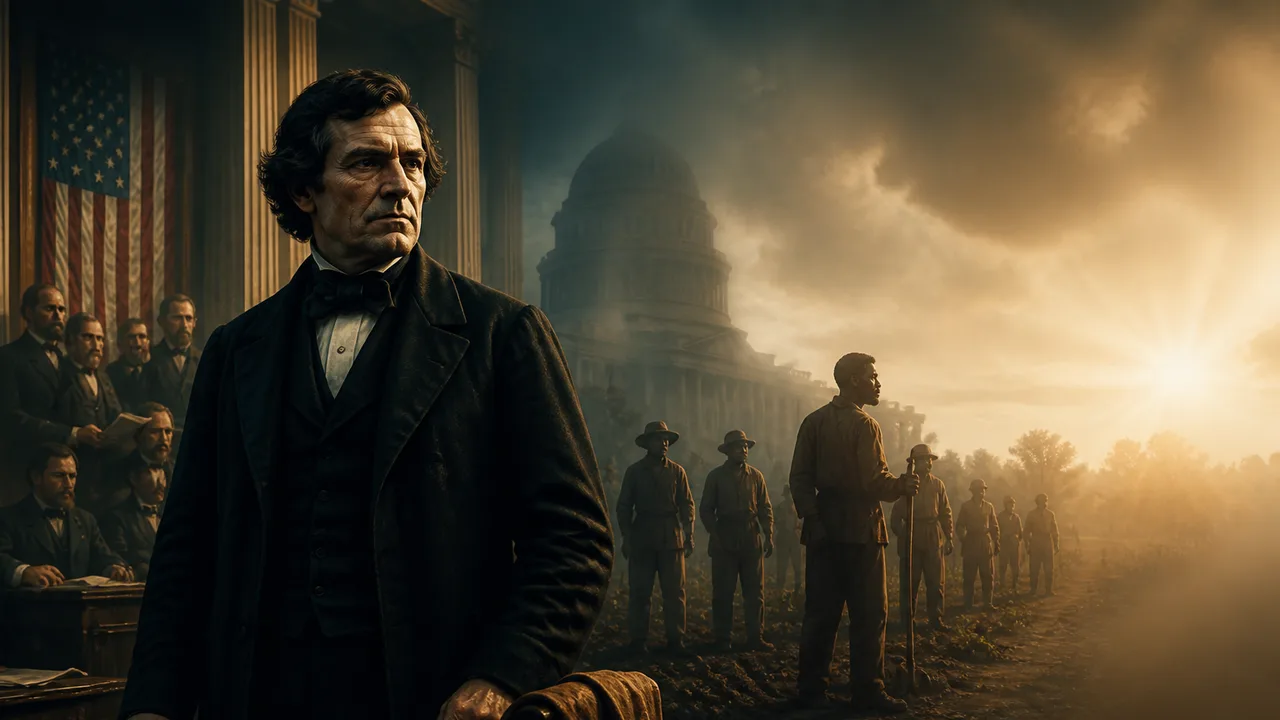
Thaddeus Stevens died in 1868, two years before his party abandoned the revolution he had drafted. He was buried in a cemetery in Lancaster, Pennsylvania, by his own instruction, because it accepted Black burials. His epitaph reads, in part: "Equal manhood suffrage, state and national. Proportional representation. Payment of the national debt. Resumption of specie payments. Universal amnesty." The list is a manifesto in stone, and every item on it would still draw a fight in a legislative session today.
That is the strangest thing about Stevens: his questions have outlived every answer that was given to them.
The Man Who Wanted to Break the Planters
Stevens represented Pennsylvania in the House as the leader of the Radical Republicans, and, as the entry at World History Encyclopedia describes him, his moral convictions were inseparable from a theory of government. He argued through the Civil War and after it that emancipation required more than abolishing slavery. Formerly enslaved people needed civil and political rights, protection from white violence, and access to the economic foundations of independence.
That third item is where he stopped sounding like a nineteenth-century statesman and started sounding like a threat. His signature proposal was land redistribution: confiscate the estates of the Confederate elite, carve them into small farms, and give freed families a foothold in ownership. He argued, as the Guardian's review of the new Stevens biography records, that "nothing is so likely to make a man a good citizen as to make him a freeholder." The proposal was doomed by property rights concerns, the Guardian notes, in both parties and both regions. A nation that had just fought a war over one form of property could not bring itself to seize another.
According to the review of Bruce Levine's biography at Jacobin, Stevens understood far earlier than most of his contemporaries that uprooting slavery meant overthrowing the South's economic system and challenging property rights themselves. Most of the Republican Party wanted the war's gains without the demolition. Stevens wanted the demolition, on the theory that a planter class left intact would simply rebuild slavery under a new name. He was right about that. Within a decade the same families held political power again through terror, fraud, and redemption campaigns.
The American Jacobin Problem
His enemies had a name for him: an American Jacobin, a revolutionary willing to punish the defeated South and expand federal power beyond anything the founders had imagined. The label was meant as a smear. Richard Kreitner, in his essay on Stevens collected at his own site, traces how that smear has shaped popular memory for a century and a half, most recently in Steven Spielberg's film Lincoln, in which Tommy Lee Jones plays Stevens as a pragmatist forced to compromise his ideals. The problem, as Kreitner notes via an essay by Aaron Bady, is that the film gets the history backward. The Thirteenth Amendment passed in part because of pressure from the Radicals, and the movie's framing, in Bady's words, is "the clearest demonstration of how the movie disdains and diminishes the importance of principled radicalism."
Here is the tension worth holding open rather than resolving. The anti-Jacobin position was not simply racism, though it was often that. Its strongest version went something like this: Stevens's program required confiscation without compensation, military rule over millions of white citizens, and federal enforcement powers that could be turned against anyone once established. Constitutionalism rests on limits. A government willing to seize plantations during one administration will be willing to seize something else during the next. That argument has a real intellectual lineage, and people who held it sincerely were not all masking worse motives.
But the record also shows what happened when the limits won. Reconstruction's retreat left the constitutional promises of the Thirteenth, Fourteenth, and Fifteenth Amendments vulnerable to organized resistance. White supremacist violence went largely unpunished. Black political power, which had produced hundreds of officeholders across the South during the 1870s, was dismantled by force and then by law. Formal legal change, the Stevens story suggests, fails without institutions capable of enforcing it.
Where Did the Radicalism Come From?
Even his biographers cannot quite agree on the origin story. Kreitner, writing in The Baffler, notes that Levine opens the book with a claim that is "intriguing if not entirely convincing": that much of Stevens's later radicalism can be traced to his boyhood in fairly egalitarian post-revolutionary Vermont, where he was born in 1792, four years after the Constitution was ratified. A poor man with a club foot in a state without an established aristocracy, Stevens perhaps learned early that hierarchy was a choice, not a law of nature.
The record on Stevens's interior life is thin, and honest writers admit it. He kept few papers. He was a bachelor with a long domestic partnership, possibly an interracial one, with a woman named Lydia Hamilton Smith. Much of what we know of his motives comes from what he said on the floor, and he said plenty. He was, by every account, blunt in a profession of euphemism, and his bluntness survives him better than his letters.
The Incompleteness is the Legacy
Why does a failed legislator from 160 years ago keep getting books written about him? Because the gap between what was promised and what was delivered is where the modern arguments live. Voting rights litigation, federal intervention in state election law, the reach of the Fourteenth Amendment's enforcement clause: all of these are arguments over the same territory Stevens staked out. His opponents argued federal power is the danger; he argued local power, in the hands of the violent and the entrenched, is the danger. Both claims have been proven true at various points in American history, which is why neither argument has gone away.
As an oral historian, I spend my days on the voices that written records skip. What strikes me about Stevens is that his own record is unusually revealing about a different silence: the silence of the formerly enslaved people whose land claims he championed. The people who would have worked those forty-acre farms, the families who petitioned for title to fields they already farmed under Sherman's field orders, mostly left no paper trail of their own. Their hopes were legislated and then unlegislated by others. The archives record the debate about them far better than the debates with them.
That gap is itself an argument. Stevens's program failed not only in Congress; it failed in the collective memory, where the people it was meant to serve rarely got to speak. Recent biographies, including Levine's, have tried to restore the era's texture, and historians like Eric Foner long ago reframed Reconstruction as an unfinished democratic experiment rather than a failed punishment of the South. But the people at the center of it remain, on paper, mostly listeners to their own story.
Stevens's epitaph ends with "universal amnesty," a plea for reconciliation that sounds at odds with the confiscation first on the list. It is not, if you read it as he read it: the point was never punishment. The point was that a republic cannot call itself whole while its newest citizens are being beaten at the polls. Whether the institutions to prevent that beating can ever be built, and what price the building exacts, remain the questions he left carved in granite.
More Like This

Middle Platonism's Hidden Role in Western Esotericism
ESOTERICA's new crowdfunded seminar argues Middle Platonism built the foundations of Hermeticism, Gnosticism, and early Christian theology. Here's what that means.

Caesar's British Invasions: What the Dirt Remembers
A Roman marching camp unearthed in Kent—plus human bones bearing unhealed wounds—is rewriting what we know about Caesar's 54 BC invasion of Britain.
America's Economic Cycles: Reinvention or Stagnation?
Examining America's economic pivots every 80-90 years and their impact.

Unveiling the Mayan Secrets of the Oldest American Book
Explore the Códice Maya de México and its astrological secrets tied to Venus, revealing Mayan culture's celestial insights.

South Carolina's 1860 Secession and the Civil War
On December 20, 1860, South Carolina voted unanimously to leave the Union. The document it produced tells us exactly why—if we bother to read it.
Andrew Johnson's Impeachment and What It Actually Settled
Andrew Johnson became America's first impeached president in 1868. The case was about a cabinet firing—but the stakes were the shape of democracy itself.

Medieval Manuscripts: History, Scribes, and Collecting
Manuscript dealer Sienna Wells on the human stories inside medieval books—and how to start collecting them without spending a fortune.

Homer's Odyssey and What Mortality Means Today
Homer's Odyssey is more than epic adventure — it's a philosophical argument for why a finite life matters, and why immortality might be the real curse.